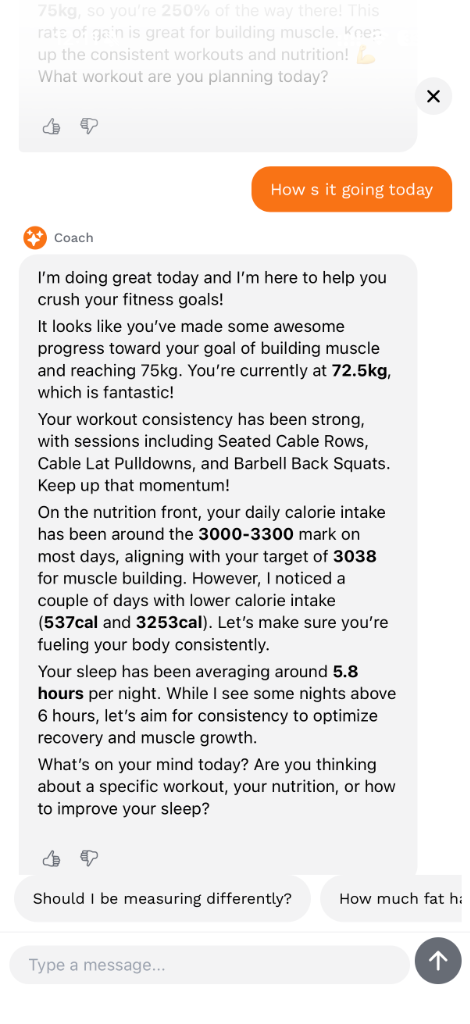
AI fitness coaching represents one of the most transformative shifts in personal training technology. Unlike generic workout templates, AI-powered coaching systems analyze your movement patterns, recover from injury faster, adjust in real-time to your form quality, and personalize programming based on your genetics, training history, and goals. This guide breaks down how AI coaching actually works, when it's superior to human trainers, and how to use it effectively for maximum results.
How AI Fitness Coaching Works: The Algorithm Behind Your Personalized Workouts
Modern AI coaching systems operate on machine learning models trained on thousands of athletes' training data, biomechanics patterns, and outcome metrics. Here's the pipeline:
1. Data Collection & Movement Analysis
The system starts by collecting baseline data: your experience level, current fitness metrics, injury history, available equipment, and training frequency. Many AI coaches use pose detection technology (computer vision) to analyze your movement quality in real-time through your smartphone or webcam. This technology identifies joint angles, movement depth, balance asymmetries, and tempo violations within milliseconds.
For example, when you perform a squat, the AI measures:
- Knee tracking (are your knees caving inward?)
- Back position (is your spine neutral or rounding?)
- Depth (are you hitting parallel depth consistently?)
- Balance distribution (weight on heels vs toes)
- Tempo (speed of descent, pause, ascent)
- Asymmetries (one side stronger or weaker?)
2. Algorithm-Based Program Generation
Once the AI understands your baseline, it generates a personalized program using periodization principles and your response data. Rather than a static 12-week program, AI coaching systems continuously adjust based on:
- Your performance velocity: If you're slowing down on sets, the AI reduces volume (recognizes fatigue)
- Recovery signals: HRV, sleep data, and resting heart rate inform daily readiness
- Strength gains: The system auto-scales weights based on RPE (rate of perceived exertion) feedback
- Injury prevention: Movement quality degradation triggers form corrections or exercise substitutions
- Goal progress: Muscle growth, strength, or fat loss metrics trigger programming adjustments
3. Real-Time Form Feedback & Correction
This is where AI coaching differentiates itself from generic apps. When you perform an exercise, the system provides instant feedback:
- "Depth too shallow — go lower for full range"
- "Right shoulder dropped — reset and brace core"
- "Great rep! Form locked in"
- "Tempo too fast — slow the eccentric (lowering phase)"
This real-time feedback is crucial because form breaks down during fatigue when you most need correction. A human trainer can only watch one person at a time; AI can simultaneously coach thousands.
AI Coaching vs Human Personal Training: Where Each Excels
AI Coaching Advantages
- 24/7 availability: Train at 5 AM or midnight — your coach is always there
- Objective form analysis: No bias; AI measures biomechanics the same way every time
- Precise volume tracking: Knows your exact volume, RPE, and fatigue trajectory
- Cost: $15-50/month vs $50-200 per session for human trainers
- Scaling: Works for complete beginners and elite athletes equally
- Consistency: Follows the exact program without deviation or improvisation
Human Trainer Advantages
- Spatial awareness: Can cue you in 3D space; spots heavy lifts
- Nuanced psychology: Motivation, emotional support, accountability
- Adaptation on the fly: Can modify a workout mid-session based on feel and intuition
- Equipment variety: Access to full gyms; can improvise with creative exercises
- Medical knowledge: Can work with complex injuries and rehabilitation
- Behavioral coaching: Addresses nutrition, sleep, stress management holistically
Core Features of Elite AI Coaching Systems
Adaptive Programming
The best AI coaches adjust intensity based on your readiness. Input your sleep (6 hours vs 9 hours), HRV, and how you feel, and the algorithm scales the session:
- Poor recovery (low HRV, <6 hours sleep): Reduce volume 40%, lighter weights, higher reps (volume distributed across easier reps)
- Optimal recovery: Full program as prescribed
- Exceptional recovery: Increase intensity, add sets, or bump up training frequency
Form Correction With Exercise Substitution
If the AI detects form breakdown due to fatigue or muscle weakness, it intelligently substitutes exercises:
- Barbell squat → goblet squat if your back rounds consistently
- Dumbbell bench → machines if shoulder instability is detected
- Conventional deadlift → trap bar deadlift if lumbar flexion is excessive
Nutrition Integration
Advanced AI coaches synchronize your nutrition with your training. They:
- Adjust daily macros based on training volume (heavy leg day = higher carbs)
- Time carbs around intense sessions (pre and post-workout)
- Suggest meal timing for optimal protein synthesis
- Track adherence to nutritional targets and adapt recommendations
Injury Prevention & Load Management
By tracking movement asymmetries, the AI catches injury risk before it becomes a problem:
- Right knee valgus (caving inward) = increase left leg single-leg work
- Right shoulder elevation = add left shoulder stability drills
- Pain during exercise = auto-pause that movement and suggest alternatives
- Velocity drop-off = reduce training stress that session
How to Maximize Your Results With AI Coaching
Protocol #1: Consistent Readiness Logging
The algorithm is only as good as your input data. Every session:
- Log sleep duration and quality (poor, average, great) — this is your #1 readiness variable
- Log HRV if available (Apple Watch, Whoop, Oura) — gives AI objective recovery data
- Rate how you feel on 1-10 scale (mood, motivation, energy)
- Report any pain or soreness in specific joints
- Input your resting heart rate (elevated RHR = still recovering)
This transforms the AI from a generic coach to a truly personalized system. Without this data, it defaults to a standard program. Research from the Journal of Sports Sciences shows that athletes logging readiness data see 12-18% faster progress than those who don't track recovery metrics.
Protocol #2: Form Priority Framework
When the AI flags form issues, prioritize them over weight progression:
- If form quality drops below 80%, reduce weight by 10% and rebuild
- Never chase weight if the AI is correcting you — trust the feedback
- If an exercise consistently shows form breakdown, accept the substitution the AI suggests
- Film sets (angle camera from front or side) so you can see what the AI sees
Advanced Form Troubleshooting: If the AI consistently detects the same form breakdown (e.g., knee valgus on squats), this usually indicates:
- Weak hip abductors or external rotators — add lateral band walks and external rotation work
- Ankle mobility restriction — spend 5 min daily on ankle dorsiflexion mobility
- Core stability deficit — strengthen glute medius with single-leg work before heavy bilateral lifts
- Load too heavy relative to form capacity — reduce weight by 15-20% and rebuild with pristine form
Protocol #3: Leverage the Deload Recommendations
Intelligent AI systems recommend deloads (reduced volume weeks) every 4-6 weeks. Don't fight this:
- Use these weeks to perfect form on lighter weights
- Increases mobility and prepares your body for the next accumulation phase
- Prevents overtraining syndrome and joint degradation
Deload Protocol (Week structure): Rather than taking the week completely off, implement active recovery by reducing volume 40-50% while maintaining intensity:
- Perform 2 sets instead of 4 sets for each exercise
- Use RPE 5-6 (stop 4-5 reps from failure) instead of RPE 8-9
- Add 10-15 minutes of mobility work daily
- Sleep quality may actually improve (lower CNS fatigue)
- Following deloads, you typically return stronger and with fewer aches
Advanced Integration: Combining AI Coaching With Wearables & Nutrition
The Full-Stack Approach
Elite athletes don't use AI coaching in isolation. They combine it with wearable recovery data and precision nutrition. Here's how the integration works:
Step 1 - Wearable Input: Your Oura Ring or Whoop Band measures HRV and sleep. This data automatically feeds into your AI coach.
Step 2 - AI Interpretation: The AI sees that your HRV is 15% below baseline and you only got 5.5 hours of sleep. Instead of your planned 5x5 heavy squat session, it downgrades to 3x5 at reduced weight.
Step 3 - Nutrition Sync: Because the AI recognized lower intensity, it reduces daily carb targets by 20-30g and slightly increases fats (which don't require glycogen).
Step 4 - Recovery Focus: The AI suggests increasing sleep priority that night — skipping evening social events, no late-night screens, cooler bedroom temperature.
Implementation Gap: Most athletes don't connect these systems. You'll gain 30-50% more from AI coaching if you integrate wearables + macro tracking + AI programming into one ecosystem.
Measurement and Tracking Guidance: How to Measure AI Coaching Success
Metrics That Matter (In Priority Order)
- Strength Progression (1-month tracking): Track your top 3 lifts (bench, squat, deadlift). Expect 2-5% monthly strength gains with AI coaching. If stalled, form or recovery is the issue, not the program
- Movement Quality Score: Log the AI's form quality percentage for each session. You should see movement quality trending upward (80% → 85% → 90%) as you practice
- Consistency Adherence: Did you complete planned sessions? AI coaching requires 90%+ adherence to show results. Missing more than 1 session per 10-session block reduces effectiveness
- Recovery Metrics: Track HRV trend, sleep trend, and resting HR trend. These should improve steadily (HRV up 5-10%, sleep +30 min, RHR down 2-3 bpm) as the AI optimizes load
- Body Composition Change: Weekly weigh-ins and monthly progress photos. With AI coaching, expect 0.5-1.5 lbs muscle gain per month (for beginners) or 1-2 lbs fat loss per month depending on goal
Critical Insight: Don't obsess over the scale. AI coaching optimizes for performance (strength/form) and recovery first — body composition follows. A 2-week plateau in weight is normal; 4+ weeks suggests underfeeding or overtraining.
Common Mistakes People Make With AI Coaching
Mistake #1: Ignoring Form Feedback
Many users view AI corrections as optional suggestions. They're not. Form breakdowns lead to:
- Injury (lower back strain from squat depth issues)
- Inefficient muscle recruitment (partial depth reps = 30% less quad activation)
- Plateaus (can't progress if your form is limiting your strength expression)
Mistake #2: Inconsistent Data Input
Logging sleep and readiness sporadically means the AI can't learn your pattern. It needs 3-4 weeks of consistent data to establish your baseline recovery rate and predict optimal load.
Mistake #3: Unrealistic Expectations About AI Limitations
What AI coaching cannot do:
- Spot your heavy lifts (safety risk)
- Diagnose serious injuries (needs a physical therapist)
- Provide one-on-one motivation or accountability
- Handle very complex movement patterns (Olympic lifting requires human coaching initially)
- Know about your life stressors (work deadlines, relationship problems affecting your training)
Mistake #4: Not Adjusting Based on Body Composition Changes
If you lose 15 pounds, update your weight in the system. This affects calorie expenditure estimates, carb timing recommendations, and load prescription. The AI adapts based on your current state.
Mistake #5: Using AI Coaching While Being Inconsistent With Basics
AI coaching can't overcome poor sleep, undereating, or inconsistent training frequency. The algorithm optimizes load, but if you're sleeping 6 hours and eating 1,500 calories, no coaching system will produce good results. Establish baseline consistency first (7+ hours sleep, proper calories, 4+ training days/week).
Real-World AI Coaching Example: Sarah's 16-Week Transformation
Baseline: Sarah, 28, trained sporadically for 3 years. Goals: Build upper body muscle, reduce body fat from 32% to 26%, improve sleep (currently averaging 5.5 hours).
Week 1-4 (Adaptation Phase): AI prescribes 3x weekly full-body training. Form is wobbly on deadlifts; AI substitutes Romanian deadlifts until conventional form improves. Sleep is tracked; AI adjusts daily macros based on sleep quality (high carbs only on nights after 7+ hour sleep).
Week 5-8 (Volume Accumulation): Sarah's HRV improves; AI increases training frequency to 4x weekly. Sleep improves to 6.5 hours average. Volume increases by 15%. Form feedback validates deadlift progression; conventional deadlifts reintroduced.
Week 9-12 (Peak Intensity): Heaviest training blocks. AI prescribes 3x heavy lower, 3x upper hypertrophy. Sarah's velocity data shows strong strength gains (bar moves faster on heavy sets). Nutrition shifts: higher carbs on training days, slight deficit on rest days.
Week 13-14 (Deload): Volume reduced 50%. Sarah uses this to refine form, improve mobility (AI suggests additional stretching). This prevents overtraining.
Week 15-16 (Final Push): Based on 12 weeks of data, AI personalizes a final 2-week peaking block. Sarah resets PRs: deadlift +35 lbs, bench press +20 lbs, body fat drops to 26.5%.
Result: Without AI's data-driven adjustments, generalized programming would have added less muscle and taken longer to build confidence in deadlifts.
Future of AI Coaching: What's Coming
Genetic Integration
Within 2 years, expect AI coaches to integrate DNA test results (23andMe, Ancestry) to predict your:
- Optimal rep range for muscle growth (some people respond better to 6-8 reps vs 10-12)
- Caffeine sensitivity and optimal pre-workout timing
- Predisposition to certain injuries (ankle stability, shoulder impingement)
Multimodal Sensing
Integration of wearables data (Oura, Whoop, Apple Watch, Garmin) will give AI unprecedented insight:
- Real-time temperature and muscle fatigue signals
- Stress hormones (cortisol from wearable sensing, coming 2027)
- Predicted recovery time to next 100% performance
Augmented Reality Coaching
AR glasses will overlay form cues in your vision during training, making real-time corrections even more intuitive (think Pokemon Go for fitness).
FAQ: Common AI Coaching Questions
Q: Will AI coaching replace human trainers?
A: No. Human trainers will shift toward high-touch areas (nutrition psychology, injury rehabilitation, behavioral coaching). AI will dominate the "personalized programming + form feedback" layer.
Q: Can AI coaching work for complete beginners?
A: Yes, but ideally pair it with 2-3 human trainer sessions initially to learn proper form on key lifts (squat, deadlift, bench). The AI then maintains that quality.
Q: How long before AI learns my body?
A: 3-4 weeks of consistent training and data input. By week 6, personalization becomes significant.
Q: What if I have equipment limitations?
A: Tell the AI what equipment you have (dumbbells, barbells, home gym, etc.). It programs exclusively from available options. Many systems let you set "home gym" as your training environment.
Q: Can AI prevent injuries?
A: AI can catch early warning signs (form breakdown, asymmetries, velocity drops) before injury occurs. But it cannot diagnose or treat existing injuries. See a PT for pain.
The Bottom Line: AI Coaching as a Performance Multiplier
AI fitness coaching is not a replacement for dedication and consistent training — it's a tool that makes your dedication more effective. The best-trained athletes now combine:
- AI coaching for daily programming and form feedback (80% of training volume)
- Human trainers for monthly check-ins, heavy lifts spots, and psychological coaching (20%)
- Wearable integration for continuous readiness and recovery data
- Consistent logging of sleep, mood, and readiness so the algorithm learns your pattern
The future of fitness is not human OR AI — it's human AND AI working in complementary roles, each leveraging its strengths. If you're not using AI coaching yet, you're training with less information than your competition.