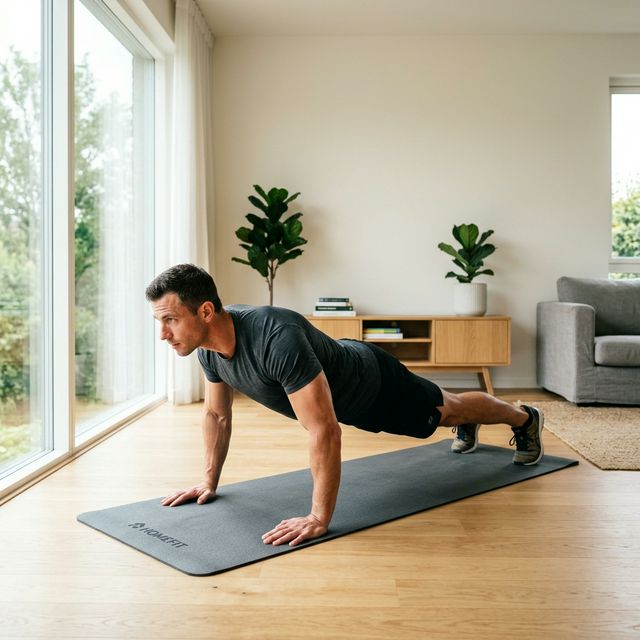
You don't need a barbell to build serious strength. The limiting factor in bodyweight training isn't the absence of plates and cables — it's the absence of a plan. Progressive overload is the engine behind every strength adaptation, and your body doesn't care whether that overload comes from adding weight or making the movement harder. Master the art of bodyweight progressions and you can develop genuine, functional strength from your living room floor, a park, or anywhere else you happen to be.
Why Progressive Overload Still Applies Without Weights
Progressive overload means consistently demanding more of your muscles over time. With a barbell, the obvious lever is adding plates. Without one, you pull four other levers instead: variation difficulty (advance to a harder movement pattern), tempo manipulation (slow the eccentric, pause at the bottom, reduce momentum), leverage shifts (change your body angle to increase effective load), and unilateral loading (shift work onto one limb to roughly double the demand per side).
Each of these levers produces a real training stimulus. Slowing a push-up's descent to four seconds increases time under tension and recruits more motor units. Shifting to an archer push-up loads one arm with a disproportionate fraction of your bodyweight. Progressing to a pistol squat forces your leg to handle your entire mass through a deep range of motion. These are not beginner modifications — they are structured steps in a logical progression ladder.
Push Progressions: From Incline to One-Arm
The push pattern — horizontal pressing — follows one of the clearest progression ladders in bodyweight training. Work through each step only when you can perform the current level with control, full range of motion, and without form breakdown under fatigue.
- Incline push-up: Hands elevated on a counter or bench. Reduces load on the upper body, ideal for building the motor pattern.
- Standard push-up: Hands directly under shoulders, body rigid. The foundation. Aim for sets of 15–20 with a 3-second descent before moving on.
- Close-grip (diamond) push-up: Hands together beneath the sternum. Increases tricep demand and requires more wrist stability.
- Archer push-up: Both hands wide; shift your weight to one arm while the other extends straight. Each rep is essentially a loaded single-arm partial. This is the critical bridge to the one-arm variation.
- One-arm push-up: Full single-arm press. Requires significant shoulder stability, anti-rotation core strength, and wrist conditioning. Start with feet wide for a wider base, then narrow stance over time.
Alongside this ladder, use tempo and pause work at every level. A 4-second descent on a standard push-up is more demanding than a fast archer push-up. Layer difficulty thoughtfully rather than rushing to the next variation before you're ready.
Squat Progressions: Building to the Pistol
The single-leg squat — the pistol — represents elite lower body strength and mobility. Getting there is a multi-stage process that builds quad strength, hip mobility, and balance simultaneously.
- Bodyweight squat: Full depth, knees tracking toes, neutral spine. Establish this before anything else.
- Tempo squat: Five-second descent, two-second pause at the bottom. Builds positional strength and ankle/hip mobility passively.
- Bulgarian split squat: Rear foot elevated. Loads the front leg heavily and exposes hip flexor tightness that would otherwise limit the pistol.
- Assisted pistol squat: Hold a doorframe, suspension strap, or pole. Allows you to practice the single-leg pattern with balance assistance while your strength catches up.
- Box pistol squat: Lower to a box or bench, then drive up unassisted. Removes the bottom-range strength requirement temporarily, letting you build confidence and quad drive.
- Full pistol squat: One leg extended forward, full depth, controlled descent, no assistance. Once here, add volume before adding load (a backpack or a weight vest).
Ankle and hip mobility are often the limiting factor, not leg strength. Daily calf stretching, ankle circles, and deep squat holds (passive hanging in the bottom of a squat for 2–5 minutes total per day) will accelerate this progression significantly.
Pull and Row Progressions: No Bar, No Problem
Vertical pulling requires a bar, but horizontal pulling — rows — can be performed without any equipment beyond a sturdy table or low horizontal surface. And if you have a pull-up bar or access to playground equipment, the full vertical ladder is available to you.
For rows without a bar:
- Incline row under a table: Lie beneath a dining table, grip the edge, pull your chest to it. Adjust difficulty by how horizontal your body is.
- Feet-elevated row: Feet on a chair, body more horizontal — increases load on the back and biceps.
- Single-arm table row: One hand grips, one hangs free. Significant unilateral demand.
For those with a pull-up bar:
- Dead hang: Builds grip, shoulder health, and lat engagement before any pulling begins.
- Scapular pull-up: From a dead hang, depress and retract your shoulder blades without bending your elbows. Activates the lats and sets a strong foundation.
- Negative pull-up: Jump or step to the top position, then lower yourself as slowly as possible. Eccentric strength comes before concentric.
- Standard pull-up: Full range, chin clearing the bar. Chest-to-bar is the next goal after that.
- Archer pull-up: One arm pulls while the other extends wide. Bridge movement toward the one-arm pull-up.
Core Progressions: Beyond the Crunch
Core training in a progression framework means developing the ability to resist movement — anti-extension, anti-rotation, and anti-lateral-flexion — not just to produce it. These qualities carry over directly to every compound movement.
- Dead bug: Lower back pressed to the floor, alternate extending opposite arm and leg. Trains anti-extension under control.
- Plank: Full-body tension, no sagging hips. Build toward 60-second holds before advancing.
- RKC plank: Standard plank with deliberate glute squeeze, posterior pelvic tilt, and forearm drag cues. Dramatically increases demand without changing position.
- Long-lever plank: Elbows forward of the head rather than below the shoulders. Increases the torque demand on the core.
- Ab wheel rollout (or push-up rollout): Extend from a kneeling position, then from standing as strength grows.
- Hollow body hold: Lower back flat, arms overhead, legs extended. The foundation of gymnastic core control.
- L-sit: Legs extended parallel to the floor from a support position. Requires significant hip flexor and core strength. Build in stages using bent knees first.
A Sample Weekly Routine
This template uses a three-day-per-week full-body structure. Choose the variation in each category that represents your current working level — challenging but technically sound.
- Day 1 — Push focus: Push progression (4 sets × 6–10 reps), squat progression (3 sets × 6–8 per leg), core anti-extension (3 sets × 20–40 sec)
- Day 2 — Pull focus: Row or pull-up progression (4 sets × 5–8 reps), Bulgarian split squat (3 sets × 8 per leg), hollow body or L-sit hold (3 sets × 20–30 sec)
- Day 3 — Integration: Archer push-up or current push variation (3 sets), assisted or full pistol squat (3 sets × 3–5 per leg), one-arm row or archer pull (3 sets × 5 per side), RKC plank (3 sets × 30 sec)
Rest 90–120 seconds between sets on strength work. Tempo work requires longer rest — the sets are harder than they look. Progress within a variation before moving to the next: when you can complete all sets at the top of the rep range with crisp form and controlled tempo, you're ready to advance.
How to Keep Progressing Long-Term
Bodyweight training stalls when people stop treating it as a progression system and start treating it as a fixed routine. The principles that prevent stagnation are the same ones that drive any strength program forward.
Track every session. Note the variation, sets, reps, and tempo. What gets measured gets managed. Without records, you'll repeat the same session indefinitely without realizing it.
Cycle your intensity. Don't push maximum effort every session. Alternate harder sessions — working close to failure with difficult variations — with easier sessions using lower variations at higher volume. This prevents accumulated fatigue from masking progress.
Prioritize skill acquisition. Movements like the one-arm push-up and pistol squat have significant neuromuscular skill components. Practice them frequently, even at low volumes, rather than waiting until you feel "strong enough." Skill practice at low intensity still drives adaptation.
Use density as a tool. Once a variation feels easy, try doing the same total reps in less time, or with longer rest intervals compressing over weeks. This is a subtle but effective way to drive adaptation without changing the exercise.
Introduce load when appropriate. A backpack with books, a weight vest, or even a filled water jug held during squats provides external load without gym equipment. Once you've maxed out bodyweight progressions in a pattern, adding modest load extends the ladder further.
Bodyweight strength has a ceiling only if you stop climbing. The athletes who make the most progress are those who treat each session as a data point in a long-term experiment — adjusting variables, tracking outcomes, and advancing with intention rather than repetition.
UltraFit360 lets you log your current variation level for every movement pattern, track session-by-session progress, and get AI coaching cues when you're ready to advance to the next step in any progression. Whether you're working toward your first clean push-up or your first pistol squat, your progression ladder is waiting inside the app.
Transform Your Fitness Journey
Log your workouts, track your diet, and get AI coaching insights — all with UltraFit360.