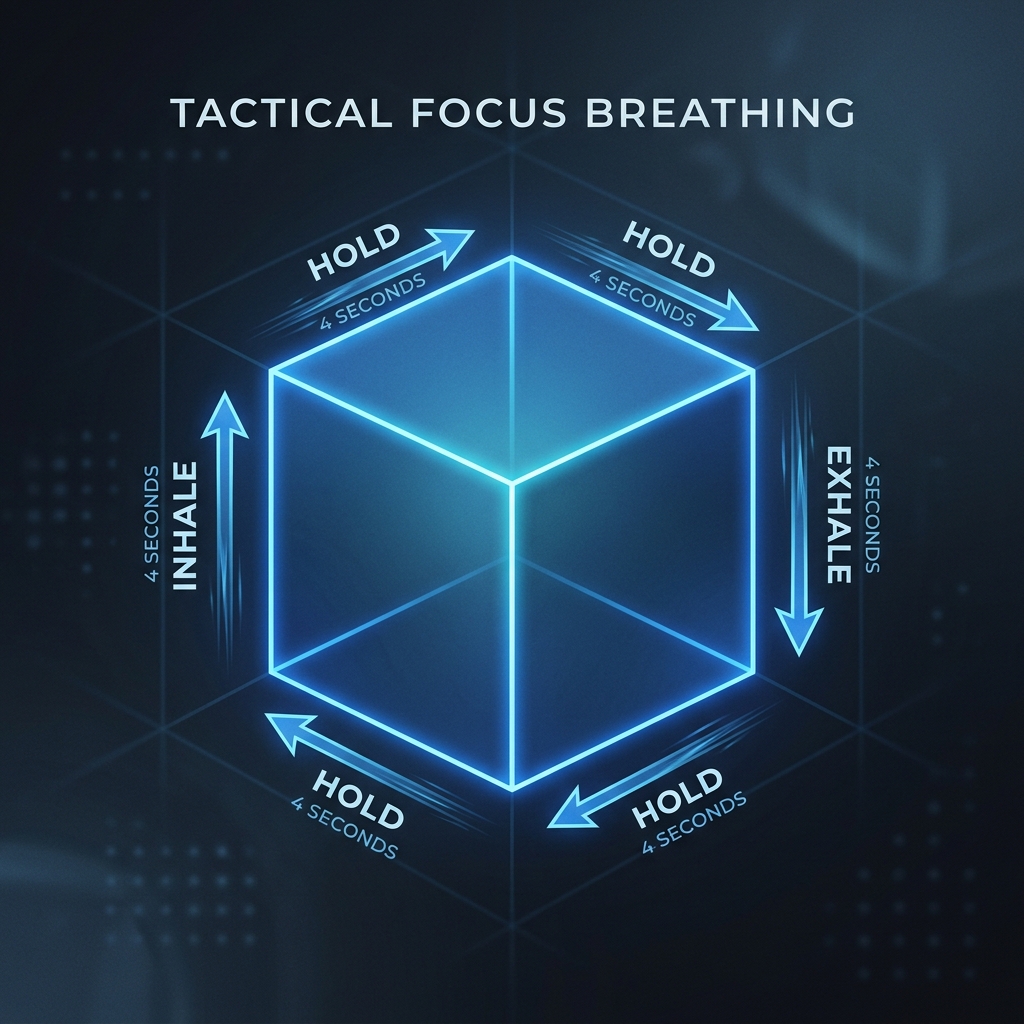
Before the whistle blows, before the bar comes off the floor, before you step onto the court — what you do with your breath in those final seconds shapes everything that follows. Box breathing is a structured breathwork technique used by military operators, elite athletes, and performance coaches to dial in focus, accelerate recovery, and regulate the nervous system on demand. It requires no equipment, costs nothing, and can be practiced anywhere. If you train seriously, box breathing deserves a place in your toolkit alongside sleep, nutrition, and progressive overload.
What Is Box Breathing?
Box breathing — also called square breathing or four-square breathing — follows a simple four-phase pattern: inhale, hold, exhale, hold. Each phase lasts the same duration, creating a symmetrical "box" shape when visualized. The most common version uses a four-second count for each phase, giving you the 4-4-4-4 pattern you may have seen referenced in athletic or tactical contexts.
- Inhale — breathe in slowly through the nose for four counts
- Hold — retain the breath at the top for four counts
- Exhale — release slowly through the nose or mouth for four counts
- Hold — pause at the bottom of the exhale for four counts
One complete cycle takes sixteen seconds. Most practitioners complete four to six cycles per session, which keeps a single session under two minutes. That brevity is part of what makes box breathing so practical — it fits between warm-up sets, in the tunnel before competition, or in the final minutes before sleep.
The Nervous System Mechanism
To understand why box breathing works, you need a quick look at how your autonomic nervous system operates. The autonomic nervous system has two primary divisions: the sympathetic branch — responsible for the fight-or-flight response — and the parasympathetic branch, which governs rest, digestion, and recovery. These two systems are always active, but they shift in balance depending on what your brain perceives as the current demand.
When you're under stress — physical, psychological, or competitive — your sympathetic system ramps up. Heart rate climbs, blood is shunted to working muscles, and your cognitive focus narrows. This is useful in small doses, but excess sympathetic drive leads to tunnel vision, muscle tension, and the mental static that kills fine motor performance.
Controlled breathing directly influences this balance through the vagus nerve — the longest cranial nerve in the body and the primary pathway of the parasympathetic system. Slow, deliberate breathing, especially with prolonged exhalation or breath holds, stimulates vagal tone. Higher vagal tone is associated with better heart rate variability (HRV), faster recovery between bouts of effort, and improved emotional regulation.
The breath holds in box breathing are particularly significant. Holding at the top of an inhale gently elevates thoracic pressure, which has a mild parasympathetic effect. Holding at the bottom of an exhale gives the cardiovascular system a moment of reduced input, reinforcing the downregulation signal. Together, the four phases create a rhythmic oscillation that your nervous system responds to within just a few cycles.
Pre-Competition Focus
Most athletes assume they need to "get fired up" before competition, but uncontrolled arousal is often the enemy of peak performance. Research on the Yerkes-Dodson curve shows that optimal performance occurs at a moderate arousal level — too low and you're flat, too high and you make errors, lose technique, or choke under pressure.
Box breathing threads this needle. A short four-to-six cycle session before competition raises alertness — the deliberate focus required to count and control the breath engages the prefrontal cortex — while simultaneously preventing the anxiety spiral that pushes arousal too high. Athletes report a sense of calm clarity: present, focused, and ready without being scattered or tense.
Practical implementation before competition:
- Begin four to six minutes before your event or your first heavy set
- Sit or stand upright — posture affects breath mechanics
- Close your eyes if the environment allows
- Use nasal breathing for the inhale and exhale when possible
- Follow with a brief visualization of your first few actions
Post-Training Downregulation
What you do in the thirty minutes after a hard session has a significant impact on how well your body shifts from a catabolic, stress-driven state into a recovery-oriented one. Many athletes make the mistake of going straight from a brutal workout into a car, commute, or screen — keeping the sympathetic system elevated long after training has ended. This delays the cascade of hormonal and physiological processes that make adaptation possible.
A five-minute box breathing session at the end of your cool-down acts as a deliberate "off switch." It signals to your nervous system that the threat or demand has passed, which allows cortisol to begin tapering and parasympathetic activity to rise. Some athletes also combine box breathing with a body scan or progressive muscle relaxation during this window.
Post-training protocol:
- Complete your physical cool-down — light movement, stretching
- Lie flat on your back or sit in a chair with feet flat on the floor
- Complete five to eight cycles of 4-4-4-4 breathing
- Avoid checking your phone until after the session ends
Sleep Onset and Stress Management
Sleep is where adaptation actually happens, and poor sleep quality is one of the most underestimated limiters in athletic development. Box breathing is a highly effective pre-sleep practice because it manually shifts your body toward the conditions that allow sleep onset: slowed heart rate, reduced muscle tension, and a quieting of mental activity.
For stress management outside of training, box breathing gives you an on-demand tool that works in real time. The key is practicing when you're not stressed so that the technique is ingrained and automatic when you genuinely need it — during a difficult conversation, after an injury setback, or before a high-stakes performance review.
For sleep, practice in bed with lights off. Keep the count at four seconds per phase to start. As you become more familiar, you may find that slower counts — five or six seconds per phase — work better in this context, as they produce a stronger parasympathetic response. For acute stress, the standard 4-4-4-4 works quickly and can be done discreetly, even seated in a public setting.
How to Practice: Starting Out
Box breathing is straightforward to learn, but the first few attempts can feel awkward — particularly the breath holds, which may trigger a mild urge to breathe before the count ends. This is normal and resolves with practice. The sensation of air hunger during the bottom hold is not dangerous; it reflects carbon dioxide sensitivity, which also adapts over time.
A starting protocol for beginners:
- Week 1-2: Four cycles of 4-4-4-4 once per day, preferably at the same time each day (morning or pre-sleep works well)
- Week 3-4: Six cycles, twice daily — once in the morning and once post-training or pre-sleep
- Ongoing: Use situationally based on need, with at least one daily anchor session to maintain the habit
Focus on keeping the breath smooth and controlled throughout, especially the transitions between phases. A rough or gasping inhale defeats the purpose. If you feel lightheaded at any point, return to normal breathing and shorten the hold duration on your next attempt.
Progressions and Variations
Once 4-4-4-4 feels comfortable, you have several meaningful progressions available. These aren't required — the standard pattern is highly effective on its own — but they allow you to tailor the stimulus to your specific goal.
- Longer counts: Move to 5-5-5-5 or 6-6-6-6 once 4-4-4-4 is effortless. Longer cycles produce a stronger parasympathetic response and are particularly useful for sleep and deep recovery.
- Extended exhale variant: Try 4-4-6-4 (longer exhale) for stronger downregulation. The exhale phase has the greatest influence on vagal activation, so extending it amplifies the relaxation effect.
- Higher rep sets: Extend sessions to ten or twelve cycles for a deeper effect before sleep or during active recovery days.
- Paired with HRV measurement: Practicing box breathing immediately before your morning HRV reading can stabilize results by controlling for acute stress. Note whether consistent practice shifts your baseline HRV upward over weeks — this is one of the clearest objective markers that the technique is producing real physiological change.
- Combined with cold exposure: Some athletes use box breathing during cold water immersion to maintain composure and accelerate adaptation to the initial cold shock. This is an advanced application and should be approached carefully.
The most important progression is consistency. A practice you do daily for three minutes outperforms an elaborate protocol done sporadically. Start simple, anchor it to an existing routine, and build the habit before adding complexity.
Tracking your morning HRV and readiness scores in UltraFit360 gives you objective data to see how breathwork practices like box breathing are affecting your recovery over time — letting you connect daily habits to real physiological trends and make smarter decisions about training load and competition timing.
Transform Your Fitness Journey
Log your workouts, track your diet, and get AI coaching insights — all with UltraFit360.