You don't fail at fitness because you don't know what to do. You fail because you can't sustain the habits required. This guide is about psychology, not programming. You'll learn the neuroscience of habit formation, how to use behavioral design to automate fitness into your daily life, and the specific systems that elite athletes use to maintain consistency even when motivation disappears.
The Habit Loop: How Your Brain Automates Behavior
Every habit follows a neurological loop with three components:
1. The Cue (Trigger)
This is the environmental or temporal signal that kicks off the behavior. Examples:
- Time-based: "It's 6 AM" → your brain expects a workout
- Location-based: You arrive at the gym → your brain primes for training
- Emotional: You feel stressed → your brain craves a run (mood regulation)
- Preceding action: You finish breakfast → your brain expects meal logging
2. The Routine (Behavior)
The actual action. The more automatic this becomes, the less willpower it requires. This is where 66 days of consistency matters — your brain literally forms new neural pathways (neuroplasticity).
3. The Reward (Reinforcement)
The positive outcome that your brain remembers. This is critical: if the reward doesn't feel good, the habit dies.
Example loop:
- Cue: Alarm goes off at 5:45 AM
- Routine: You put on gym clothes, drive to the gym, train for 60 min
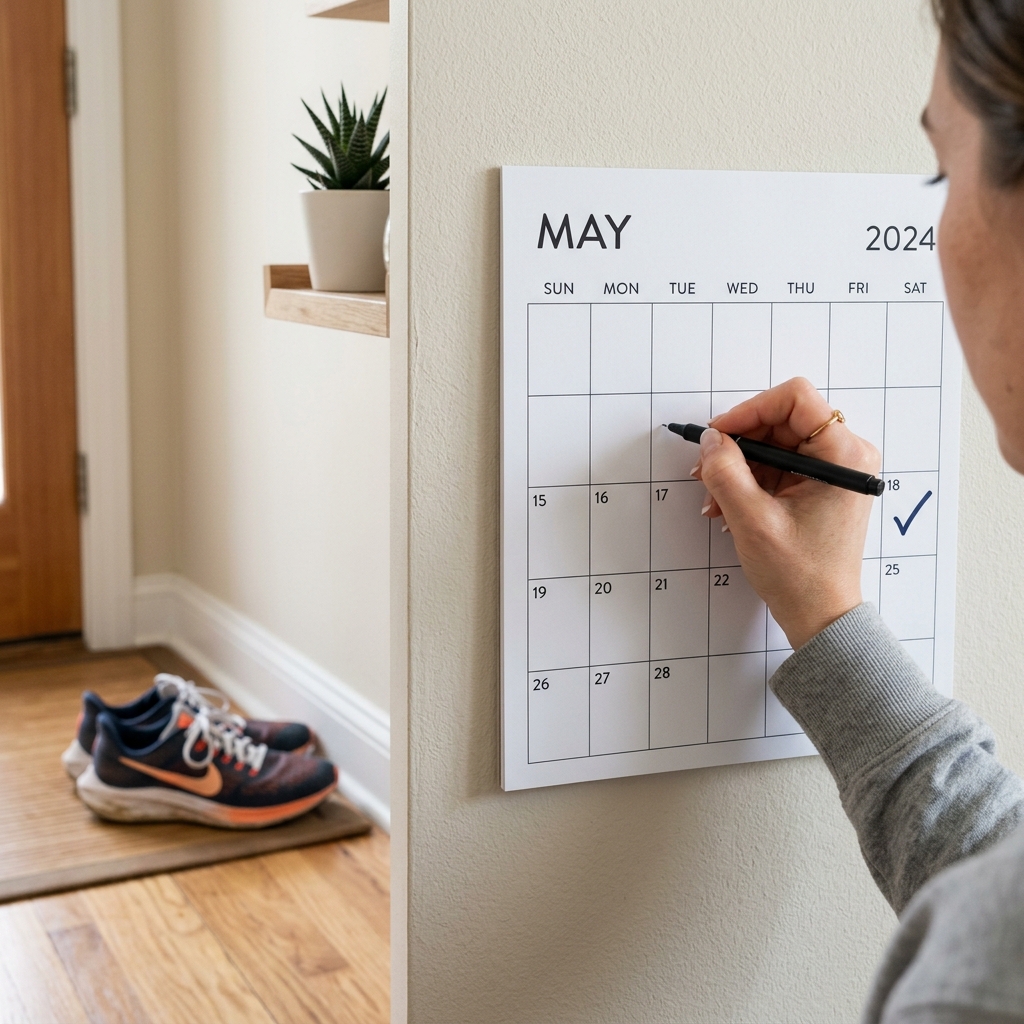
- Reward: Post-workout endorphins, sense of accomplishment, adding a check mark to your calendar
If there's no reward (you hate the workout, you feel terrible after, you never see progress), the habit breaks. Your brain stops linking the cue to the behavior.
The 66-Day Habit Formation Cycle
Research shows it takes 66 days on average for a behavior to become automatic (range: 18-254 days depending on complexity and individual). Here's what happens in each phase:
Days 1-10: Honeymoon Phase
- Motivation is high (fresh goal, excitement)
- Willpower is abundant (you're fresh, not fatigued)
- Challenge: None. Everything feels doable
- Strategy: Build momentum. Do the behavior every single day (no excuses). You're building the neural pathway from scratch
Days 11-30: Reality Phase
- Honeymoon novelty wears off
- Your brain starts questioning "why am I doing this?"
- Willpower declines 20-30% (fatigue begins)
- Challenge: This is when 50% of people quit
- Strategy: Focus on the reward. On hard days, remember why you started. Track visibly (check marks, calendars) to acknowledge progress
Days 31-50: Adaptation Phase
- Your body adapts to the training stimulus
- The behavior starts feeling slightly easier (less cognitive load)
- First visible results appear (strength gain, body composition shift)
- Challenge: Results are still subtle. Patience required
- Strategy: Increase difficulty slightly (progressive overload). Celebrate small wins. The habit is forming — don't break the chain
Days 51-66: Automation Phase
- The behavior becomes semi-automatic (you do it without consciously deciding)
- Willpower requirement drops by 40-60% (now it's just what you do)
- Habit is now resistant to disruption (missing one day is harder than doing it)
- Challenge: None. You're basically done
- Strategy: Maintain the chain. Missing one day is okay; missing two breaks the pattern. After 66 days, the habit is strong enough to survive occasional interruptions
The Habit Stacking Framework
Don't try to build 5 habits simultaneously. Instead, stack new habits onto existing ones. This leverages existing neural pathways.
Formula: "After [CURRENT HABIT], I will [NEW HABIT]"
Example Stack:
- After I wake up (current habit) → I drink 16 oz water (new habit)
- After I drink water → I log my weight (new habit)
- After I log weight → I check my training app for today's workout (new habit)
- After breakfast (current habit) → I take my supplements (new habit)
- After work (current habit) → I go to the gym (new habit)
- After the gym → I log my workout (new habit)
- After dinner → I log my meals (new habit)
- After dinner → I prepare tomorrow's gym bag (new habit)
By 66 days, these 8 new habits are stacked into your existing routine. The cue for the first habit triggers the entire sequence automatically.
Environmental Design: Make Good Behavior the Path of Least Resistance
Willpower is finite. Instead of relying on it, design your environment so the correct choice is the easiest choice.
For Workout Consistency
- Gym bag in your car overnight: Removes friction (one less decision)
- Gym immediately after work: Route home passes the gym (reduces decision fatigue)
- Same time every day: At 5 PM your brain automatically primes for training (no decision needed)
- Workout clothes laid out: Removes morning friction
- Alarm on your phone: External reminder removes reliance on memory
For Nutrition Consistency
- Meal prep on Sundays: The "choice" is already made (just reheat)
- Protein shake pre-made in fridge: Faster than deciding what to eat
- Tracking app on your home screen: Easier to log if it's visible
- No junk food in the house: You can't eat what doesn't exist (prevents temptation)
- Healthy snacks visible in fridge; junk hidden: The visible choice is more likely to be chosen
For Sleep Consistency
- Phone in another room after 9 PM: Removes the temptation to scroll
- Blue light glasses after sunset: Automates melatonin preservation
- Thermostat set to 65°F: Removes the temperature decision
- Alarm set for 7 AM: Consistent wake time (trains circadian rhythm)
Behavioral Psychology: The Motivation-Action Inversion
Most people think: "I need motivation first, then I'll take action."
Actually: "I take action first, then motivation follows."
This is backed by research (Beyondblue studies on exercise motivation): starting the behavior (even if you don't feel like it) triggers neurochemical changes that make you feel better. The motivation comes during or after the action, not before.
Protocol:
- You don't feel like training. Don't wait for motivation
- Put on your gym clothes anyway (just 2 minutes)
- Drive to the gym (3 more minutes)
- Do just ONE warm-up set
- At this point, 95% of people feel motivated enough to finish the workout
The barrier isn't the actual training; it's starting. Once started, momentum builds. This is why "motivation doesn't matter; system does" is the mantra of successful people.
Tracking Systems: How to Measure and Reinforce Habits
The Calendar Chain Method
Print a calendar, hang it on your wall. Put an X on each day you complete your habit. Your job: "don't break the chain."
- Visual feedback (seeing the X's accumulate) is psychologically reinforcing
- The chain becomes a sunk cost (you won't want to break 45 days of consistency)
- One day of failure is fine; breaking the chain is what hurts
Habit Tracking Apps
Streaks, Habitica, Done — all provide digital versions of calendar chains. Benefits:
- Automatic reminders (reduces reliance on memory)
- Notifications (provides dopamine hit)
- Data visualization (shows trends over months)
Quantified Self Tracking
Beyond "did you do it or not" — track the actual metric:
- Workouts: Track weight lifted, volume, intensity
- Nutrition: Track calories, macros, consistency (% logged)
- Recovery: Track sleep hours, HRV, resting heart rate
Quantified data creates a feedback loop: you see the relationship between actions and outcomes. This is more powerful than motivation.
Troubleshooting: When Habits Fail
Problem #1: "I'm in the reality phase (days 11-30) and I want to quit"
Solution: This is normal. You're not lazy; your brain is just adjusting. Don't rely on motivation. Instead:
- Reduce friction further (if you're skipping workouts, go to a gym 5 min from home, not 20 min)
- Find an accountability partner (text them after every workout)
- Remind yourself why you started (read your goal daily)
- Make the reward more immediate and satisfying (buy yourself a small treat post-workout)
Problem #2: "I skipped a day — now I've broken my streak and I feel defeated"
Solution: One skip doesn't break the habit. Missing 3+ days in a row is when it matters. Get back to it tomorrow. This is normal — even elite athletes have off days.
Problem #3: "The habit is formed but I got busy and didn't do it for 2 weeks"
Solution: After 66 days, habits are resilient but not immune. If you break the chain for 2+ weeks, you've returned to day 1. You need to rebuild for 66 days. Start immediately (don't wait for Monday or the new month).
The Top 3 Fitness Habits to Build First
#1: Training Consistency (Priority: 1)
Everything else is secondary. Build the habit of training 4-5x weekly for 12 weeks before worrying about supplement optimization or advanced programming.
#2: Nutrition Logging (Priority: 2)
You can't manage what you don't measure. Logging macros/calories for 12 weeks teaches you portion sizes, food awareness, and creates the feedback loop necessary for body composition change.
#3: Sleep (Priority: 3)
7-9 hours nightly. This is non-negotiable for recovery and sustainable motivation. After workouts and nutrition, sleep is the third pillar.
Don't try to perfect all three simultaneously. Build habit #1 for 66 days. Then add #2. Then add #3. By week 20, all three are automatic and you're unbreakable.
Accountability Systems for Long-Term Success
Option 1: Social Accountability
- Find a training partner or accountability group
- Commit publicly (tell friends your goal)
- Weekly check-ins with a friend (text your workout log every Monday)
- Cost: Free, but requires reliable partner
Option 2: Financial Accountability
- Sign up with a personal trainer (financial commitment forces attendance)
- Use Beeminder or Stickk (betting money on your habit)
- Cost: $50-200/month or variable
Option 3: Metric Accountability
- Track metrics (body composition, strength, consistency %)
- Weekly review of data (did you hit your targets?)
- Adjust training if metrics plateau (remove guesswork)
- Cost: $10-50/month (app subscriptions)
Advanced Habit Science: The Neurobiology Behind 66 Days
Research from the University of London (2009) tracked habit formation in 96 people and found that habit formation takes anywhere from 18 to 254 days, with an average of 66 days. But here's the neuroscience: what's actually happening in your brain?
The Habit Formation Neurochemistry:
- Days 1-10: High dopamine from novelty. Your prefrontal cortex (conscious decision-making) is heavily engaged. Every workout requires willpower
- Days 11-30: Dopamine decreases (novelty wears off). This is the "valley of despair" when 50% quit. Your striatum (automated movement center) begins strengthening pathways
- Days 31-50: Your basal ganglia (habit center) becomes more activated. Neural pathways strengthen through BDNF (brain-derived neurotrophic factor) release during training
- Days 51-66: Habit circuit is now dominant. Your prefrontal cortex can relax — the behavior is automatic. Willpower requirement drops 40-60%
The physiological mechanism: Myelin sheaths (insulation on neural pathways) thicken with repetition, allowing signals to travel faster and more efficiently. 66 days is approximately how long this myelination takes for a moderately complex behavior.
Troubleshooting Advanced: When Habits Regress After Formation
Scenario: You built a 90-day habit, then broke it for 3 weeks during travel. Now it's hard again.
You're not back to day 1, but you're close (probably day 5-7 strength). Why? Your myelin sheaths are still partially intact, but neurotransmitter balance has shifted. Recovery is faster than initial formation (usually 10-14 days to re-establish) because the neural pathway wasn't fully erased, just dormant.
Regression prevention protocol:
- Maintain habit even during disruptions (modified version counts). On vacation? Do 1 workout instead of 5 — still signals your brain the habit is active
- Habit stacking becomes more important during disruptions. When traveling, stack: "After I arrive at hotel → I do a 15-min bodyweight workout"
- If you do break 3+ weeks, restart with lower friction. Go back to the simplest version of the habit for 1-2 weeks before increasing difficulty
Habit Measurement: Tracking Consistency Beyond Binary Yes/No
Beyond "did you do it or not," track the quality of habit completion:
Consistency Scoring (0-100%):
- Workout habits: 100% = full workout completed, 50% = shortened workout, 0% = no workout
- Nutrition habits: 100% = all meals logged, 75% = missed one meal, 50% = logged only half
- Sleep habits: 100% = 8+ hours, 75% = 7-8 hours, 50% = 6-7 hours
After 12 weeks, calculate average consistency score. Scores above 90% build unbreakable habits; scores below 70% suggest the habit needs environmental redesign (lower friction).
Research Backing Your Habit Change
Key studies supporting this framework:
- Lally et al. (2009): University of London study validating 66-day average habit formation with individual variation (18-254 days range)
- Duhigg (2012): "The Power of Habit" — popularized habit loop framework (cue → routine → reward); validated in neuroscience literature
- Fogg (2020): "Tiny Habits" research showing behavior change is easier with smaller commitments and immediate rewards
- Clear (2018): "Atomic Habits" — evidence-based system of 1% improvements compounding; consistent implementation beats perfection
These frameworks aren't theory — they're backed by neuroscience research on neuroplasticity, habit formation, and behavioral change.