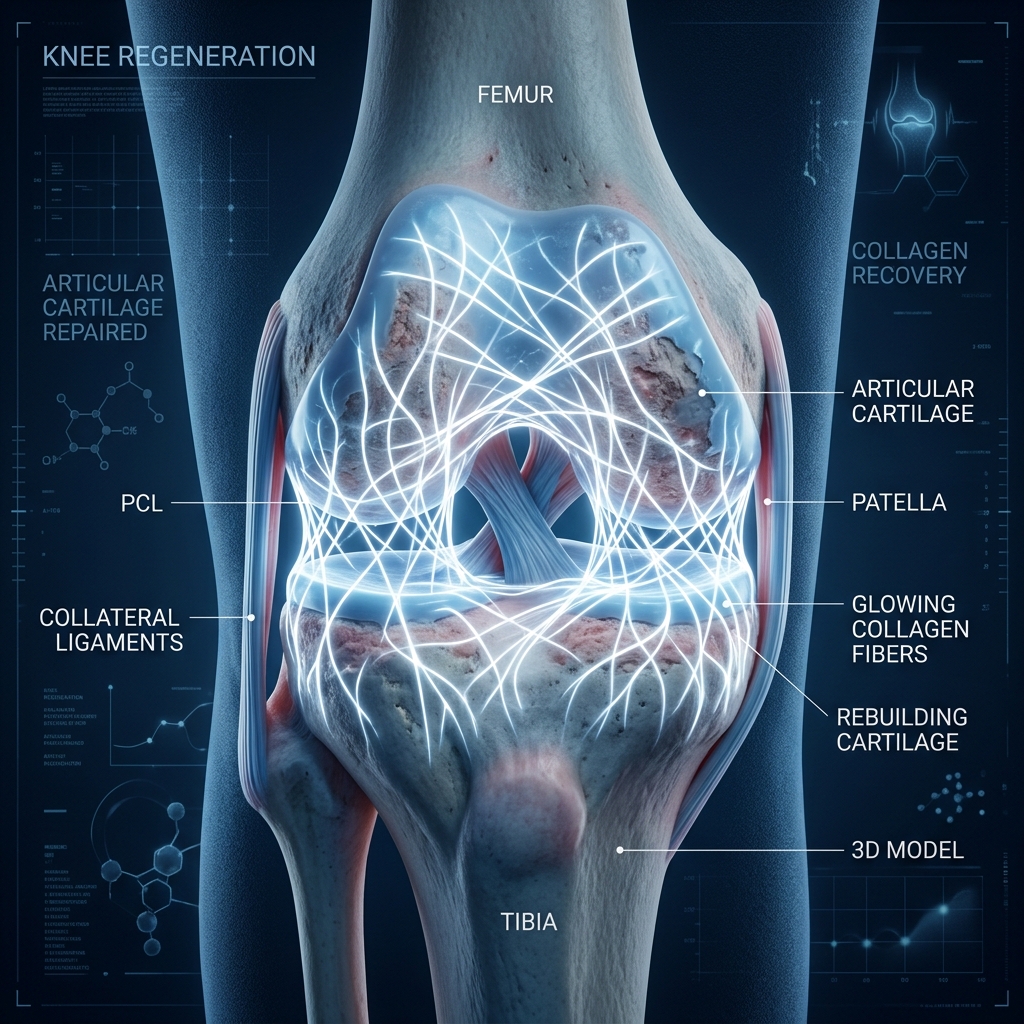
If your knees ache after a long run, your elbows flare up during heavy pressing, or your tendons take weeks to recover from a hard training block, you have probably heard someone recommend collagen. The supplement has moved from the beauty aisle into sports nutrition, and for good reason — the underlying biology is genuinely interesting. But the evidence is also more nuanced than most marketing copy lets on. Here is what the science actually says, how to use collagen strategically, and what you should realistically expect.
What Collagen Is and Why It Matters for Athletes
Collagen is the most abundant protein in the human body, making up roughly 30 percent of total protein mass. It is the primary structural protein in connective tissues — tendons, ligaments, cartilage, bone, and skin. There are at least 28 distinct types, but types I, II, and III dominate musculoskeletal tissue. Type I is the main component of tendons and ligaments. Type II is concentrated in cartilage. Type III appears alongside type I in skin and some soft tissues.
Unlike muscle protein, which turns over relatively quickly, connective tissue has a slow metabolic rate. Tendons in particular are largely avascular — they receive limited blood flow — which is one reason tendon injuries heal so slowly and why supporting their maintenance requires a different strategy than muscle building. Collagen synthesis in tendons can be stimulated, but the window for doing so is narrower and more time-sensitive than most people realize.
The Evidence for Collagen and Connective Tissue Recovery
The research on collagen supplementation for joint and tendon health is still maturing, but several well-designed studies have produced meaningful findings. The most cited work, published in the American Journal of Clinical Nutrition by Shaw and colleagues, found that supplementing with hydrolyzed collagen alongside vitamin C before exercise increased collagen synthesis markers in the blood and improved the mechanical properties of engineered ligament tissue. This was not a long-term clinical trial, but it established a plausible mechanism.
Subsequent research on tendinopathy — chronic tendon pain and degeneration — has shown more promising results. A randomized controlled trial in athletes with chronic Achilles tendinopathy found that those taking hydrolyzed collagen alongside a rehabilitation protocol reported greater reductions in pain and faster return to sport compared to placebo. Other studies on patellar tendinopathy have shown similar directional trends, though effect sizes vary.
The evidence for joint cartilage is somewhat mixed. Some studies on undenatured type II collagen (UC-II) in osteoarthritis patients show reduced pain and improved function, but most of the participants in these trials had existing cartilage damage rather than healthy tissue under athletic stress. Extrapolating these findings to healthy athletes is not straightforward.
What the evidence does support, fairly consistently:
- Hydrolyzed collagen can increase circulating markers of collagen synthesis, particularly when combined with vitamin C and timed around exercise.
- Tendon pain from overuse injuries may respond to collagen supplementation when combined with an appropriate loading program.
- Joint comfort during sustained training is modestly improved in some populations, though results are heterogeneous.
- Collagen does not build muscle the way whey or casein does — it is low in leucine and branched-chain amino acids, so it should not replace your primary protein source.
The Vitamin C Connection You Cannot Ignore
Collagen synthesis is not a passive process. Your body does not simply absorb collagen peptides and redirect them to tendons intact. Instead, the amino acids from hydrolyzed collagen — primarily glycine, proline, and hydroxyproline — are taken up and used as building blocks for new collagen fibers in your connective tissue. The catch is that this synthesis depends on vitamin C as an essential co-factor.
Vitamin C is required for the activity of enzymes called prolyl hydroxylase and lysyl hydroxylase, which stabilize the triple-helix structure of collagen. Without adequate vitamin C, newly formed collagen is structurally weak and prone to degradation. This is why scurvy — severe vitamin C deficiency — causes connective tissue breakdown and wound healing failure.
For collagen supplementation to work, you need to ensure adequate vitamin C intake at the same time. Most research protocols use around 50 mg of vitamin C alongside the collagen dose, but since the upper tolerable limit is 2,000 mg per day and typical supplemental doses of 500–1,000 mg are well tolerated, including a modest vitamin C supplement with your collagen is practical and low-risk. Alternatively, consuming your collagen with a vitamin C-rich food — citrus juice, kiwi, bell pepper — achieves the same effect.
Timing: Why the Pre-Exercise Window Matters
Timing collagen intake is one of the most actionable findings from recent research, and it differs meaningfully from typical protein supplement timing advice. The current evidence suggests that consuming hydrolyzed collagen approximately 30 to 60 minutes before exercise or mechanical loading of the target tissue optimizes collagen synthesis in tendons and ligaments.
The rationale is that exercise increases blood flow to connective tissue — even the relatively avascular tendons experience transient increases in nutrient delivery during and immediately after loading. Taking collagen before training means the amino acid precursors and vitamin C co-factor are circulating in the blood at the moment when the tissue is most receptive to incorporating them into new collagen fibers.
This pre-exercise timing is in contrast to post-workout protein, where the goal is to capitalize on muscle protein synthesis in the hours after training. For connective tissue, the pre-loading window appears more critical. If you are doing a rehabilitation protocol for a tendon injury, schedule your collagen dose 45 minutes before your loading exercises or physiotherapy session.
Dosing: How Much Do You Actually Need
The doses used in most positive research trials fall in the range of 5 to 15 grams of hydrolyzed collagen per day. The Shaw et al. study used 15 grams. Some tendinopathy protocols have shown benefits with as little as 5 grams when combined with structured loading. There is no strong evidence that going above 15 grams per day produces additional benefit for connective tissue — the response curve appears to plateau.
Key dosing considerations:
- Hydrolyzed collagen (collagen peptides) is the form used in most studies. It is broken down into smaller peptides that are rapidly absorbed. Gelatin is a partially hydrolyzed form and may offer similar benefits at a lower cost.
- Start with 10–15 grams daily if you are managing an active tendon or joint issue. If you are supplementing preventatively during heavy training, 5–10 grams is a reasonable maintenance dose.
- Consistency matters more than dose. Collagen synthesis in connective tissue is slow. Studies showing structural or symptomatic improvements typically run for 8 to 24 weeks. Do not expect results in two weeks.
- Undenatured type II collagen (UC-II) for cartilage is a different product taken at a much lower dose (40 mg). It works through a different mechanism — oral tolerance — rather than providing substrate for synthesis. Do not confuse it with hydrolyzed collagen peptides.
Food Sources vs. Supplements
Collagen comes from animal connective tissue, so foods that include skin, bones, and cartilage are naturally rich sources. Bone broth is the most commonly cited option, though its collagen content varies widely depending on preparation time, bone type, and water ratio. Slow-cooked cuts of meat with connective tissue — oxtail, shanks, chicken thighs with skin — also contribute meaningful amounts. Skin-on fish provides marine collagen, which is predominantly type I.
The practical challenge with food sources is consistency and dose. A cup of well-made bone broth might provide 5–10 grams of collagen-derived protein, but reliably hitting a specific dose is difficult without knowing the collagen content of what you are consuming. Supplements are standardized, which makes them more reliable for therapeutic purposes.
That said, incorporating collagen-rich foods into your diet alongside supplementation is a reasonable approach — and whole foods bring other nutrients, including minerals like calcium and phosphorus from bone broth, that support musculoskeletal health broadly. Neither approach is inherently superior; the right choice depends on your dietary habits, budget, and how targeted your goals are.
One important note: collagen is not a complete protein. It is deficient in tryptophan and low in leucine, so it cannot replace high-quality protein sources like meat, dairy, eggs, or legumes for muscle protein synthesis. It should be used alongside your regular protein intake, not instead of it.
Setting Realistic Expectations
Collagen supplementation is not a quick fix for tendon pain or joint wear. Connective tissue remodels slowly — months, not weeks — and supplementation is most effective as part of a comprehensive approach that includes appropriate loading, progressive rehabilitation when injuries exist, adequate sleep, and overall nutritional sufficiency.
What collagen can realistically offer, based on the current evidence:
- Modest support for tendon recovery when combined with structured loading protocols, particularly for chronic overuse injuries like Achilles or patellar tendinopathy.
- Potential reduction in joint discomfort during sustained training loads in some individuals, especially those with early signs of cartilage stress.
- A low-risk nutritional addition during periods of heavy training volume or when returning from connective tissue injuries, given its favorable safety profile and relatively low cost.
What it will not do: reverse significant cartilage damage, eliminate the need for rehabilitation, or substitute for adequate rest and recovery. The athletes who benefit most are those who use collagen as one component of a well-structured recovery protocol — not a standalone solution.
Tracking how your joints and tendons are responding over weeks of training is one of the most valuable things you can do, and it is where UltraFit360 gives you an edge. Log your recovery quality, joint soreness, and training load inside the app to spot patterns — whether that is identifying the training volume threshold where your tendons start to protest, or confirming that a new recovery protocol is actually moving the needle over time.
Transform Your Fitness Journey
Log your workouts, track your diet, and get AI coaching insights — all with UltraFit360.