💡 Key Takeaways
- The single best-evidenced use for you is wearing graduated compression socks on long flights to cut leg swelling — not chasing faster muscle recovery.
- For workout soreness the benefit is small and mostly perceived; it will not offset a night of bad hotel sleep.
- Make it a default rule, not a decision: socks in the carry-on for flights over ~3-4 hours, sleeves only after your hardest hotel session.
- No garment compensates for chronic sleep restriction or stacking caffeine on travel fatigue — sleep is still the lever that matters.
Tuesday: a 6am call, a hotel-gym session squeezed in before checkout, a 4-hour flight, a client dinner with two glasses of wine, and a 1am hotel bed in a new time zone. Somewhere in that day you want a recovery tool that asks nothing of your decision-making and survives airports. Compression garments come up constantly in that conversation, usually oversold.
Here is where they genuinely fit your week — and where they do not. The strongest, best-established case for compression in your life has little to do with the gym: it is the compression sock you wear on long flights to keep your lower legs from swelling during hours of sitting. The muscle-soreness benefit, by contrast, is small and mostly something you feel rather than measure.
This guide slots compression into the realities of travel, hotel gyms, and a packed calendar, and tells you what to ignore.
1. Where Compression Slots Into a Travel-Heavy Week
Start with your actual constraints: unpredictable schedule, long sitting blocks, time-zone disruption, and 20-40 minute training windows wherever you land. Two distinct uses of compression map onto that week, and they are not equally supported.
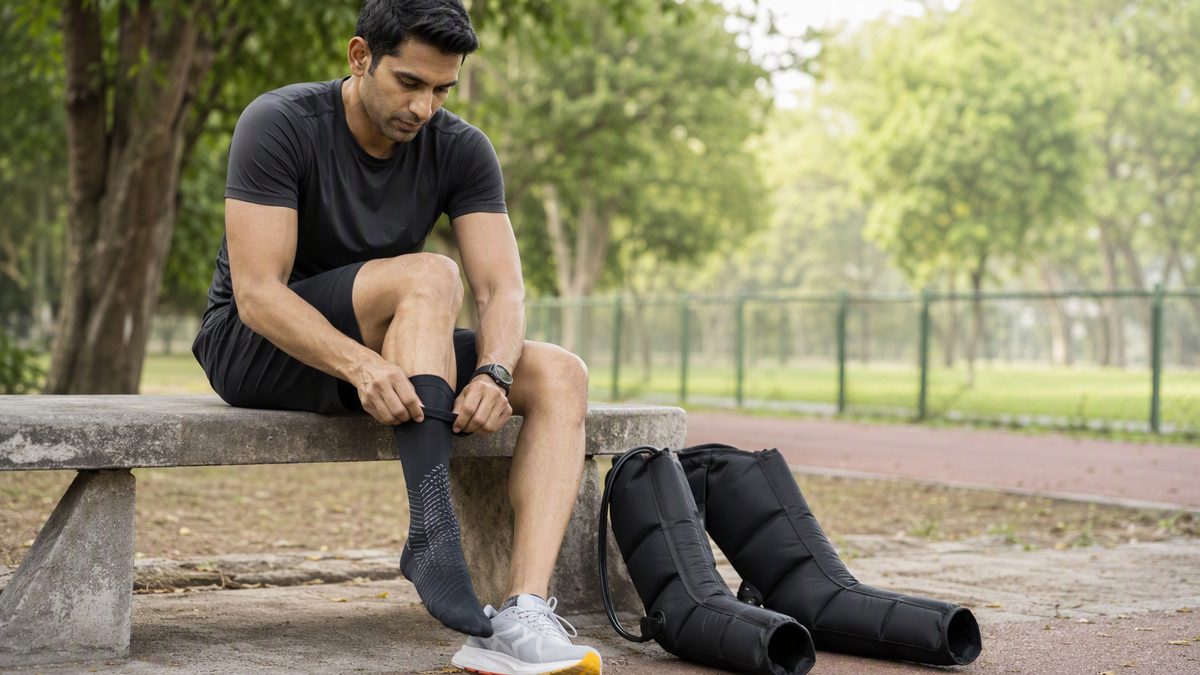
The first is travel. Sitting for hours on a flight or in a car lets fluid pool in your lower legs, and graduated compression socks are a well-established, low-cost way to reduce that swelling and the heavy-leg feeling on arrival. This is the clearest-value use case in your entire life, and it has nothing to do with workout soreness. The second is recovery wear after a hard session — sleeves or tights worn for a few hours afterward. That one delivers a small, mostly perceived reduction in soreness, not a measurable acceleration of recovery. Treat the first as a genuine travel tool and the second as an optional comfort. Build them into default rules so they never cost you a decision: socks always go in the carry-on; sleeves come out only after a session that actually left you sore.
2. The Default-Rules Protocol for Airports and Hotel Gyms
You want 'same item, same trigger, anywhere' rather than a fresh judgment call each trip. The table below is built that way. Pressure ranges are textbook estimates; consumer garments are inconsistently rated, so buy by limb measurement and the sizing chart, and pack the same trusted pair every time.
| Garment | When to wear it | Strength of the evidence |
|---|---|---|
| Graduated compression socks (~15-20 mmHg) | Any flight or drive over ~3-4 hours, on for the whole journey | Strongest — well-established for reducing travel leg swelling |
| Calf or thigh sleeves (~15-20 mmHg) | 2-4 hours after your hardest hotel-gym or home session of the trip | Modest — small drop in perceived soreness only |
| Full recovery tights | Worn in the room for an evening after an unusually heavy or long session, occasionally overnight | Weak to modest — comfort, not measurable recovery |
| Any garment on rest or light-travel days | Skip it unless you are on a long flight | No meaningful benefit |
Snug and firm, never numbing. If you feel tingling or see color change in the foot, take them off — easy to miss when you are working through the flight.
3. Why Sleep Still Beats the Garment on the Road
The temptation in your world is to treat recovery as a stack of gadgets that lets you keep cutting sleep. Compression cannot do that job, and neither can anything else you can pack. Most of your hormonal and tissue recovery happens during sleep, and sleep loss is directly linked to worse muscle recovery and degraded performance — including the cognitive sharpness your job actually runs on. Adults generally need about seven to nine hours; heavy travel weeks push the need higher, not lower.
This is why the single metric worth watching is not anything a sleeve reports — it is your sleep. Premium wearables (Oura, Whoop, Garmin) estimate sleep, resting heart rate, and HRV well enough to reveal trends, though they are best read as direction-of-travel rather than precise truth. If those trends are sliding, no compression garment, cold plunge, or supplement will rescue the week; protecting sleep and easing training load will. Compression is a comfort layer on top of recovery, never a replacement for it. And stacking caffeine on top of a sleep deficit to feel functional only deepens the hole.
4. Executive Mistakes: All-or-Nothing and Stimulant Stacking
- Treating compression as performance insurance. It will not offset a 1am bedtime or a missed week. It is a minor comfort tool, full stop.
- All-or-nothing thinking. You do not need the perfect recovery stack. Socks on flights and good sleep beat an elaborate routine you abandon by Wednesday.
- Stacking stimulants over sleep debt. Caffeine masks fatigue; it does not repair it. No garment compensates either. Watch caffeine timing against your sleep window, especially across time zones.
- Drinking through it. Alcohol at client dinners worsens sleep quality and recovery. One garment does nothing for that; moderating the second glass does more.
- Wearing them all day to 'maximize' benefit. All-day everyday compression has no support without a medical reason and makes a fit problem easy to miss.
5. The Annual Physical as Your Real Checkpoint
You almost certainly do an executive health panel once a year, and that is a far more useful recovery checkpoint than anything a compression garment reports. Use it. Chronically elevated cortisol from travel and decision fatigue, disrupted sleep, and regular alcohol all leave fingerprints your physician can read — resting heart rate, blood pressure, metabolic and lipid markers, and how you feel day to day. If those are drifting the wrong way, no recovery tool fixes the cause; reducing the load on yourself does. Bring the question to that appointment directly: am I under-recovered, and what is actually driving it?
The travel-and-sitting case for compression connects here as well. Long sedentary stretches on flights raise the case for compression socks specifically because pooling and swelling in the lower legs are a real, well-recognized consequence of immobility — that is the one use a clinician would readily endorse. Beyond that, keep the mental model simple. Compression is a low-stakes item: cheap, reusable, worth a try if it feels good, replaced when it loses its stretch. It earns no place in your annual physical conversation. Sleep, alcohol, stress load, and movement do. Spend your limited bandwidth on those, and let the garment be the small convenience it actually is.
What Time-Pressed Executives Ask About Compression
What's the minimum effective way to use compression when I travel?
One rule covers most of it: pack a pair of graduated compression socks and wear them on any flight or drive over three to four hours to reduce lower-leg swelling. That is the use case with the clearest evidence. For workout soreness, slip on calf or thigh sleeves for a couple of hours after your single hardest session of the trip. Skip the rest. Everything beyond that is marginal comfort, not measurable recovery.
Does alcohol at client dinners cancel out the benefit?
Alcohol mainly hurts you through worse sleep and slower recovery, and a compression garment does nothing to counter that. Wearing sleeves after a session will not offset two glasses of wine the same evening. If recovery matters that week, the higher-leverage move is moderating the alcohol and protecting your sleep window. Treat compression as a small comfort layer, not as a buffer against the things that genuinely degrade your recovery on the road.
Can I keep this up across time zones?
Yes, because the routine is deliberately decision-free: socks on long flights, sleeves after your hardest session, nothing complicated to schedule around jet lag. The harder problem across time zones is sleep, which no garment fixes. Anchor your recovery to protecting sleep and managing caffeine timing relative to your new bedtime. Compression travels well and asks nothing of you, but it sits well below sleep in what actually keeps you recovered.
What single metric should I watch to know I'm recovered?
Sleep, tracked as a trend rather than a nightly score. Most tissue and hormonal recovery happens during sleep, and your wearable's sleep, resting heart rate, and HRV trends will tell you more about your recovery than any soreness reading from a sleeve. Read those numbers as direction over a week, not gospel for one night. If the trend is sliding, ease training load and fix sleep — compression will not move that needle.
Disclaimer: This article is for educational purposes only and is not medical advice. Consult a qualified healthcare professional before starting any supplement, nutrition, or training protocol — especially if you are pregnant or breastfeeding, under 18, taking medication, or managing a health condition.
Scientific References & Clinical Sources
- Dupuy O, et al. An Evidence-Based Approach for Choosing Post-exercise Recovery Techniques to Reduce Markers of Muscle Damage, Soreness, Fatigue, and Inflammation: A Systematic Review With Meta-Analysis. Front Physiol, 2018. PMID: 29755363
- Dattilo M, et al. Sleep and muscle recovery: endocrinological and molecular basis for a new and promising hypothesis. Med Hypotheses, 2011. PMID: 21550729
- Thun E, et al. Sleep, circadian rhythms, and athletic performance. Sleep Med Rev, 2015. PMID: 25553531
- Fullagar HH, et al. Sleep and athletic performance: the effects of sleep loss on exercise performance. Sports Med, 2015. PMID: 25315456
- Peake JM, et al. A Critical Review of Consumer Wearables, Mobile Applications, and Equipment for Providing Biofeedback, Monitoring Stress, and Sleep in Physically Active Populations. Front Physiol, 2018. PMID: 30002629

