💡 Key Takeaways
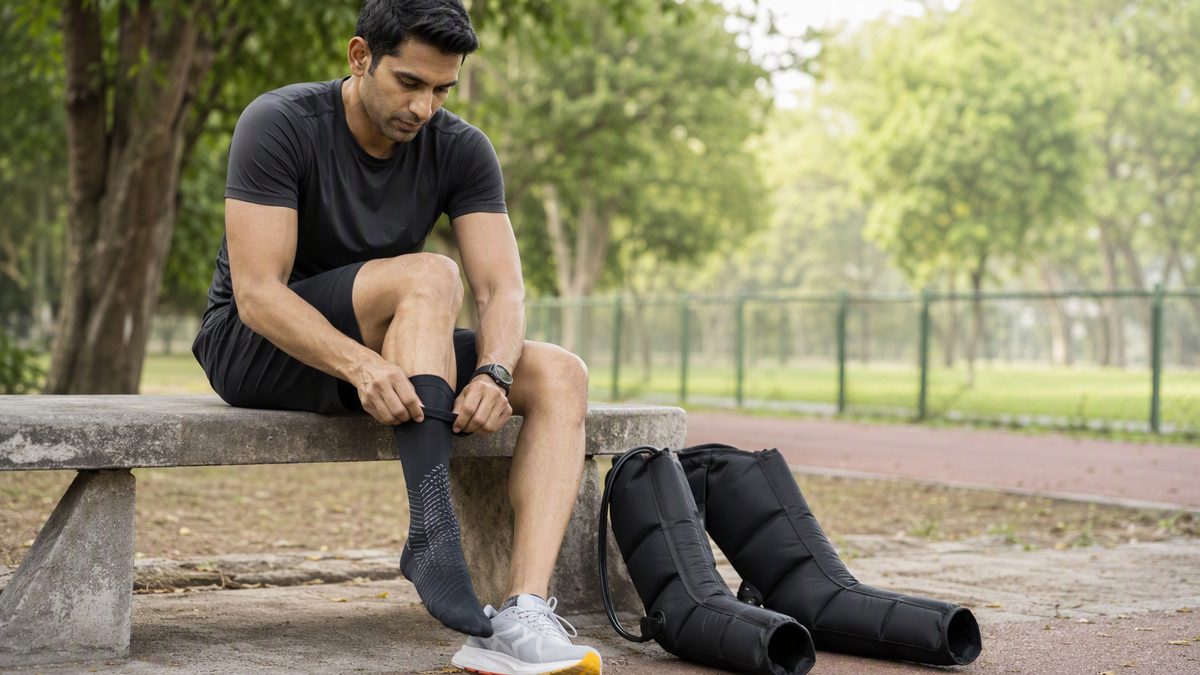
- Two different problems: weekend-warrior gym soreness (compression gives a small perceived edge) and stiff, slightly puffy legs from sitting (where graduated socks have a clearer rationale).
- After a harder-than-usual workout, wear recovery socks or tights for 2-4 hours that evening; expect modestly less stiffness, not faster healing.
- On long-haul flights or all-day drives, graduated compression socks at roughly 15-25 mmHg reduce lower-leg swelling and pooling — the clearest-value use.
- No sock cancels 8-10 hours of sitting; movement breaks, sleep, and protein matter far more than any garment.
The question a lot of desk workers quietly google: "My legs feel stiff and a bit swollen by 5pm, and I'm sore from the gym — would compression socks actually help?" Short answer: partly, and for two separate reasons. For the soreness after a harder workout, compression gives a small, mostly perceived comfort benefit. For the heavy, slightly puffy feeling that builds during a long day in the chair — or worse, a long flight — graduated socks have a clearer, well-established rationale for reducing lower-leg swelling. Neither is a cure, and neither undoes the deeper cost of sitting all day.
That distinction matters because the two uses get blurred in marketing. Below is the honest breakdown: what compression does for post-gym soreness, what it does for desk-and-travel leg swelling, when to wear it around a 9-to-6, and why no sock replaces simply getting up and moving.
1. The Direct Answer for a Desk-Bound Trainee
Start with post-gym soreness, since that is half the question. Recovery-technique research finds compression produces small reductions in perceived delayed-onset soreness and fatigue, with little reliable change in objective muscle-damage markers. So after a leg day that leaves you sore, recovery socks or tights worn that evening may make your legs feel a bit less stiff. They do not heal the muscle faster — soreness from an unaccustomed session peaks around 24 to 72 hours later and fades on its own within a few days regardless.
This honesty matters for desk workers specifically, because the classic pattern here is the weekend warrior: sedentary all week, then a hard session that produces outsized soreness. Compression can take a little edge off how that feels, but the real fix is ramping load gradually so you are not blindsided by soreness every Monday.
The second half of the question — the stiff, faintly swollen legs from sitting — is where compression has a genuinely clearer case, and it is not about muscle soreness at all. That is covered next.
2. Sitting All Day vs. a Long Flight: Where Socks Earn Their Keep
Hours of stillness let fluid pool in your lower legs — the reason your socks leave deeper marks by evening or your shoes feel tighter. Graduated compression socks, tightest at the ankle, encourage venous return and reduce that pooling and swelling. This is the same principle behind wearing compression on a long flight, and the travel case is the clearest, best-established use of compression there is: on a long-haul flight or an all-day drive, graduated socks meaningfully reduce lower-leg swelling from prolonged sitting.
For a normal office day, the case is softer but reasonable if your legs genuinely feel heavy and swollen by evening — some desk workers find light graduated socks make the late afternoon more comfortable. But be clear-eyed: this is managing a symptom of sitting, not fixing the sitting. If your leg swelling is new, one-sided, or comes with pain or warmth, that is a clinical question, not a sock to buy — one-sided leg swelling can signal a clot.
So: gym soreness → small perceived benefit; long travel → clear benefit; ordinary desk swelling → modest, symptom-level comfort at best.
3. How to Fit Compression Around a 9-to-6
Here is the practical schedule for a desk worker who also trains, separating the recovery use from the travel use.
| Scenario | Garment | When to wear | Duration |
|---|---|---|---|
| Evening after a hard leg session | Recovery socks or tights | At home after dinner | 2-4 hours, or overnight |
| Sore quads from a weekend ramp-up | Full recovery tights | Evening, post-workout | 2-3 hours |
| Legs heavy/puffy by late afternoon | Light graduated socks (15-20 mmHg) | From mid-morning at the desk | Through the sitting block |
| Long-haul flight or all-day drive | Graduated compression socks | Before boarding / departing | Duration of travel |
| Light or easy workout | Skip — minimal benefit | — | — |
| Hourly desk break (free, do this) | None — just stand and walk | Every 30-60 min | 2-3 min movement |
There is no trial-validated wear time, so treat these as practical ranges. For recovery wear aim for a firm, snug 15-25 mmHg feel; for all-day desk wear, lighter is more comfortable. Measure your ankle and calf against the brand's chart and wear the socks smooth — a rolled-down band can act like a tourniquet, and a loose sock does almost nothing.
4. Why No Sock Cancels 8 Hours in the Chair
The most important thing for a desk worker to internalize: a single workout, and certainly a pair of socks, does not undo a day of sitting. Long sedentary bouts blunt how your body handles blood sugar and fats even in people who train regularly, and the antidote is breaking up the sitting — not compressing it. Standing and walking for two or three minutes every half hour does more for your metabolism and your stiff legs than any garment.
Compression also can't touch the postural side of desk life: tight hip flexors, a stiff upper back, the afternoon energy crash. Those respond to movement snacks, walking meetings, a standing desk used in intervals, and sleep — not to squeezing your calves. If you only have bandwidth for one change, make it the movement breaks, and treat compression as an optional comfort layer on top.
And keep the hierarchy straight. Sleep is the foundation of recovery; most repair happens there, and sleep loss worsens both recovery and the afternoon slump you are fighting. Adequate protein and sensible, gradual training loads beat any sock for your post-gym soreness. If you want a framework to make the small things — desk breaks, consistent sleep, a steady training ramp — actually stick, our guide to building durable fitness habits is a practical place to start. Compression is the footnote, not the plan.
5. Fit, Warning Signs, and When It's a Doctor's Question
Fit is everything, and there is no validated optimal pressure, so this is practical guidance. The garment should feel firm and snug but never painful or numbing. Take it off at once for tingling, numbness, pins-and-needles, skin going pale or bluish, marked redness, throbbing, or a cold foot — those mean the fit is wrong, not that it is working harder. Wear socks smooth with no rolled bands, oriented tightest at the ankle.
Be especially careful here, because office workers are exactly the population that buys compression socks off a shelf without measuring. Follow the sizing chart, and replace socks once they lose stretch and slide on easily, since worn-out elastic delivers little compression.
This is also the persona where medical caveats bite hardest, because desk-job leg swelling overlaps with conditions that need a clinician. New, one-sided, painful, or warm leg swelling can signal a deep vein thrombosis and is a medical emergency, not a sock fix. And if you have peripheral arterial disease, diabetes with neuropathy, heart failure, severe varicose veins, or any unexplained persistent swelling, do not self-prescribe athletic compression — see a clinician first, because in some of these conditions external compression can be harmful and must be pressure-matched professionally.
What Desk Workers Ask About Compression and Sore, Stiff Legs
Does sitting all day cancel out my training, and will compression help?
Long sitting blunts how your body handles blood sugar and fats even if you exercise, and compression does not change that — it only manages the surface symptom of heavy, swollen legs. The real fix is breaking up the sitting with a two to three minute walk every half hour. Use compression for post-gym soreness comfort or long travel, but treat movement breaks, not socks, as the actual countermeasure to a sedentary day.
When should I wear these around a 9-to-6 schedule?
Two windows. After a harder-than-usual workout, wear recovery socks or tights that evening for two to four hours for a small perceived-soreness benefit. Separately, if your legs feel heavy and puffy by late afternoon, light graduated socks through the sitting block can help. The strongest use is travel: put graduated compression socks on before a long flight or all-day drive to cut lower-leg swelling from sitting.
Why are my legs swollen and heavy by the end of the day?
Hours of sitting let fluid pool in your lower legs against gravity, which is why your socks leave marks and shoes feel tight by evening. Graduated compression and regular standing breaks both reduce it. But new, one-sided, painful, or warm swelling is different — that can signal a blood clot and needs prompt medical attention, not a compression sock. When swelling is unusual for you, get it checked rather than self-treating.
Can desk movement snacks really help more than compression?
Yes. Standing and walking for a couple of minutes every half hour breaks up the sedentary stretches that blunt your metabolism and lets your calf muscles pump fluid back out of your legs. That does more for both your metabolic health and your stiff, heavy legs than squeezing them in a sock. Compression is a comfort layer; movement is the actual intervention, and it is free.
Disclaimer: This article is for educational purposes only and is not medical advice. Consult a qualified healthcare professional before starting any supplement, nutrition, or training protocol — especially if you are pregnant or breastfeeding, under 18, taking medication, or managing a health condition.
Scientific References & Clinical Sources
- Dupuy O, et al. An Evidence-Based Approach for Choosing Post-exercise Recovery Techniques to Reduce Markers of Muscle Damage, Soreness, Fatigue, and Inflammation: A Systematic Review With Meta-Analysis. Front Physiol, 2018. PMID: 29755363
- Dattilo M, et al. Sleep and muscle recovery: endocrinological and molecular basis for a new and promising hypothesis. Med Hypotheses, 2011. PMID: 21550729
- Fullagar HH, et al. Sleep and athletic performance: the effects of sleep loss on exercise performance. Sports Med, 2015. PMID: 25315456
- Halson SL. Sleep in elite athletes and nutritional interventions to enhance sleep. Sports Med, 2014. PMID: 24791913
- Peake JM, et al. A Critical Review of Consumer Wearables, Mobile Applications, and Equipment for Providing Biofeedback, Monitoring Stress, and Sleep in Physically Active Populations. Front Physiol, 2018. PMID: 30002629

