💡 Key Takeaways
- Expect a small, mostly perceived freshness bump in the 24-72 hour sore window, maybe a point or two on a 0-10 scale, not faster repair or a better split.
- Wear recovery tights or socks for 2-4 hours after your hardest brick or long run, and during gaps between same-day sessions.
- Graduated socks on race travel reliably cut leg swelling, the clearest-value use, and never debut new kit on race day, test it in training.
- Your recovery budget is sleep, fuel, and energy availability across 9-13 sessions, compression is a small adjunct, and chronic under-fueling offsets any garment.
Here is what compression realistically delivers across your week, measured honestly. After a long run or a brick that leaves your legs trashed, recovery garments may make those legs feel modestly fresher over the next day or two, a perceived difference you might rate as one or two points lower on a 0-10 soreness scale, with little change in the actual muscle-damage markers underneath. During the long flat sits between sessions or on travel to a race, graduated socks reliably cut lower-leg swelling. That is the whole honest scorecard.
What you will not measure: faster true repair, a better run split, or prevented soreness. Compression nudges how your legs feel between your nine-to-thirteen weekly sessions; it does not expand your recovery budget, which sleep, fuel, and load still govern.
This page lays out the timeline you can expect, a protocol for recovery wear and race week, the science behind the modest effect, and where it slots into a triathlete's brutally full schedule.
1. The Timeline: What to Expect After a Brick or Long Run
Set your expectations against the natural course of soreness, because that is what compression is competing with. Delayed-onset muscle soreness from a hard, eccentric-heavy session, downhill running, a big brick, an unaccustomed long ride, shows up several hours later, peaks around 24-72 hours, and resolves on its own within a few days no matter what you wear. That self-resolution is the baseline.
Against that baseline, here is what recovery wear adds. In the hours and first day or two after a hammering session, your legs may feel a bit less heavy and beaten, a small, mostly perceived bump in freshness. That can be genuinely useful when you have another quality session the next morning, which on a triathlon schedule you usually do. The effect is real enough to feel, modest enough that some sessions you will barely notice it.
What does not move on the timeline is the objective stuff. The markers of muscle damage and inflammation largely run their own course, and the repair clock does not shorten. So part of any "it worked" impression is simply soreness fading on its own schedule. Read compression as a comfort lever for the 24-72 hour sore window, not as something that compresses the recovery timeline itself.
2. The Recovery-Wear and Race-Week Protocol
Use compression where soreness, swelling, and congestion are highest, and skip it where they are not. Here is a workable protocol across training and race week. Pressures are textbook ranges, not a validated dose, brands deliver them inconsistently, so treat the numbers as guidance.
| Session or phase | Garment | Ankle pressure | Timing and duration |
|---|---|---|---|
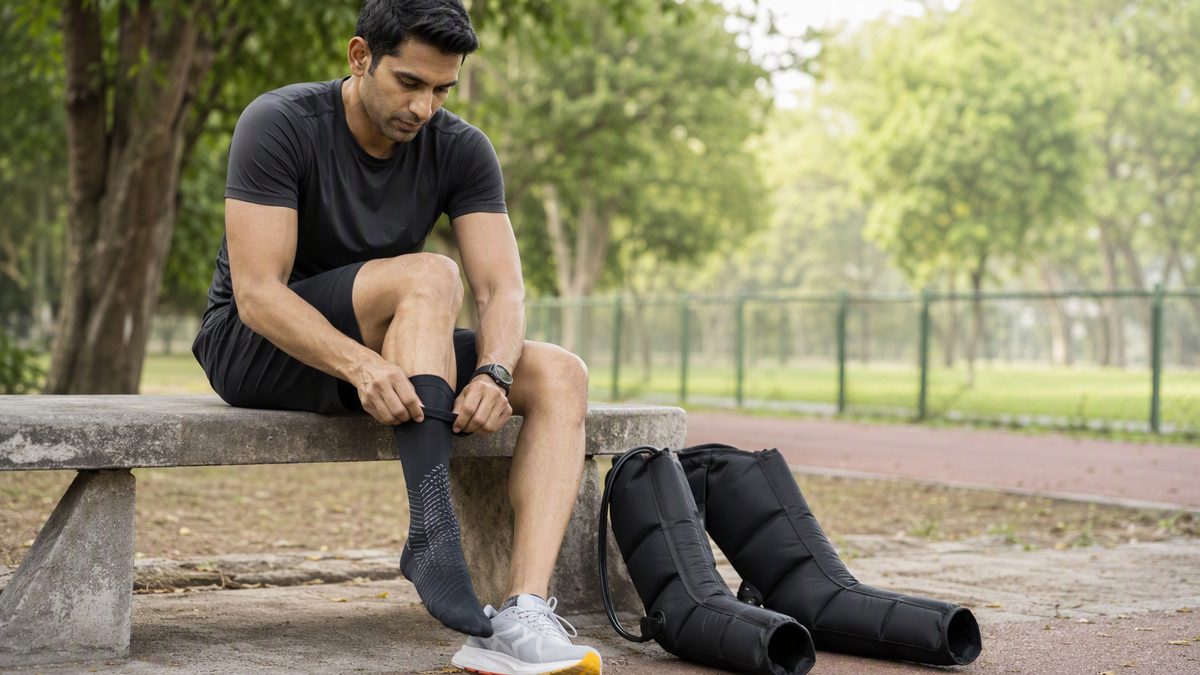
| After a long run or hard brick | Recovery tights or socks | ~15-25 mmHg | 2-4 hours post-session into the evening, before sleep |
| Between two same-day sessions | Recovery socks | ~15-20 mmHg | During the gap; legs feel fresher for session two |
| Long-haul travel to a race | Graduated socks | ~15-20 mmHg | During the flight or drive; cuts leg swelling |
| Race week, between key efforts | Recovery tights | ~15-25 mmHg | Evenings on hard days; remove for sleep |
| Easy aerobic or technique day | Optional, minimal benefit | n/a | Skip; soreness is low |
Two refinements. The post-session recovery window beats wearing anything during the swim, bike, or run, the during-exercise case is mostly comfort, with weak and inconsistent evidence for measurable performance gain. And do not introduce anything new on race day; if you want to race in compression, test it fully in training first, untested kit is how avoidable problems show up at the worst time.
3. The Science: Why the Effect Is Modest
Graduated compression is tightest distally and looser proximally, designed to aid venous return against gravity. The proposed mechanisms are plausible: it may improve local circulation and clearance, reduce post-exercise swelling and fluid pooling, dampen muscle oscillation during the run's impact, and provide a supportive, "held" sensation. Several of those could reasonably ease how sore a limb feels.
The catch is that plausible mechanisms have not translated into large measured effects. Meta-analytic work on recovery techniques places compression among the methods that reduce perceived soreness and fatigue a little, while the objective muscle-damage and inflammatory markers move little. The strongest, most consistent signal is on perceived soreness, which for a triathlete chasing freshness between doubles is still a worthwhile outcome, just not the muscle-repair accelerator the marketing implies.
There is also a recovery principle worth holding. Aggressively blunting the post-exercise stress response, as routine cold-water immersion can, may reduce long-term strength and endurance adaptations. Compression is far milder and not a concern here, but it underlines the framing: do not reflexively try to erase every bit of post-session stress, some of that signal is the adaptation you are training for.
4. Slotting It Into a 9-13 Session Week Without Wasting Time
You have the highest training hours and the tightest time budget of any athlete, so compression has to earn its place without adding admin. The decision rule: deploy recovery wear after the genuinely hard, eccentric-heavy, or congested days, and ignore it the rest of the time. Your long run, your biggest brick, and back-to-back quality days are the candidates; your easy aerobic spins are not.
Be clear-eyed that compression is support, not fitness, a classic triathlete trap is treating recovery gadgets as training. Your real recovery budget is set by three things across these huge volumes: sleep, fueling, and energy availability. Chronic low-grade under-fueling is common in triathletes and no garment offsets it; sleep loss is tied to impaired recovery and worse performance, and a sock cannot buy it back. Compression sits on top of those, a small adjunct for the sore days.
To know whether it helps you specifically, track simple signals: a 0-10 soreness rating, perceived freshness, and whether your next session actually goes better in compression versus without. A wearable can add resting heart rate, HRV, and sleep trends for a fuller recovery picture, read as personal trends, not absolutes. For fitting recovery habits around a packed multisport week, our guide to building fitness habits is a useful companion.
5. Your Multisport Compression Scorecard
Hold the honest scorecard:
- Expect a small, mostly perceived freshness bump in the 24-72 hour sore window, not faster repair or a better run split.
- Wear recovery tights or socks for 2-4 hours after your hardest brick or long run, and during gaps between same-day sessions.
- Use graduated socks on race travel to cut leg swelling, the clearest-value use, and never debut anything new on race day.
- Your recovery budget is sleep, fuel, and energy availability across 9-13 weekly sessions; compression is a small adjunct, not part of it.
- Track 0-10 soreness and next-session quality to confirm it helps you personally; fit firm-not-painful, remove for numbness or color change.
Treat compression like a marginal-gains accessory, worth a try on your hardest days if it fits well and feels good, kept strictly in proportion. It may make the day after a savage brick feel a touch more comfortable, which over a long block has some value. But the splits you actually want come from sleeping enough, fueling all three sports honestly, and managing load, not from the tights.
Multisport Recovery Questions Triathletes Ask
Which discipline benefits most from compression?
The run, because it carries the most eccentric impact and therefore the most soreness, so recovery wear after a long run or run-heavy brick is where you will notice the small freshness benefit most. Swim and bike sessions generate less of the soreness compression targets. That said, the benefit is modest and perceived everywhere; the clearest non-discipline use is graduated socks on long travel to a race, which cut leg swelling regardless of sport.
How do I use it across doubles and brick days?
Reserve it for the hard end of your week. Wear recovery socks in the gap between two same-day sessions so your legs feel fresher for the second, and put recovery tights on for a couple of hours after your biggest brick or long run, then remove them for sleep. Skip it on easy aerobic days where soreness is low. It is a sore-day adjunct, not something to wear after every session.
What's the race-week and race-day protocol?
In race week, use recovery wear in the evenings after your remaining hard efforts to feel a bit fresher, removing it for sleep. On race day, the golden rule is nothing new: if you want to race in compression, you must have tested it fully across long training sessions first. Untested kit on race day is a classic, avoidable mistake. And never let compression distract from race nutrition and hydration, which matter far more.
Will added compression weight hurt my run split?
No, the garments are light and the during-run performance evidence is weak either way, so this is not a meaningful concern, it is mostly comfort. The real risk to your run split is not a garment but under-recovery from chronic under-fueling and short sleep across your huge training volume. Fix those first. Compression neither helps nor hurts your split much; it is a small comfort tool, judged by feel, not a performance variable.
Disclaimer: This article is for educational purposes only and is not medical advice. Consult a qualified healthcare professional before starting any supplement, nutrition, or training protocol — especially if you are pregnant or breastfeeding, under 18, taking medication, or managing a health condition.
Scientific References & Clinical Sources
- Dupuy O, et al. An Evidence-Based Approach for Choosing Post-exercise Recovery Techniques to Reduce Markers of Muscle Damage, Soreness, Fatigue, and Inflammation: A Systematic Review With Meta-Analysis. Front Physiol, 2018. PMID: 29755363
- Gill ND, et al. Effectiveness of post-match recovery strategies in rugby players. Br J Sports Med, 2006. PMID: 16505085
- Roberts LA, et al. Cold water immersion dampens post-exercise muscle adaptations with resistance training. J Physiol, 2015. PMID: 26174323
- Dattilo M, et al. Sleep and muscle recovery: endocrinological and molecular basis for a new and promising hypothesis. Med Hypotheses, 2011. PMID: 21550729
- Peake JM, et al. A Critical Review of Consumer Wearables, Mobile Applications, and Equipment for Providing Biofeedback, Monitoring Stress, and Sleep in Physically Active Populations. Front Physiol, 2018. PMID: 30002629

