💡 Key Takeaways
- A consumer CGM shows useful patterns over days, but it is not a diagnostic device and never replaces the fasting glucose or HbA1c blood test your doctor orders.
- A rise to roughly 120-160 mg/dL after a carb meal that settles within 1-3 hours is normal physiology, not a warning sign, in a healthy older adult.
- If you take metformin, insulin, a sulfonylurea, or any blood-pressure medication, talk to your clinician before and during any glucose tracking — your readings interact with your prescriptions.
- A focused 2-4 week experiment usually teaches more than indefinite wear, and a 10-minute walk after meals reliably blunts the post-meal rise.
Maybe a family member gifted you a glucose sensor, or you saw an advert promising it would tell you which foods are 'bad' for you. The worry that follows is common in your sixties and beyond: you watch the curve climb after lunch, see a number in the 140s, and start to fear you are becoming diabetic. That anxiety is the real problem here, and it is mostly unfounded.
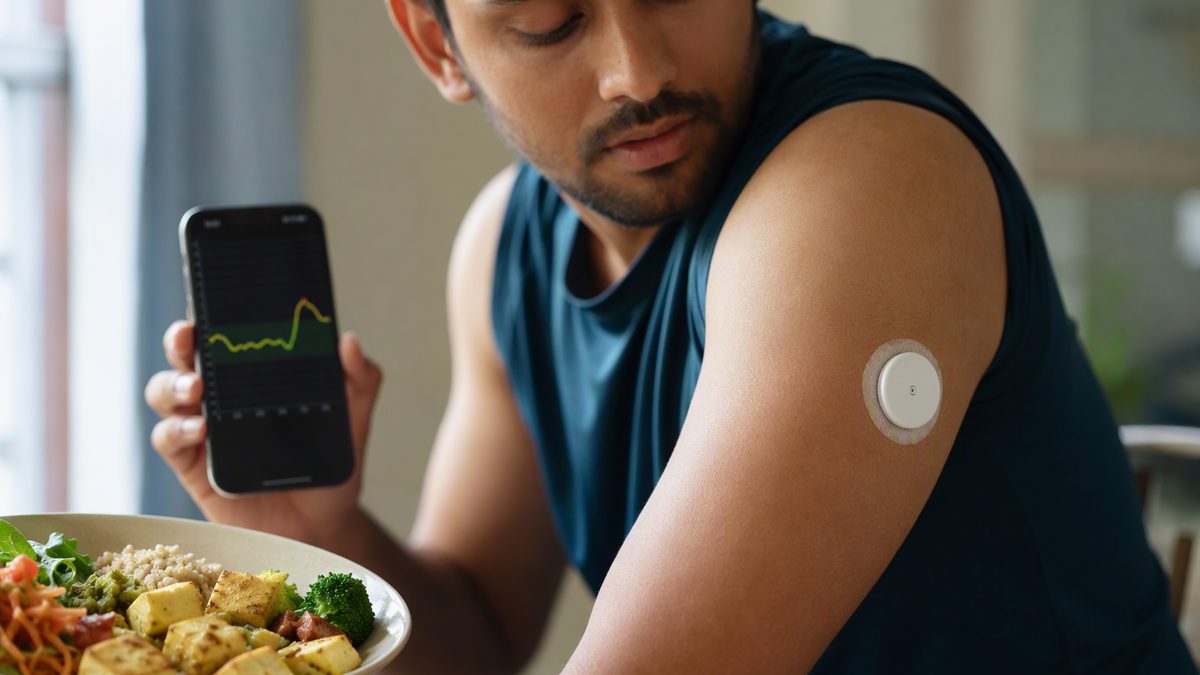
A continuous glucose monitor is a small arm sensor that estimates your glucose every few minutes and streams it to a phone. It was built for people with diabetes who use it under a doctor's care. For a healthy non-diabetic older adult, it is an optional curiosity tool, not a health verdict.
This page explains what the curve actually tells you, why normal meal rises are nothing to fear, where the medication and medical lines fall for your age group, and how to run a short, low-stress experiment if you are curious at all.
1. The Worry It Creates in Older Adults — and Why It Is Usually Misplaced
The single biggest harm a CGM causes in healthy seniors is not physical — it is the food anxiety it can stir up. You eat oatmeal with fruit, watch glucose climb to 150, and conclude you must cut out oats and bananas. That logic is backwards. A transient rise after carbohydrate is normal in everyone, and many of the foods that nudge glucose up — fruit, whole grains, legumes — are exactly the fibre-rich, nutrient-dense choices that protect aging bones, muscle, and gut.
Cutting nutritious foods to chase a flatter line is a real risk, sometimes tipping into an unhealthy fixation on 'safe' eating. For an older adult already at risk of under-eating protein and losing muscle to sarcopenia, restricting your diet around a noisy graph is the opposite of helpful. The curve does not tell you whether a food is healthy, whether you gained fat, or what your insulin is doing. It is one downstream signal, not a master metric.
There is also a physiology point worth holding onto. As we age, the body responds a little more slowly to a carbohydrate meal, so your post-meal rise may look slightly larger or last slightly longer than a younger person's — and that is still within normal variation, not a sign of disease. Watching that gentle curve and panicking would be a mistake. What actually protects an active senior is staying strong, eating enough protein at each meal, and moving daily, none of which a glucose graph can measure or improve.
2. What Counts as Normal on the Curve After 60
Reference ranges were defined for blood drawn and measured in a lab, not for a sensor reading interstitial fluid — so treat CGM numbers as approximate. With that caveat, here is the orientation healthy older adults can use to stay calm rather than alarmed.
| What you see | Typical healthy range | What it means for you |
|---|---|---|
| Fasting (overnight, before breakfast) | 70-99 mg/dL | Normal non-diabetic range |
| Two hours after a meal | Under 140 mg/dL | Considered normal |
| Brief post-meal peak after carbs | 120-160 mg/dL, settling in 1-3 hr | Normal excursion, no action needed |
| Repeated fasting readings 100-125 mg/dL | Pre-diabetic range | Ask your doctor for a proper blood test |
| Fasting 126+ mg/dL on a blood test | Diabetic range | Medical evaluation, not a wearable, decides this |
Notice the last two rows point you toward your clinician, not your app. A consumer sensor cannot diagnose diabetes. If a pattern of high readings shows up, or you have symptoms like unusual thirst, frequent urination, or unexplained fatigue, that is a reason to book a blood test — never to self-diagnose or change anything on your own.
3. Medications, Your Doctor, and the Lines You Should Not Cross
This is the part that matters most for your demographic. If you take any glucose-lowering medication — metformin, insulin, or a sulfonylurea — you are not the audience for casual biohacking, and you should only use a glucose monitor under your clinician's direction. For people on these drugs, glucose data drives dosing and protects against dangerous lows, and a noisy consumer reading is not safe to act on alone.
Blood-pressure medications and statins are common at your age and do not lower glucose, but they are reasons your overall picture belongs in a conversation with your doctor rather than an app. The honest position: bring any curiosity about a CGM to your next appointment. Your annual labs are the real checkpoint. If you want broader habit-building context, our overview of building fitness habits frames the post-meal walk and protein focus that genuinely help, without leaning on a sensor.
One more reminder specific to aging: thirst signals fade with age, so stay on top of hydration regardless of what any device shows. Dehydration, not your breakfast, is far more likely to undermine an active day.
4. A Short, Calm Experiment for the Curious Senior
If you still want to try one, do it as a time-limited experiment rather than a permanent habit. Each sensor lasts about 10-14 days and replacing them indefinitely gets expensive for an optional tool. Two to four weeks of wearing it while you log meals, walks, and sleep will teach you most of what there is to learn about your own responses.
Use the feedback for one constructive purpose: confirming that gentle habits you already know help actually do. Walking for 10-15 minutes after a meal reliably softens the rise. So does pairing carbohydrate with protein and fibre. If watching the curve nudges you toward an after-dinner stroll, that behaviour — not the number — is the benefit. You could adopt the same habit with no sensor at all.
Expect noise. The sensor lags real blood glucose by roughly 5-15 minutes, lying on it overnight can produce a false low, and two sensors on the same arm can disagree. Do not over-read a single odd value or a small wiggle. Watch the broad trend across days, then take off the sensor once you have learned your patterns.
Above all, keep your perspective. For an active senior, the things that genuinely extend strong, independent years are resistance training a few times a week, enough protein, daily movement, good sleep, and staying on top of your medications and check-ups. A glucose sensor is, at most, a brief and optional curiosity sitting far below any of those. If it ever makes you anxious or pushes you to eat less of the wholesome foods that keep you well, that is your signal to take it off and get back to the basics that actually work.
Active Senior Questions About Glucose Monitors
Is it safe to wear a CGM with my blood-pressure or kidney medication?
Blood-pressure medications do not lower glucose, so the sensor itself poses no direct conflict. But because your medications and any kidney concerns shape your whole metabolic picture, raise the idea with your clinician first. If you also take a glucose-lowering drug like metformin or insulin, you should only track glucose under your doctor's direction, since those readings can affect dosing decisions that must stay medically supervised.
I see numbers in the 140s after lunch — am I becoming diabetic?
Almost certainly not from that alone. A rise to 120-160 mg/dL after a carb meal that settles within a few hours is normal physiology in a healthy person. A single curve cannot diagnose diabetes, and a CGM is not a diagnostic device. If your fasting readings repeatedly sit at 100-125, or you have symptoms like excess thirst or fatigue, ask your doctor for a proper blood test rather than worrying over the graph.
Am I too old for this to be useful?
Age is not the barrier. The real question is whether the information will help or just create worry. For a healthy active senior, a short 2-4 week experiment can reveal a few useful patterns, like how a post-meal walk flattens your curve. Indefinite wear rarely adds value and costs money. If watching numbers makes you anxious or pushes you to cut nutritious foods, it is doing more harm than good.
Will tracking glucose help my bone density or muscle?
Not directly. A glucose curve says nothing about bone or muscle. What protects both is resistance training and adequate protein, which older adults often under-eat. If a sensor motivates better habits, fine, but do not let chasing a flat line push you to restrict fruit, whole grains, or legumes, which support healthy aging. Focus your energy on strength work, protein, and your doctor's labs instead.
Disclaimer: This article is for educational purposes only and is not medical advice. Consult a qualified healthcare professional before starting any supplement, nutrition, or training protocol — especially if you are pregnant or breastfeeding, under 18, taking medication, or managing a health condition.
Scientific References & Clinical Sources
- Thomas DT, et al. American College of Sports Medicine Joint Position Statement: Nutrition and Athletic Performance. Med Sci Sports Exerc, 2016. PMID: 26891166
- Jeukendrup AE. Nutrition for endurance sports: marathon, triathlon, and road cycling. J Sports Sci, 2011. PMID: 21916794
- San-Millán I, Brooks GA. Assessment of Metabolic Flexibility by Means of Measuring Blood Lactate, Fat, and Carbohydrate Oxidation Responses to Exercise in Professional Endurance Athletes and Less-Fit Individuals. Sports Med, 2018. PMID: 28623613

