💡 Key Takeaways
- The 'every spike is harmful' myth is false for healthy non-diabetics — a rise to 120-160 mg/dL that settles in 1-3 hours is normal, not a sign you are turning diabetic.
- A bigger glucose response to a food does not make it unhealthy; many fibre-rich, nutritious foods raise glucose more than refined low-fibre ones.
- The genuinely useful finding is that your response to the same food differs from the next person's — but that alone does not label foods good or bad.
- If you have been sedentary for years or take medication, get a basic medical check first, and trust consistency, sleep, and protein over any sensor.
You have probably heard the pitch: strap on a glucose sensor and finally see which foods are 'spiking' you, then cut them out and watch the fat melt off. It is a compelling story, especially when you are restarting fitness in your forties and want a shortcut. It is also mostly wrong, and believing it can push you to ditch perfectly healthy foods.
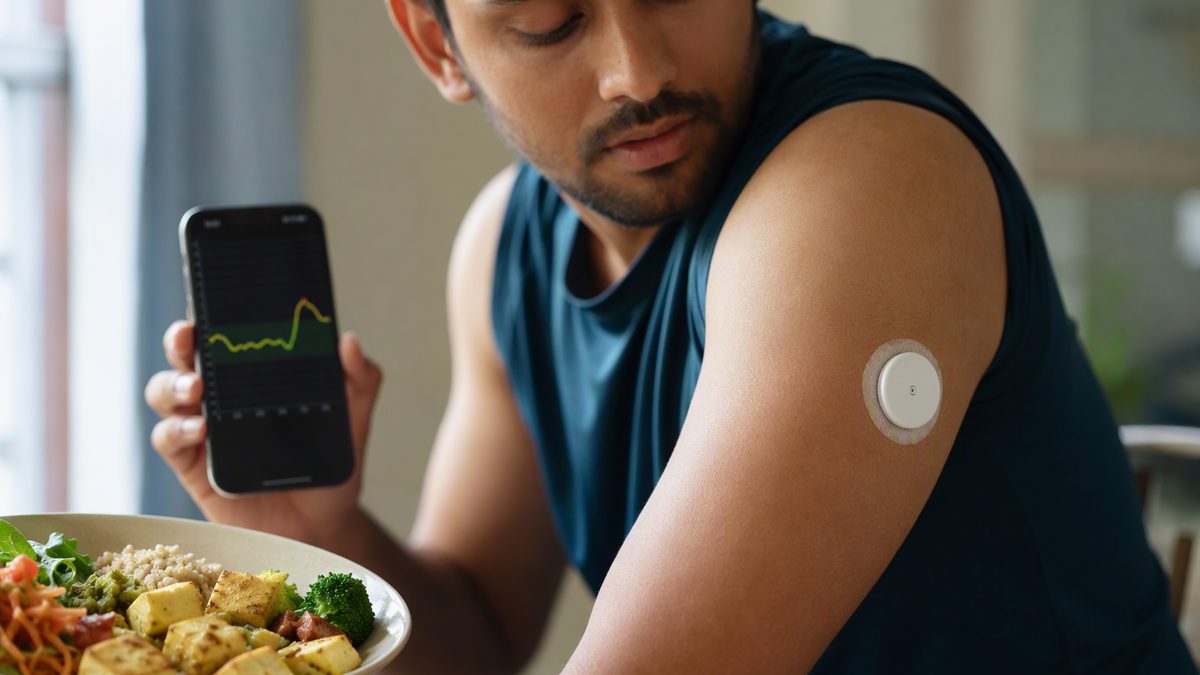
A continuous glucose monitor is an arm sensor that estimates glucose every few minutes. It was designed for managing diabetes under medical care. For a healthy non-diabetic beginner, the marketing has run far ahead of the evidence.
Before you spend money or anxiety on one, it is worth taking apart the central myth — that a flat line is the goal and every spike is damage. Once that falls, you can see clearly what a CGM can and cannot do for someone rebuilding fitness after 40.
1. The Myth a Returning-to-Fitness 40-Something Hears First
The myth goes like this: a flat glucose line is optimal, every spike is harmful, and a bigger spike means you are sliding toward diabetes. For a healthy person without diabetes, all three claims are false. Post-meal rises are normal physiology that happens in everyone who eats carbohydrate. A flat line is neither necessary nor a validated health target if you do not have diabetes.
Where does the myth come from? It borrows the genuine danger of diabetes — chronically elevated, poorly cleared glucose — and wrongly applies it to ordinary meal-to-meal swings in healthy people. Those are not the same thing. The risk that drives heart and metabolic disease is the persistent high glucose of diabetes, not the temporary bump you get after a sandwich. Chasing a perfectly flat curve is not an evidence-based goal, and pursuing it tends to crowd out nutritious foods you should be eating more of.
It is easy to see why the myth lands hard at your stage. Many people restart fitness in their forties after a health scare or a worrying lab result, primed to treat any number that looks 'high' as proof something is broken. A sensor feeds that fear with a fresh reading every few minutes. But a CGM is not a diagnostic tool, and a single curve cannot tell you that you are becoming insulin resistant or diabetic. If you genuinely want to know your metabolic status, the answer is a fasting glucose or HbA1c blood test from your doctor — not a gadget that hands you hundreds of chances a day to misread normal physiology as danger.
2. What the Evidence Actually Shows for Healthy Non-Diabetics
Strip away the hype and one real, interesting finding remains: people respond very differently to the same food. Two people can eat identical rice or bread and one barely moves while the other rises sharply, shaped by insulin sensitivity, gut microbiome, the prior meal, sleep, and stress. That personal variability is the legitimately useful thing a CGM can show. It also means population glycemic-index tables are only a rough guide to your own response.
But honesty matters here. The strong, well-validated CGM evidence lives in diabetes management. For healthy people, the high-quality evidence base is thin: research credibly shows that variability, but there is little robust proof that eating by your glucose curve improves your health, body composition, or fitness. Many bold claims sold around consumer sensors outrun the data. Knowing that protects your wallet and your peace of mind as a beginner.
3. Why a Bigger Spike Doesn't Mean a Worse Food
Here is the trap that catches new CGM users over 40. You see oats, fruit, or beans push your line up and conclude they are bad, while a flatter option like cheese or a low-fibre snack looks 'safe.' The curve has just misled you. A larger glucose rise is not automatically harmful, and many nutrient-dense, fibre-rich whole foods produce real rises while some flatter choices are simply less nutritious.
Glucose is one downstream signal among many. It does not tell you about calorie balance, fat gain or loss, or whether a food deserves a place in your diet. Optimising the curve is not the same as optimising health. For a beginner trying to lose fat and keep muscle, the foods that flatten your graph the most are not the foods that build the body you want.
| Common belief | Honest verdict | What to do instead |
|---|---|---|
| Every spike is harmful | False for healthy non-diabetics | Expect 120-160 mg/dL rises that settle in 1-3 hr |
| A flat line is the goal | Not a validated target without diabetes | Eat for nutrition and protein, not graph shape |
| Bigger spike = becoming diabetic | Not from a single curve; CGM isn't diagnostic | Use a doctor's blood test if genuinely concerned |
| High-glucose foods are 'bad' | Many are fibre-rich and nutritious | Keep fruit, whole grains, legumes |
4. Where It Can Help the Over-40 Beginner — and Where It Can't
There is a narrow, honest upside. The real value of a CGM for a healthy person is behavioural, not diagnostic. Watching the curve can motivate habits you already know help: eating more fibre and protein, not downing a huge refined-carb load alone, and walking after meals, which reliably blunts the rise. If that feedback nudges you to take a 10-minute walk after dinner, good — but the benefit is the behaviour, not the number, and you could adopt it with no sensor.
What it cannot do is replace the basics that actually drive your results in your forties: consistent training, enough sleep, adequate protein, and not getting injured while your connective tissue adapts slower than your muscle. A sensor will not fix soreness, build the habit, or undo the years of life stress weighing on your sleep. If you are curious, run a short 2-4 week experiment, learn a few patterns, then stop. For the bigger picture on what tools earn their place, our guide to the best fitness apps is a calmer starting point than the spike-chasing crowd. And if you have been sedentary for years or take any medication, get a basic medical check before you start training hard.
Beginner-Over-40 Questions on Glucose Tracking
Are glucose spikes actually bad for a healthy 45-year-old?
No. In a healthy person without diabetes, a transient rise after eating carbohydrate is normal physiology. Healthy individuals routinely see post-meal values in the 120-160 mg/dL range that return to baseline within one to three hours. That is not damage and not a sign you are becoming diabetic. The harm linked to glucose comes from the chronically elevated levels of diabetes, not from ordinary meal-to-meal swings. Eat for nutrition, not for a flat graph.
Will eating by my glucose curve help me lose fat?
There is little robust evidence that CGM-guided eating improves body composition in healthy people. A glucose curve does not measure calorie balance or fat gain, so a flatter line does not equal fat loss. What drives results at your age is a consistent calorie and protein approach, resistance training, and sleep. A sensor might motivate a post-meal walk, which is helpful, but you can do that without one. Do not let it crowd out nutritious foods.
Is it too late at my age for any of this to matter?
Starting fitness in your forties absolutely produces real results, but a CGM is not what unlocks them. The high-quality evidence for glucose tracking in healthy adults is thin. Your gains come from consistency, progressive training, protein, and sleep. If you are curious about your personal food responses, a short experiment can be interesting, but treat it as information, not a verdict on which foods to fear. The fundamentals matter far more than the gadget.
Should I get a CGM before I start working out again?
No, and you do not need one at all. What you should do first, if you have been sedentary for years or take medication, is get a basic check from your doctor. Then focus on building the training habit gradually to protect joints and tendons that adapt slower than muscle. A glucose sensor adds cost and potential food anxiety without addressing any of the things that actually limit a returning beginner's progress.
Disclaimer: This article is for educational purposes only and is not medical advice. Consult a qualified healthcare professional before starting any supplement, nutrition, or training protocol — especially if you are pregnant or breastfeeding, under 18, taking medication, or managing a health condition.
Scientific References & Clinical Sources
- Thomas DT, et al. American College of Sports Medicine Joint Position Statement: Nutrition and Athletic Performance. Med Sci Sports Exerc, 2016. PMID: 26891166
- Jeukendrup AE. Nutrition for endurance sports: marathon, triathlon, and road cycling. J Sports Sci, 2011. PMID: 21916794
- San-Millán I, Brooks GA. Assessment of Metabolic Flexibility by Means of Measuring Blood Lactate, Fat, and Carbohydrate Oxidation Responses to Exercise in Professional Endurance Athletes and Less-Fit Individuals. Sports Med, 2018. PMID: 28623613

