💡 Key Takeaways
- Run a focused 2-4 week experiment, not indefinite wear — sensors cost money every 10-14 days and a short window teaches you most of what there is to learn.
- Post-meal rises into the 120-160 mg/dL range that settle in 1-3 hours are normal; a flat line is not a validated health target for a non-diabetic.
- The one habit worth confirming: a 10-15 minute walk after a client dinner reliably blunts the post-meal rise, and you keep it after the sensor comes off.
- Your annual executive physical, with proper blood labs, is the real metabolic checkpoint — a consumer sensor is not diagnostic.
Picture your actual week: a 6am call, a flight, a hotel-gym session squeezed into 30 minutes, then a three-course client dinner with wine you did not choose. Into that chaos someone suggests a glucose monitor that will 'optimise' your metabolism. Your instinct to want one default rule that travels with you is sound. Wearing a sensor forever is not the rule you need.
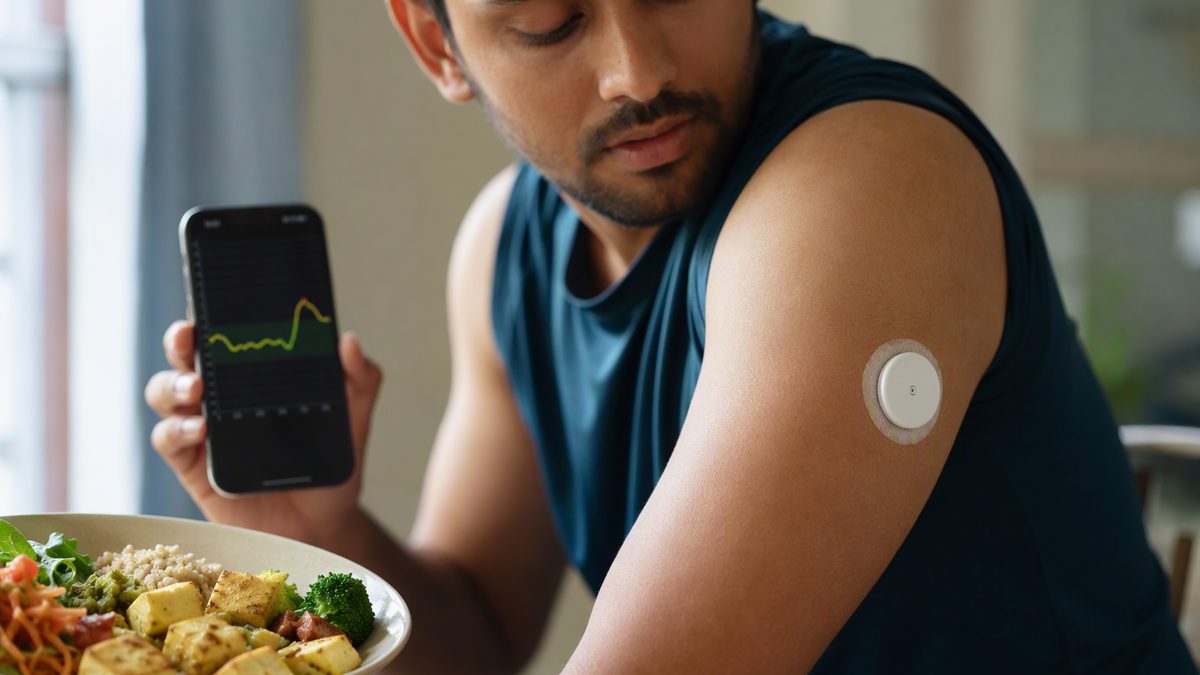
A continuous glucose monitor is an arm sensor estimating glucose every few minutes, built for diabetes management under medical care. For a healthy non-diabetic executive, it is best used as a sharp, time-boxed experiment that hands you a few decisions you can automate, then gets removed.
Here is how to slot a two-week CGM run into a travel-heavy schedule, what the curve genuinely tells you, and where the data stops being useful — so you do not turn every meal into another decision in an already decision-fatigued day.
1. Slotting a Two-Week Run Into a Travel-Heavy Schedule
Treat the sensor like a sprint project with a deadline. A sensor lasts roughly 10-14 days, so one or two sensors covers the whole experiment. Pick a stretch with both a normal week and a travel week so you see how time zones, hotel food, and client dinners actually move your numbers, then take it off. Indefinite wear bundled with a coaching subscription is expensive for an optional insight tool, and you do not need it.
| Window | What to log | Decision to extract |
|---|---|---|
| Days 1-3 (baseline week) | Usual meals, gym, sleep | Your typical fasting and post-meal pattern |
| Days 4-7 (normal week) | Post-meal walks vs none | Whether a 10-15 min walk flattens your rise |
| Days 8-11 (travel/dinners) | Hotel meals, wine, late eating | Which restaurant defaults work for you |
| Days 12-14 (wrap-up) | Confirm 2-3 personal patterns | Set your default rules, remove sensor |
The output is two or three default rules — say, walk after the client dinner, order the protein-and-vegetable option, do not stack a refined-carb load alone late. Those survive airports and time zones without you wearing anything. That is the executive win: fewer decisions, not more.
2. What the Curve Tells a High-Stress Professional — and What It Doesn't
The genuinely interesting finding is personal: your glucose response to the same food differs from your colleague's, shaped by insulin sensitivity, gut microbiome, the prior meal, sleep, and stress. So the airport pasta that barely moves you might spike them. That is worth knowing once. It does not, by itself, label any food good or bad.
What the curve will not tell you matters more for someone prone to over-optimising. It does not measure your calorie balance, fat gain or loss, insulin levels, or long-term metabolic health. A bigger rise after a fibre-rich whole food is not worse than a flat reading after a less nutritious one. Glucose is a single downstream signal, and optimising it is not the same as optimising health. Resist the urge to turn the dashboard into another KPI you must beat.
Stress is your specific confounder. Chronically elevated cortisol from travel and pressure, plus short, intense efforts in the gym, can raise glucose through stress hormones even with no food involved. That is a normal stress response, not metabolic damage — but it will confuse you if you read every bump as a dietary failure.
The personal-variability finding does have one practical payoff for a frequent traveller, though. Population glycemic-index tables are only a rough guide to how your body responds, so the airport meal that a guidebook calls 'safe' may move you more than expected, while a heartier option barely registers. A short experiment can surface a couple of reliable defaults — which hotel breakfasts sit well, whether you do better eating earlier — that you then automate. That is the whole value: a handful of repeatable decisions, not a metric to babysit. Used any other way, the curve just becomes one more thing competing for the attention you are already short on.
3. Client Dinners, Alcohol, and the Post-Meal Walk
The question every executive asks: do client dinners and alcohol ruin this? They do not ruin your health from a single evening, and the curve is not a moral scorecard. What the sensor can usefully confirm is that a short walk after a heavy dinner reliably softens the rise, and that pairing the meal with protein and fibre rather than a lone bread basket does the same. These are habits you already half-know.
Honest framing helps here: the benefit is the behaviour the feedback prompts, not the glucose number. If watching the curve gets you to take a 15-minute walk back to the hotel instead of a cab, that walk is the value, and you keep it after the sensor is gone. For more on the habits that actually compound, our piece on building fitness habits is more useful than any dashboard.
One real caution for your demographic: a sensor does not offset sleep debt or stimulant stacking. Watching glucose while running on four hours of sleep and a third coffee is optimising the wrong variable. Sleep and stress management are the metabolic levers that matter; the curve is downstream of both.
4. When to Stop Tracking and Just Get the Bloodwork
Know the exit conditions. Once you have your two or three default rules, take the sensor off — most healthy users do not need continuous wear, and a few weeks delivers most of the learning at a fraction of the perpetual cost. Dragging it on indefinitely mostly buys you more chances to over-interpret noise.
And it has noise. The sensor lags real blood glucose by 5-15 minutes, lying on it overnight can fake a low, warm-up periods are unreliable, and two sensors can disagree. Treat the curve as relative trends for you, not precise absolute numbers, and never read a single odd value as a diagnosis. A consumer CGM is not a diagnostic device.
Your real metabolic checkpoint is the executive physical you probably already get. If a CGM ever shows persistently high readings, or you have symptoms like excess thirst, frequent urination, or unexplained fatigue, that is a reason to get proper blood testing from a physician — not to self-treat from an app. The validated tools for diagnosis are blood labs, ordered and interpreted by a clinician.
Executive Questions on Glucose Tracking
What's the minimum effective way to use a CGM when I travel constantly?
Run one tight 2-4 week experiment spanning a normal week and a travel week, log meals and post-meal walks, then extract two or three default rules and remove the sensor. You do not need to wear it indefinitely — a sensor lasts only 10-14 days and perpetual use is expensive for an optional tool. The goal is automatable decisions you can carry through any airport, not a permanent dashboard to monitor.
Does alcohol at client dinners ruin the whole thing?
No. A single evening does not undo your metabolic health, and the curve is not a moral scorecard. What the data can confirm is that a 10-15 minute walk after dinner and choosing protein and fibre over a lone bread basket soften the rise. Keep those habits and stop fixating on individual readings. The bigger risk to your metabolism is chronic sleep debt and stress, neither of which a sensor fixes.
Can I keep this consistent across time zones?
You do not need to. The point of a short experiment is to learn your patterns once, then act on default rules that travel without any device. A CGM run during a couple of normal and travel weeks shows you how dinners and jet lag move your glucose, after which the sensor adds little. Trying to maintain a flat curve across time zones is chasing a target that is not even validated for healthy non-diabetics.
What single metric should I actually watch?
Not your glucose curve. For a healthy executive, sleep and stress are the metabolic levers that matter most, and your annual physical's blood labs are the real checkpoint. A CGM is a one-time learning tool, not an ongoing KPI. If you want one number to manage, manage your sleep consistency. Persistent high readings or symptoms warrant a doctor's blood test, never self-treatment from a wearable's app.
Disclaimer: This article is for educational purposes only and is not medical advice. Consult a qualified healthcare professional before starting any supplement, nutrition, or training protocol — especially if you are pregnant or breastfeeding, under 18, taking medication, or managing a health condition.
Scientific References & Clinical Sources
- Thomas DT, et al. American College of Sports Medicine Joint Position Statement: Nutrition and Athletic Performance. Med Sci Sports Exerc, 2016. PMID: 26891166
- Jeukendrup AE. Nutrition for endurance sports: marathon, triathlon, and road cycling. J Sports Sci, 2011. PMID: 21916794
- San-Millán I, Brooks GA. Assessment of Metabolic Flexibility by Means of Measuring Blood Lactate, Fat, and Carbohydrate Oxidation Responses to Exercise in Professional Endurance Athletes and Less-Fit Individuals. Sports Med, 2018. PMID: 28623613

