💡 Key Takeaways
- A glucose curve can wrongly flag fiber-rich plant staples — oats, fruit, legumes — when those are exactly the foods fuelling your training.
- A larger rise doesn't mean a worse food; many of the most nutrient-dense plant choices raise glucose, and that's normal.
- Real value is narrow: spotting personal responses and confirming a walk or more protein blunts your own curve over a 2-4 week test.
- Glucose isn't the lab that matters for you — B12, ferritin and iron status deserve far more of your monitoring attention.
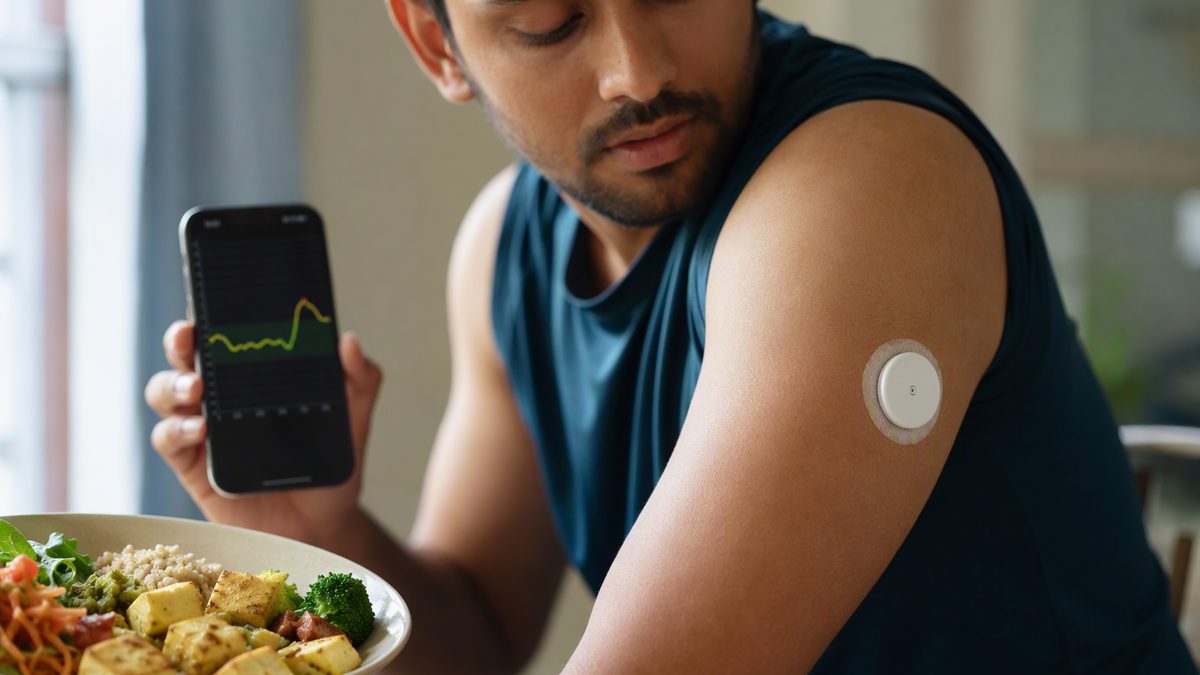
Here is the trap a vegetarian athlete walks into with a continuous glucose monitor. You eat the way you should — oats and berries before training, lentils and rice at dinner, fruit as fuel — and the sensor lights up with rises after nearly all of it. Read naively, the graph seems to indict the most wholesome plant foods on your plate, the very ones doing the fuelling. Suddenly you are tempted to cut the banana, the beans, the whole grains, in pursuit of a flatter line.
That instinct is the problem, and it is backwards. A rise after carbohydrate is normal physiology in every healthy person, and a bigger rise does not make a food worse. Many fiber-rich, nutrient-dense plant staples produce real glucose excursions while being excellent choices; some flatter options are simply less nourishing. For an athlete whose whole game is getting enough quality nutrition without meat, letting a graph demonize plant foods is a genuine risk worth naming up front.
This page shows where a CGM actually helps you, where it misleads, and why the labs that truly matter for a vegetarian athlete are not on that screen at all.
1. The problem: a graph that demonizes your best foods
Picture your typical training-day plate: oatmeal with fruit, a big lentil-and-rice bowl, dates around a workout, whole-grain toast. Every one of those raises glucose, and a CGM dutifully draws the rises. If you have absorbed the popular framing that spikes are bad and a flat line is the goal, the graph reads like a list of foods to avoid — which would gut the carbohydrate base your training runs on.
The framing is false for a healthy person. Post-meal glucose routinely climbs into the 120 to 160 mg/dL range and sometimes briefly higher after a substantial carb meal, then drifts back toward baseline within one to three hours. That is your body fuelling itself, not damaging itself. The harm that glucose research actually flags comes from the chronically elevated glucose of diabetes — not from a normal excursion after a bowl of oats in someone who clears it fine.
Over-restriction is the real danger here, and it is sharper for you than for most. Consumer CGM use can fuel food anxiety and orthorexia — an unhealthy fixation on 'safe' eating — and the foods most likely to get cut are fruit, whole grains and legumes, which happen to be cornerstones of a good vegetarian athlete's diet. If you have any history of disordered eating, be especially cautious with a CGM, or skip it. A flatter graph is not a better-fuelled athlete.
2. What the curve does show: your personal responses
Used well, a CGM does have one genuinely interesting thing to offer, and it is not a 'good food / bad food' list. The most robust finding from CGM research in healthy people is that the same food moves different people very differently — two athletes eat identical rice and one's glucose climbs while the other's barely moves. Your response is shaped by the food's composition, your insulin sensitivity, your gut microbiome, your previous meal, your activity and your sleep.
For a vegetarian athlete that personal variability can be mildly useful. You might learn that your morning oats sit better paired with more protein or fat, that a handful of nuts alongside fruit changes the shape of your curve, or that a short walk after a big legume meal blunts the rise. Those are reasonable, sustainable tweaks — and notice they are all behavioral, the kind of broadly sensible habits the feedback nudges you toward rather than truths hiding in the number itself.
What the curve cannot do is rank your foods by health. It does not measure your protein quality, your leucine intake, your micronutrient status, or whether a meal is nutritious. A plant meal that raises glucose more than a processed snack is very often the better meal. Glucose is one downstream signal, not a verdict on a food — and for a vegetarian athlete, the signals that actually matter live elsewhere.
3. A short experiment, and the labs that matter more
If you do try a CGM, run a tight 2-to-4-week experiment, log your meals and activity, learn a couple of personal patterns, then take it off — sensors last only 10 to 14 days each and the data is noisy anyway, carrying a 5-15 minute interstitial lag and measurement error in the high-single to low-double-digit percent range. But the more important monitoring for you is not on the sensor at all. Here is where your attention actually belongs.
| What to monitor | Why it matters for you | How to check |
|---|---|---|
| Vitamin B12 | Requires supplementation on a meat-free diet | Annual blood test; supplement reliably |
| Ferritin / iron | Plant iron is non-heme, lower absorption | Annual labs, especially if fatigued |
| Glucose (optional) | Shows personal food responses, not food quality | Optional 2-4 week CGM experiment |
| Leucine per meal | Plant protein is lower in leucine per serving | Plan protein by leucine, not just grams |
| Energy availability | Under-fuelling risk if you fear carb foods | Track intake vs. training, not the graph |
The honest hierarchy: your B12 and iron status, your protein and leucine intake, and simply eating enough to fuel training matter far more than any glucose curve. A CGM is an optional, time-limited curiosity for you; your annual labs are the monitoring that protects your performance and health. If you want a broader view of tracking that actually moves the needle, our guide to the best fitness apps covers the tools worth your time.
4. Honest limits and when it's a doctor's job
Keep the boundaries clear. The strong, validated CGM evidence is in diabetes management; for healthy non-diabetic people the high-quality evidence that CGM-guided eating improves health, body composition or performance is thin, and many marketed claims outrun the data. So treat anything a CGM tells you as a low-stakes curiosity, not a mandate to overhaul a diet that is already serving your training.
The medical line is firm. A consumer CGM is not a diagnostic device and cannot tell you whether you have pre-diabetes or diabetes — that comes from validated blood tests ordered by a clinician. Persistently high readings, or symptoms like excessive thirst, frequent urination, unexplained weight loss or unusual fatigue, warrant a doctor and proper testing, never a self-diagnosis from the app. And if you have diabetes or take glucose-lowering medication, none of this self-experiment framing applies — your CGM use must be directed by a clinician. For a healthy vegetarian athlete, the takeaway is simple: do not let a glucose graph push your best plant foods off the plate, and put your monitoring energy into the labs that genuinely matter.
Plant-based questions about glucose and the data
My CGM spikes after oats and fruit — should I cut them?
No. Oats, fruit and other fiber-rich whole foods raise glucose because they're fuel, and that rise is normal physiology, not damage. Cutting them to flatten a graph would strip carbohydrate and nutrients your training depends on. A bigger rise doesn't make a food worse; many of your most nutritious plant staples raise glucose more than a processed snack would. Keep them and ignore the alarm the graph seems to raise.
Do vegetarians respond differently on a CGM?
Not in a special vegetarian way — everyone's glucose response to the same food varies a lot, shaped by gut microbiome, insulin sensitivity, sleep and the prior meal. A CGM can show your personal responses, which is mildly useful, but it can't tell you a plant food is 'bad.' The differences that actually matter for vegetarian athletes — B12, iron, leucine — don't show up on a glucose curve at all.
Which should I monitor instead of glucose?
Your B12 and ferritin/iron status top the list — B12 needs supplementation on a meat-free diet and plant iron absorbs less well, so annual labs matter. Track your protein by leucine rather than just grams, and make sure you're eating enough to fuel training. Those checks protect your health and performance far more than a glucose graph, which is at best an optional, short-term curiosity for you.
Is a CGM worth it for a healthy vegetarian athlete?
Mostly optional. The evidence that CGM-guided eating helps already-healthy people is thin, and the real risk for you is over-restricting nutritious plant foods to chase a flat line. If you're curious, run a 2-4 week experiment, learn a couple of personal patterns, then take it off. Put the money and attention you'd spend on perpetual sensors into your annual labs and simply eating enough instead.
Disclaimer: This article is for educational purposes only and is not medical advice. Consult a qualified healthcare professional before starting any supplement, nutrition, or training protocol — especially if you are pregnant or breastfeeding, under 18, taking medication, or managing a health condition.
Scientific References & Clinical Sources
- Thomas DT, et al. American College of Sports Medicine Joint Position Statement: Nutrition and Athletic Performance. Med Sci Sports Exerc, 2016. PMID: 26891166
- San-Millán I, Brooks GA. Assessment of Metabolic Flexibility by Means of Measuring Blood Lactate, Fat, and Carbohydrate Oxidation Responses to Exercise in Professional Endurance Athletes and Less-Fit Individuals. Sports Med, 2018. PMID: 28623613

