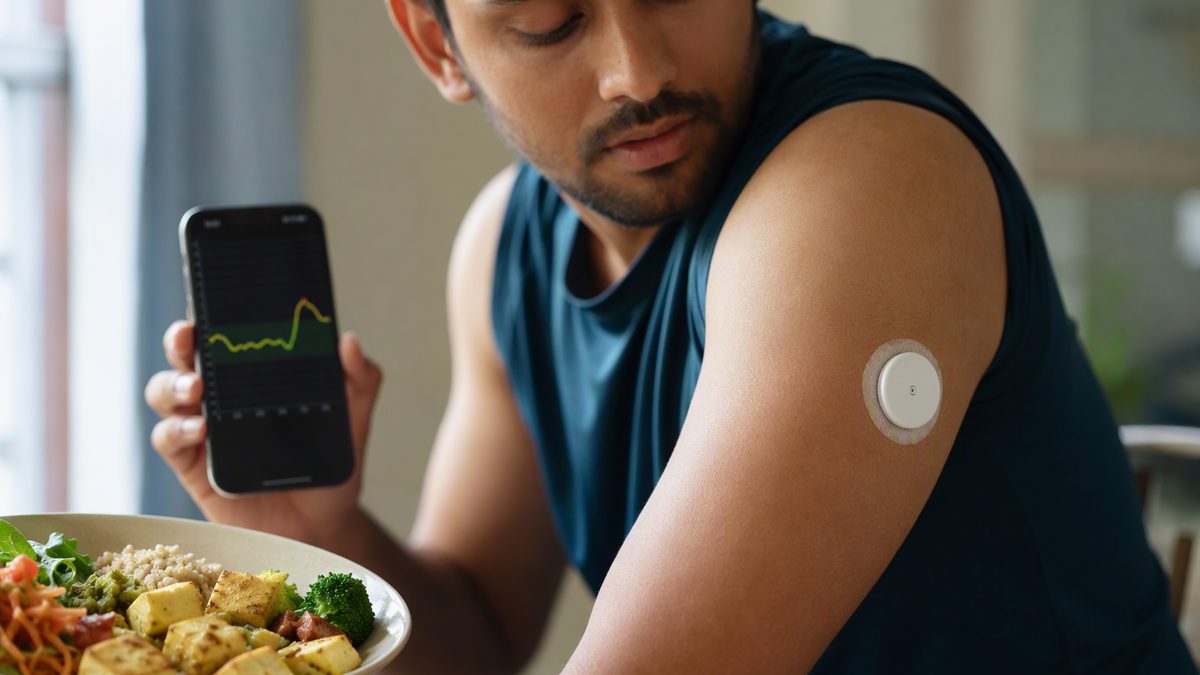
💡 Key Takeaways
- For a healthy young player, a CGM is generally inappropriate — it risks food anxiety more than it delivers any real edge.
- Glucose rises after fruit, rice and other fuel foods are normal; teaching a growing player to fear them steers them away from fuel they need.
- Decisions like this belong to parents and a clinician, not a teammate's recommendation or an influencer's post.
- Tournament weekends run on real food, fluids and sleep — sandwiches and water beat any graph on the sideline.
Picture the real week of an academy player. Monday off, Tuesday and Thursday club practice, Wednesday school PE, a match Saturday, and several weekends a season a tournament with three or four games in two days. Somewhere in that schedule a teammate shows off a glucose monitor on their arm, and now a parent is wondering whether it belongs in the kit bag too.
Here is the honest answer before we walk through the week: for a healthy young player with no diabetes, a continuous glucose monitor generally does not belong anywhere in that schedule. The likely result is not better performance but a new anxiety about food during the exact years a growing athlete needs to eat freely and well. The strong evidence for CGMs is in managing diabetes under a doctor — not in fine-tuning a 14-year-old's snacks.
So this page maps the club week the way it should actually run: food-first, with parents and a clinician steering any decision, and the sideline cooler doing the work a sensor never could.
1. Walking the club week: where fuel really fits
Run through the schedule and you can see the fuelling needs without any sensor. Practice nights need a real after-school meal beforehand and a snack with carbs and protein after. School PE on a non-training day still needs lunch that did not get skipped. Match day needs a carbohydrate-forward meal two to three hours before kickoff, and the days between games need ordinary, generous eating to keep the tank full.
None of that requires a glucose graph. Soccer is a repeated-sprint game — dozens of maximal accelerations across a 70 to 90 minute match with incomplete recovery between them — and the fuel for those bursts is built by eating enough carbohydrate consistently, not by reading a curve. A young player in a growth spurt has genuinely large energy needs, and the priority every single week is simply getting enough food, sleep, and recovery, not optimizing the shape of a line on a phone.
What a CGM would add to this week is mostly noise and worry. It does not measure whether your child is fuelled for Saturday, recovered from Thursday, or growing well. It measures one downstream signal, imperfectly, and invites a young athlete to overthink meals that should be straightforward. The club week is built on food and rest; a sensor sits outside it.
2. The food-anxiety problem, in a growing player
This is the part that matters most, so it gets its own section. The single biggest harm of a healthy young person wearing a CGM is psychological: it turns every meal into a pass-or-fail test. That mindset feeds food anxiety and orthorexia — an unhealthy fixation on 'clean' or 'safe' eating — and the foods most likely to get cut are fruit, whole grains, rice and other fuel that raise glucose by design. For a 12-to-18-year-old still forming their relationship with food, that is a serious risk, not a minor side effect.
It rests on a myth, too. The idea that every glucose spike is bad and a flat line is the goal is false for a healthy person. A rise after carbohydrate is normal physiology in everyone, and post-meal glucose routinely climbs into the 120 to 160 mg/dL range before settling back within one to three hours. That is a body fuelling itself, not damaging itself. Teaching a growing soccer player to fear that rise would push them toward eating less of exactly what powers their sprints and their growth.
Add that the data is noisy anyway — a 5 to 15 minute lag behind real blood, plus measurement error in the high-single to low-double-digit percent range — and you have a fragile, anxiety-prone basis for a young athlete to judge their food. The downside is real and the upside is thin. For a healthy player, that math points clearly away from a CGM.
3. The food-first match-week plan (no sensor required)
Here is the plan that actually serves a young player across a club week and a tournament weekend. It costs a fraction of a sensor subscription, builds habits that last, and needs no graph.
| Day | What to fuel | The food, concretely |
|---|---|---|
| Practice day (Tue/Thu) | Pre-practice meal + recovery snack | Rice or pasta meal before; chocolate milk + fruit after |
| Match day | Carb meal 2-3 hr before kickoff | Oatmeal or toast + banana; water through the day |
| Between games | Refill glycogen and fluids | Sandwich, fruit, pretzels; steady water, not slushies |
| Tournament weekend | Real food in a cooler, every game | Sandwiches, fruit, salty snacks, plenty of water |
| Every night | Sleep, the real recovery tool | 8-10 hours; protect it like training |
Tournament weekends are won and lost on this, not on glucose. What collapses across four games in two days is glycogen, fluid and sleep — and the classic failure is a snack-bar diet of fries and slushies. Pack a cooler of real food, drink on a schedule rather than by thirst, and respect the event's heat policy, because young bodies regulate temperature less efficiently than adults in summer tournaments. A graph on the sideline would not change a single one of those levers. For building the habits that make this automatic, our guide to building fitness habits is a better investment than any wearable.
4. Whose decision this is — and the real medical flags
The framing that keeps a young athlete safe is simple: this is a parent-and-clinician decision, not a peer-driven one. Any nutrition tech or supplement choice at this age belongs with the adults who can weigh it properly — not a teammate's recommendation, not an influencer's affiliate link, and not a pro player's posted routine, which is built on an adult body with full-time support staff. Secrecy is the warning sign; if a player is hiding what they are using from parents or coaches, the supervision that makes any of it defensible is gone.
Know the genuine medical flags, too, because they have nothing to do with biohacking. A consumer CGM is not a diagnostic device and cannot tell anyone whether a child has diabetes. If a player shows real symptoms — constant thirst, frequent urination, unexplained weight loss, unusual fatigue — that is a doctor and a proper blood test, urgently, never an app interpretation. And growth-spurt pain at the front of the knee or the heel — Osgood-Schlatter or Sever's territory — is a medical conversation and a reason not to play through it, again with nothing for a glucose monitor to offer. For a healthy young soccer player the bottom line holds: skip the CGM, feed the schedule, protect the sleep, and let parents and a clinician make the calls.
Sideline questions from players, parents and coaches
Is a CGM appropriate for a healthy young soccer player?
Generally no. For a healthy player with no diabetes, a glucose monitor offers little real benefit and carries a real risk — it can turn eating into a constant test and breed food anxiety during the years a young athlete needs to eat freely to fuel growth and sport. The strong CGM evidence is in diabetes care under a doctor. Money and attention go further on real food and sleep.
Should fueling come from food instead of tracking glucose?
Yes, clearly. A carbohydrate-forward meal before training and matches, a recovery snack after hard sessions, and generous everyday eating fuel a young player far better than any graph. A bigger glucose rise after fruit or rice doesn't make those foods bad — they're the fuel. Fix the meals and the sleep first; that's the whole job at this age, and it needs no sensor.
How do we handle a 4-game tournament weekend?
With a cooler of real food, not a sensor. Pack sandwiches, fruit, salty snacks and plenty of water; drink on a schedule rather than by thirst, and respect the event's heat policy, since young bodies handle summer heat less efficiently than adults. What fades across four games is glycogen, fluid and sleep — fix those between games and the weekend takes care of itself.
Whose decision is it to use one, and when is it medical?
It's a parent-and-clinician decision, never a teammate's or an influencer's. Keep adults in the loop on any nutrition tech. And know the real flags: a CGM can't diagnose anything, so symptoms like constant thirst, frequent urination or unexplained weight loss need a doctor and a blood test, while growth-spurt knee or heel pain is medical too — none of which a glucose monitor addresses.
Disclaimer: This article is for educational purposes only and is not medical advice. Consult a qualified healthcare professional before starting any supplement, nutrition, or training protocol — especially if you are pregnant or breastfeeding, under 18, taking medication, or managing a health condition.
Scientific References & Clinical Sources
- Thomas DT, et al. American College of Sports Medicine Joint Position Statement: Nutrition and Athletic Performance. Med Sci Sports Exerc, 2016. PMID: 26891166
- Jeukendrup AE. Nutrition for endurance sports: marathon, triathlon, and road cycling. J Sports Sci, 2011. PMID: 21916794
- San-Millán I, Brooks GA. Assessment of Metabolic Flexibility by Means of Measuring Blood Lactate, Fat, and Carbohydrate Oxidation Responses to Exercise in Professional Endurance Athletes and Less-Fit Individuals. Sports Med, 2018. PMID: 28623613

