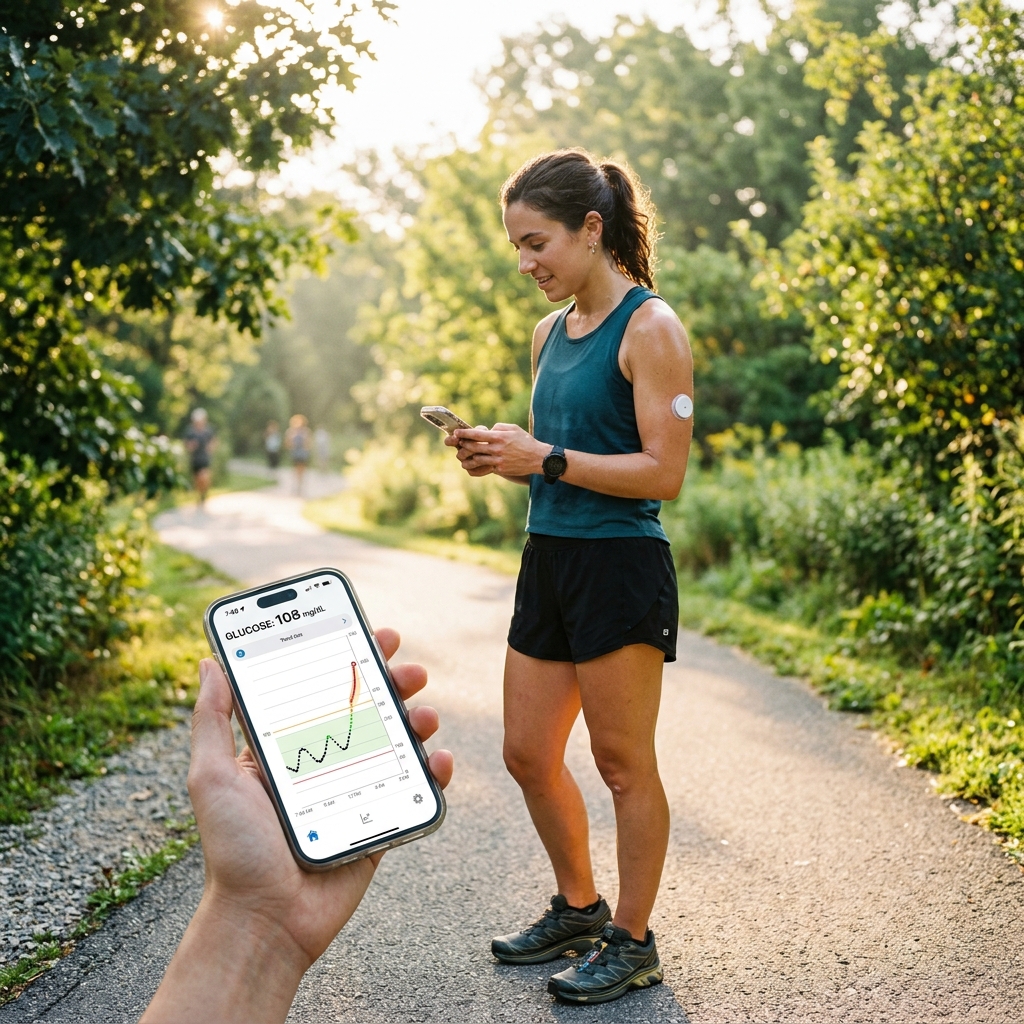
Strapping a small sensor to your upper arm and watching your blood sugar respond to a bowl of oatmeal, a hard interval session, or a poor night's sleep used to be the exclusive domain of people managing diabetes. In 2026, that picture has changed completely. Continuous glucose monitors — CGMs — are now widely available without a prescription in many countries, and a growing slice of the fitness and preventive-health community is wearing them to understand how their metabolism actually works, not because anything is wrong. Whether this trend represents a genuine breakthrough in self-knowledge or a fast lane to health anxiety depends almost entirely on how you interpret what you see.
What a CGM Actually Measures
A CGM is a small patch containing a hair-thin filament that sits just beneath the skin's surface, typically on the back of the upper arm or the abdomen. Every one to five minutes, it reads glucose concentration in the interstitial fluid — the fluid surrounding cells — and transmits that value to your phone. Because interstitial glucose lags behind blood glucose by roughly five to fifteen minutes, the readings are not identical to a finger-prick test, but they are close enough for trend analysis. Most consumer devices are factory-calibrated and require no finger-prick confirmation unless you feel symptoms that contradict the reading. Sensors last between ten and fifteen days before you swap them out.
What you see on the app is a rolling line graph of glucose values across the day and night. You can zoom into the two hours after a meal, overlay it with your sleep data, or compare Monday's spin class to Thursday's strength session. That continuous visibility is what makes CGMs interesting to healthy people — not any single number, but the pattern.
What Meals Reveal
The most immediate and startling thing most first-time CGM users notice is how differently their body responds to foods they assumed were equivalent. Two meals with similar calorie counts and even similar carbohydrate totals can produce very different glucose curves depending on fiber content, cooking method, fat and protein content, meal timing, and individual gut microbiome composition. Research in this area — particularly work on personalized glycemic responses — has consistently shown that population-level glycemic index tables are a rough approximation at best.
Practical observations people commonly report:
- White rice eaten alone spikes glucose more sharply than the same amount eaten with vegetables, protein, and fat — the macronutrient context matters as much as the carb quantity.
- Cooling and reheating starchy foods like potatoes and pasta increases resistant starch content, which tends to blunt the glucose rise.
- A walk of even ten to fifteen minutes after eating meaningfully flattens the post-meal curve by driving glucose into working muscle.
- Eating the same breakfast at 7 a.m. versus 11 a.m. can produce different responses due to circadian variation in insulin sensitivity, which tends to be highest in the morning.
- Alcohol the night before often disrupts the following morning's fasting glucose, reflecting the liver's overnight workload.
None of this requires you to eliminate foods or optimize obsessively. The value is in recognizing which combinations and sequences work well for your own physiology, then applying that knowledge with proportion rather than rigidity.
Exercise: The Complexity Worth Understanding
Exercise has a profound effect on glucose, and a CGM makes that effect visible in real time. The direction and magnitude of the response depend heavily on exercise type, intensity, duration, and your glycogen status going in.
Aerobic exercise at moderate intensity typically causes a gradual decline in glucose as muscle tissue absorbs it. You may see values drop into the 70s mg/dL during a long run, which is entirely normal for a healthy person without diabetes. High-intensity intervals or heavy strength work often produce a temporary glucose spike — sometimes into the 140–160 mg/dL range — driven by the stress hormone surge that signals the liver to release stored glucose for immediate fuel. This spike is physiologically normal and resolves quickly once the hormonal signal clears.
Seeing a spike during a hard workout and interpreting it as "my workout made my blood sugar dangerously high" is one of the most common misreadings among new CGM users. Context is everything. A transient exercise-induced spike that returns to baseline within an hour is categorically different from chronic post-meal elevations that stay elevated for two or three hours. A CGM shows you both; learning to read them differently is the essential skill.
Sleep and Stress: The Underrated Drivers
Many people are surprised to discover that what disrupts their glucose most dramatically is not food — it is sleep and stress. A night of five or six hours of sleep, even in an otherwise healthy person, reliably degrades insulin sensitivity the following day. You may notice that the same breakfast produces a higher and more prolonged glucose response after a short night compared to after eight hours of quality sleep. This is not a CGM quirk; it reflects well-documented biology around cortisol, growth hormone, and glucose regulation during sleep.
Chronic psychological stress activates the hypothalamic-pituitary-adrenal axis, elevating cortisol, which in turn raises fasting glucose and blunts insulin sensitivity. People who wear a CGM during stressful work periods often see their overnight and morning glucose values creep upward compared to calmer stretches, even without changing diet or exercise. This feedback can be motivating — it makes the physiological cost of chronic stress concrete and visible, which many people find more compelling than abstract advice to "manage stress better."
Acting on the Data Without Overreacting to It
The most important thing to internalize before putting on a CGM is that glucose variability is normal and expected in healthy people. Values fluctuate across the day in response to meals, movement, stress, temperature, and even posture. A healthy non-diabetic person will routinely see post-meal spikes into the 120–140 mg/dL range, and some will exceed 140 mg/dL after a particularly carbohydrate-dense meal. This does not mean anything is wrong. Clinical thresholds used to diagnose prediabetes — 140 mg/dL two hours after a standardized glucose challenge — are not the same as a CGM value seen fifteen minutes after a large bowl of rice.
Treating every spike as a crisis creates anxiety without producing any useful behavioral change. A more productive framework focuses on patterns across days and weeks rather than individual data points:
- Time in range — the percentage of readings falling between roughly 70 and 140 mg/dL — is a more meaningful metric than any single peak value.
- Post-meal return to baseline — how quickly glucose returns to your pre-meal level after eating is often more informative than the peak itself.
- Fasting and overnight trends — consistently elevated fasting values or a glucose pattern that rises through the night (rather than dipping) can be worth discussing with a doctor.
- Exercise response consistency — tracking whether high-intensity sessions affect your recovery glucose over multiple days helps you calibrate fueling and training load.
- Sleep correlation — systematically comparing nights of adequate sleep versus short sleep builds a personal, data-backed case for prioritizing rest.
The Balanced Case for Caution
CGMs are not without downsides for the general population. The most significant risk is over-interpretation leading to dietary restriction or anxiety — patterns that, in susceptible individuals, can shade toward disordered eating. If you find yourself refusing meals because you are worried about a spike, or spending mental bandwidth tracking glucose instead of enjoying food and social situations, the sensor is not serving you. The tool is meant to produce a period of learning — ideally one or two wear cycles — that informs durable habits, not a permanent surveillance state you manage meal by meal.
There is also a cost consideration. Consumer CGMs remain expensive, and insurance coverage for non-diabetic use is limited in most markets. Spending that money on a coach, better sleep conditions, or higher-quality food may yield comparable or better metabolic outcomes for many people. CGMs are powerful, but they are one input among many, not a replacement for the foundational behaviors that drive long-term health.
Clinicians have also noted that the normative data on what constitutes a healthy glucose pattern for non-diabetics across different demographics, fitness levels, and ages is still maturing. Interpret your data against reasonable general benchmarks, and loop in a physician or registered dietitian if you see sustained patterns that concern you rather than trying to self-diagnose from a consumer device.
Integrating CGM Data Into Your Fitness Practice
The real power of CGM data emerges when you stop looking at glucose in isolation and start layering it with the rest of your health picture — your training load and recovery, your sleep architecture, your stress markers, and your performance trends over time. A glucose spike that looks alarming in isolation makes complete sense when you see it happened at the end of a four-day training block with poor sleep. A persistently flat and stable glucose pattern on a recovery week confirms that your body is handling the nutrition and rest well. Neither insight is available from glucose alone.
When you bring your CGM patterns into UltraFit360 alongside your workout data, sleep scores, and readiness metrics, the AI coach can help you connect these dots — identifying which combinations of training load, meal timing, and recovery are producing your best metabolic and performance outcomes, and adjusting your plan accordingly rather than treating each variable in isolation.
Transform Your Fitness Journey
Log your workouts, track your diet, and get AI coaching insights — all with UltraFit360.