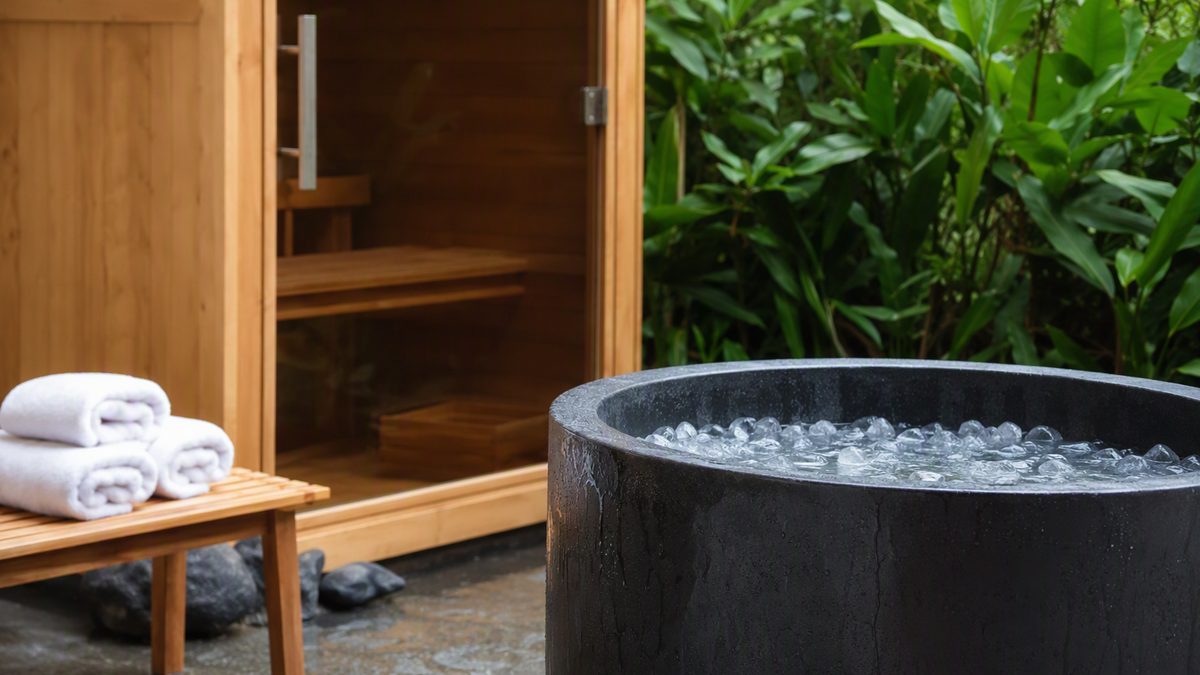
💡 Key Takeaways
- One default rule covers most of it: never cold-plunge right after lifting — cold blunts strength and muscle gains, so reserve it for non-lifting days.
- Sauna is the time-efficient pick: 15-20 minutes, no impact on your gym results, and a promising (observational) link to heart health for high-stress, high-mileage professionals.
- Across time zones and hotel gyms, anchor the rule to the session, not the clock: heat near lifting is fine, cold goes on cardio or rest days.
- Travel risk is real — never sauna or plunge after client-dinner alcohol, never solo where fainting could happen, and skip both if your cardiovascular status is unclear.
Tuesday: 6am call with Singapore, three back-to-backs, a flight, a client dinner, a 20-minute hotel-gym window if you are lucky. Recovery for you cannot be a project. It has to be a default rule that survives airports and decision fatigue. So let us drop heat and cold straight into a week that looks like yours, rather than describing them in the abstract.
The single rule worth memorizing: the cold plunge and your lifting session do not belong together. Everything else is detail. Sauna is the modality that fits an executive's constraints best — short, repeatable, and free of the catch that makes cold tricky.
Below, we map exactly where each one slots into a packed, unpredictable week, then cover the science behind the rule and the travel-specific cautions that actually matter when you are doing this in a different hotel every night.
1. Where Heat and Cold Slot Into Your Week
Picture a typical block. Monday and Thursday you lift in the hotel or home gym. Tuesday and Friday you do something aerobic — incline treadmill, a bike, a fast walk between meetings. The weekend is freer. Here is the placement that protects your results without adding decisions.
On your two lifting days, if you want heat, take the sauna afterward — it does nothing to undermine the strength work. Keep the cold plunge entirely off these days. On your aerobic or rest days, a cold plunge is fair game if you enjoy the alertness and mood lift; the muscle-blunting concern is tied to resistance training, and endurance adaptations appear far less affected. That is the whole system: heat anywhere, cold only away from lifting. It survives jet lag because it is anchored to what you trained that day, not to a time on the clock. No matter the time zone, you always know whether you lifted — so you always know whether cold is on the menu.
One refinement for the road. When your only window is a hotel gym with a sauna but no plunge, you lose nothing — heat is the higher-value option for you anyway, and it pairs fine with whatever you trained. When a property has a cold plunge but you lifted that morning, skip it without a second thought; the plunge is not the prize, your strength adaptation is. Build the rule once and you stop spending scarce decision-making on it entirely, which is the real win for a brain already running on fumes by 6pm.
2. The One Rule That Protects Your Gym Time
You train for return on minutes, so understand why this rule earns its place. In a controlled study, people who cold-immersed right after resistance sessions for twelve weeks gained less muscle and strength than those who did light active recovery instead. Cold suppresses the post-workout inflammatory and signaling response — and that response is part of how muscle remodels and grows. Dampen it at the wrong moment and you are paying gym time for a worse result.
Sauna does not carry this problem. Heat is not known to impair strength or size adaptation, and it may even support endurance through heat acclimation — repeated heating can expand plasma volume and improve thermoregulation. There is also a transient growth-hormone bump with acute heat, though treat that as a minor footnote rather than a headline. The executive read: heat is a clean, low-risk add-on; cold is a useful tool kept deliberately away from your strength stimulus. If you only remember one thing from this page, remember not to pair the plunge with the platform.
3. A Default Protocol for Hotel and Home Gyms
Decision fatigue is your enemy, so here are fixed defaults — same approach, any city. These are conventional ranges; adjust for your tolerance and skip entirely if your cardiovascular status is unclear or you have had alcohol.
| Modality | Default protocol | When in your week |
|---|---|---|
| Sauna (dry) | 80-100 C, 15-20 min, hydrate before and after | Any day, including after lifting; the time-efficient default |
| Infrared cabin | Lower air temp, 20 min; common in hotel spas | Good when dry heat is unavailable; same heart cautions |
| Cold plunge | 10-15 C, 1-3 min, controlled entry | Cardio or rest days only — never after a lifting session |
| Contrast (hot/cold) | 3-4 min hot, 30-60 sec cold, 3-4 rounds, finish cold | Optional rest-day reset; modest, mixed evidence |
If you feel faint, get chest discomfort, palpitations, or numbness, exit immediately. These are non-negotiable stop signals regardless of how packed your day is.
4. Travel, Alcohol, and Time-Zone Realities
- Client-dinner alcohol. Never sauna or cold-plunge after drinking. Alcohol impairs temperature control and judgment and raises arrhythmia and drowning risk. If you drank, skip both that night — no exceptions.
- Solo hotel sessions. Many hotel saunas and plunges are unsupervised at odd hours. Do not use either alone if you have any fainting history; a cold-water gasp reflex with no one present is a genuine danger.
- Stimulant stacking. Cold gives a sharp catecholamine and alertness surge. Stacking that on pre-workout and sleep debt to power through a bad night is a poor trade — it does not replace sleep.
- Time zones. Anchor the rule to the session, not local time. You always know if you lifted, so you always know if cold is allowed.
- Cardiovascular screening. Both extremes strain the heart. Use your annual executive physical to confirm you are clear before making either a habit.
5. The One Metric Worth Watching
You asked for a single number to watch, so here it is: heart-rate variability trends, read across days, not in single readings. HRV is a reasonable general gauge of how your nervous system is coping with combined training, travel, and work stress. A wearable like an Oura or Whoop will track HRV, resting heart rate, and sleep — just remember these devices are best for your personal trends, not absolute precision.
Use heat and cold as inputs to that picture, not as the point of it. If sauna sessions correlate with better sleep and steadier HRV, they are doing their job. If a cold plunge perks you up on a rough morning without hurting your training, fine. But be ruthless about hierarchy: chronic sleep restriction and stacked stress will swamp any benefit a hot or cold room provides. No protocol offsets four hours of sleep across five time zones. Treat these modalities as small, repeatable comforts that travel well, screen for cardiovascular and alcohol risks first, and keep your attention on the sleep and load management that actually determine how you perform.
Executive Questions on Sauna and Cold Plunge
What's the minimum effective version when I'm traveling?
A 15-20 minute sauna is the highest-return option: short, available in most hotel spas, and it will not blunt your gym results. Skip the cold plunge on days you lift. If you want cold for alertness, use it on cardio or rest days. The default rule travels with you — heat anytime, cold away from lifting — so you make zero new decisions in a strange city. And never use either after a client-dinner drink.
Does alcohol at client dinners ruin this?
It does more than ruin it — it makes it dangerous. Alcohol plus sauna or cold water impairs your temperature regulation and judgment and raises arrhythmia and drowning risk. If you have been drinking, skip both that evening entirely. There is no safe way to combine them. Treat the sauna or plunge as something you do on clear-headed mornings, not after a night out, and you sidestep the real hazard completely.
Can I keep this consistent across time zones?
Yes, because you anchor it to the session rather than the clock. No matter what local time it is, you know whether you lifted that day — and that is the only thing the rule depends on. Heat is fine on any day, including lifting days. Cold goes on aerobic or rest days. That makes the system jet-lag-proof: it never requires you to know what time your body thinks it is.
What single metric should I watch to know it's helping?
Heart-rate variability, viewed as a multi-day trend on a wearable like Oura or Whoop. It is a decent general read on how your system is handling combined training, travel, and work load. Pair it with sleep quality. If sauna sessions track with steadier HRV and better sleep, keep them. Just treat the numbers as personal trends, not precise measurements, and remember no recovery tool compensates for chronic sleep loss.
Disclaimer: This article is for educational purposes only and is not medical advice. Consult a qualified healthcare professional before starting any supplement, nutrition, or training protocol — especially if you are pregnant or breastfeeding, under 18, taking medication, or managing a health condition.
Scientific References & Clinical Sources
- Roberts LA, et al. Cold water immersion dampens post-exercise muscle adaptations with resistance training. J Physiol, 2015. PMID: 26174323
- Laukkanen T, et al. Association between sauna bathing and co-moromedities: a cohort study. JAMA Intern Med, 2015. PMID: 25705824
- Dupuy O, et al. An Evidence-Based Approach for Choosing Post-exercise Recovery Techniques to Reduce Markers of Muscle Damage, Soreness, Fatigue, and Inflammation: A Systematic Review With Meta-Analysis. Front Physiol, 2018. PMID: 29755363
- Peake JM, et al. A Critical Review of Consumer Wearables, Mobile Applications, and Equipment for Providing Biofeedback, Monitoring Stress, and Sleep in Physically Active Populations. Front Physiol, 2018. PMID: 30002629

