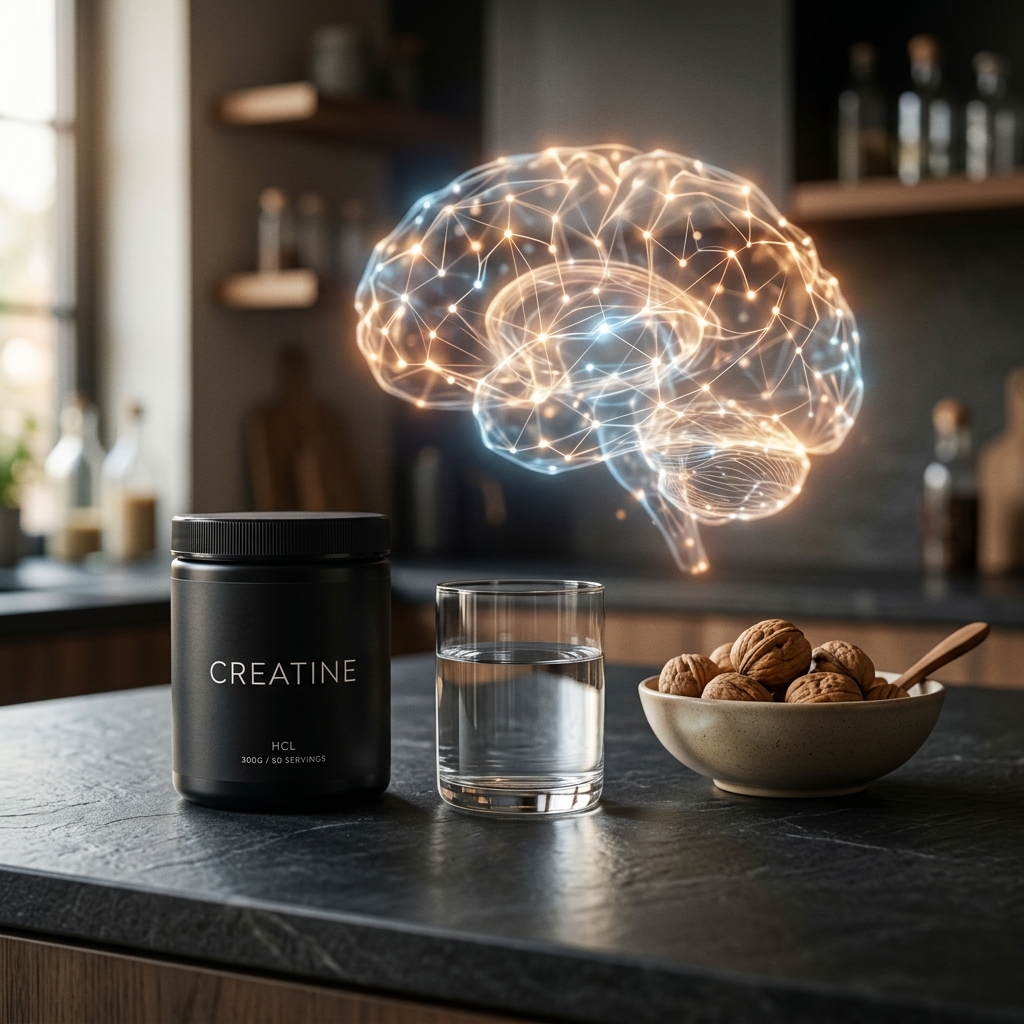
For decades, creatine sat comfortably in the supplement aisle as the domain of weightlifters chasing bigger squats and faster sprint times. That reputation was well-earned — but it was always incomplete. In 2026, the research picture has expanded considerably. Creatine is increasingly understood not just as a muscle fuel, but as a broad-spectrum cellular energy compound with meaningful implications for brain health, aging, and long-term resilience. If you've been taking it only on training days, or dismissing it because you don't care about getting bigger, it's worth a second look.
What Creatine Actually Does in the Body
Creatine's mechanism is straightforward, but its reach is wider than most people realize. The compound is stored in tissues primarily as phosphocreatine, which acts as a rapid phosphate donor to regenerate adenosine triphosphate (ATP) — the cell's primary energy currency. When a cell burns through ATP faster than aerobic metabolism can replenish it, phosphocreatine steps in to bridge the gap.
Most people associate this with explosive muscle contractions: a heavy deadlift, a 100-meter sprint, an all-out set of pull-ups. But ATP demand isn't limited to muscle. The brain is one of the most metabolically expensive organs in the body, consuming roughly 20% of the body's total energy despite representing a small fraction of body weight. Neurons are particularly sensitive to energy supply disruptions. This is precisely why researchers have been paying closer attention to creatine's neurological effects.
The body produces creatine endogenously from amino acids (arginine, glycine, glycine) primarily in the liver and kidneys, and obtains it through diet — red meat and fish are the richest sources. Vegetarians and vegans tend to have lower baseline creatine levels, which may make supplementation especially meaningful for this group.
Cognitive Benefits: What the Evidence Shows
The cognitive research on creatine is genuinely interesting, though it's important to be honest about where the evidence is strong and where it's still emerging.
The most consistent signal comes from studies examining creatine under conditions of mental stress or energy depletion. Sleep deprivation research has shown that creatine supplementation can attenuate declines in tasks requiring sustained attention, working memory, and complex reasoning — precisely the functions that suffer most when you're running on too little sleep. The hypothesis is that sleep deprivation creates an energy deficit in the brain, and creatine's role in ATP buffering helps compensate.
Studies on older adults have also shown promising results for memory performance. Several randomized controlled trials have found improvements in short-term memory and processing speed with creatine supplementation compared to placebo, particularly in populations with lower dietary intake. The effect appears most pronounced in those who start with lower baseline creatine stores — again pointing to vegetarians and older adults as groups that may benefit most.
The mechanisms proposed include:
- ATP buffering during cognitive load — keeping neurons energized during demanding mental tasks
- Neuroprotection — early research suggests creatine may help protect against excitotoxicity and oxidative stress in brain tissue
- Mitochondrial support — creatine appears to interact with mitochondrial function in ways that may support healthy neuronal metabolism over time
It would be overstating the evidence to say creatine is a proven cognitive enhancer for healthy, well-rested young adults. The signal in that population is weaker. But for individuals managing sleep debt, high cognitive workloads, or the normal cognitive changes of aging, the evidence is more compelling than most people realize.
Creatine and the Aging Body
Perhaps the most underappreciated application of creatine is in the context of aging and sarcopenia — the progressive loss of muscle mass and function that accelerates after roughly age 50 and is one of the primary drivers of frailty, falls, and loss of independence in older adults.
Creatine doesn't reverse aging, but it appears to support the conditions that slow its effects on muscle. When combined with resistance training — which remains the gold standard for combating sarcopenia — creatine supplementation has been shown in multiple studies to amplify lean mass gains, improve strength outcomes, and support functional performance in older adults to a greater degree than resistance training alone.
The mechanisms here likely overlap with its muscle effects in younger populations: enhanced phosphocreatine availability improves training quality, supports faster recovery between sessions, and may have secondary effects on anabolic signaling. There's also emerging research into creatine's potential role in bone health, though this is earlier-stage and shouldn't be treated as established.
For older adults who are not yet doing resistance training, creatine is not a substitute — but it's a reasonable complement to start alongside a training program, and the safety profile in healthy adults across long-term use is well-documented.
Recovery and Inflammation
Recovery is where creatine's benefits connect across populations — young athletes and aging adults alike. Intense exercise generates significant oxidative stress and muscle damage that requires adequate energy and cellular resources to repair. Creatine's role in accelerating ATP resynthesis means that recovery processes — protein synthesis, cell membrane repair, glycogen restoration — may proceed more efficiently.
Some research also suggests creatine may have modest anti-inflammatory effects, though this is an area where the evidence is still accumulating and the picture isn't yet clear. What's more established is that creatine can reduce markers of muscle damage following intense or eccentric exercise, and that athletes using creatine consistently tend to report better readiness for subsequent training sessions.
Practically, this matters most when training volume is high, recovery windows are short, or when someone is returning from a layoff and ramping back up. Creatine isn't a recovery hack, but it's a reliable support compound that makes the conditions for recovery slightly more favorable.
Dosing: Simpler Than the Marketing Suggests
Creatine supplementation has accumulated one of the longer safety records of any widely used sports supplement, and the practical guidance in 2026 is straightforward:
- Form: Creatine monohydrate remains the standard. It is the most studied form, the most affordable, and there is no compelling evidence that more expensive alternatives (ethyl ester, buffered creatine, hydrochloride) provide meaningful advantages for most people.
- Dose: 3–5 grams per day is the standard maintenance dose for most adults. Higher body mass may warrant the upper end of this range.
- Loading phase: Not necessary. Loading (typically 20 g/day split across 4 doses for 5–7 days) does accelerate muscle saturation, but the same saturation is achieved after 3–4 weeks at 3–5 g/day. Loading is optional, not required, and can cause GI discomfort in some individuals.
- Timing: Timing appears to matter less than consistency. Post-workout with a meal is a reasonable default, but the priority is simply taking it daily.
- Cycling: Creatine cycling (on/off phases) has no established benefit and isn't recommended by current evidence. Continuous daily use maintains muscle saturation and is the approach supported by long-term safety data.
- Hydration: Creatine draws water into muscle cells, which is part of how it works. Adequate hydration is sensible but doesn't need to be extreme — standard general hydration guidance applies.
Long-term safety in healthy adults is well-supported by the available evidence. Concerns about kidney stress have been studied and have not been borne out in healthy individuals at standard doses. People with pre-existing kidney disease should consult a physician before supplementing.
Who Benefits Most
Creatine is broadly useful, but the populations with the most to gain are worth naming explicitly:
- Vegetarians and vegans — lower dietary creatine intake means lower baseline stores, and the relative response to supplementation tends to be larger
- Adults over 50 — supporting muscle maintenance, cognitive function, and recovery all become higher priorities as natural creatine synthesis and muscle anabolism both decline with age
- People managing sleep debt or high cognitive load — the cognitive buffering research is most meaningful in these conditions
- Athletes in high-volume training blocks — where recovery speed and training quality have compounding effects on outcomes
- Anyone returning to training after a break — creatine can support the ramp-up phase when tissues are adapting rapidly
For healthy adults with no contraindications, creatine at 3–5 g/day of monohydrate is a low-cost, low-risk, high-evidence supplement that now has a reasonable argument for benefits extending well beyond the squat rack.
The Bigger Picture
The 2026 understanding of creatine is a good example of what happens when a well-studied compound gets serious scientific attention beyond its original context. The muscle and strength benefits are real and remain relevant. But the brain is energy-hungry, aging affects both muscle and mind, and the same cellular energy system underpins recovery across all these domains. Creatine doesn't solve any of these challenges on its own — training, sleep, nutrition, and consistency do the heavy lifting — but it's a well-supported piece of a broader strategy.
If you're already in a consistent training routine, tracking how your strength and recovery trend over time gives you the feedback loop to know whether what you're doing is actually working. UltraFit360 lets you log and visualize exactly that — so whether you're experimenting with creatine, adjusting your training volume, or working on sleep quality, you can see what's moving and what isn't.
Transform Your Fitness Journey
Log your workouts, track your diet, and get AI coaching insights — all with UltraFit360.