💡 Key Takeaways
- You do not need a 'body simulator' to start after 40 — the real value is easier self-monitoring, which is the behavior most strongly linked to sticking with a plan.
- Ignore the 'biological age' and longevity forecasts; they are unvalidated marketing, not a measurement of your progress.
- Calorie burn and sleep-stage numbers are rough estimates; trust step and heart-rate trends far more.
- Read the 7-day trend, not single mornings, and use it to ramp gradually — connective tissue adapts slower than muscle, which is why your joints, not your muscles, often complain first.
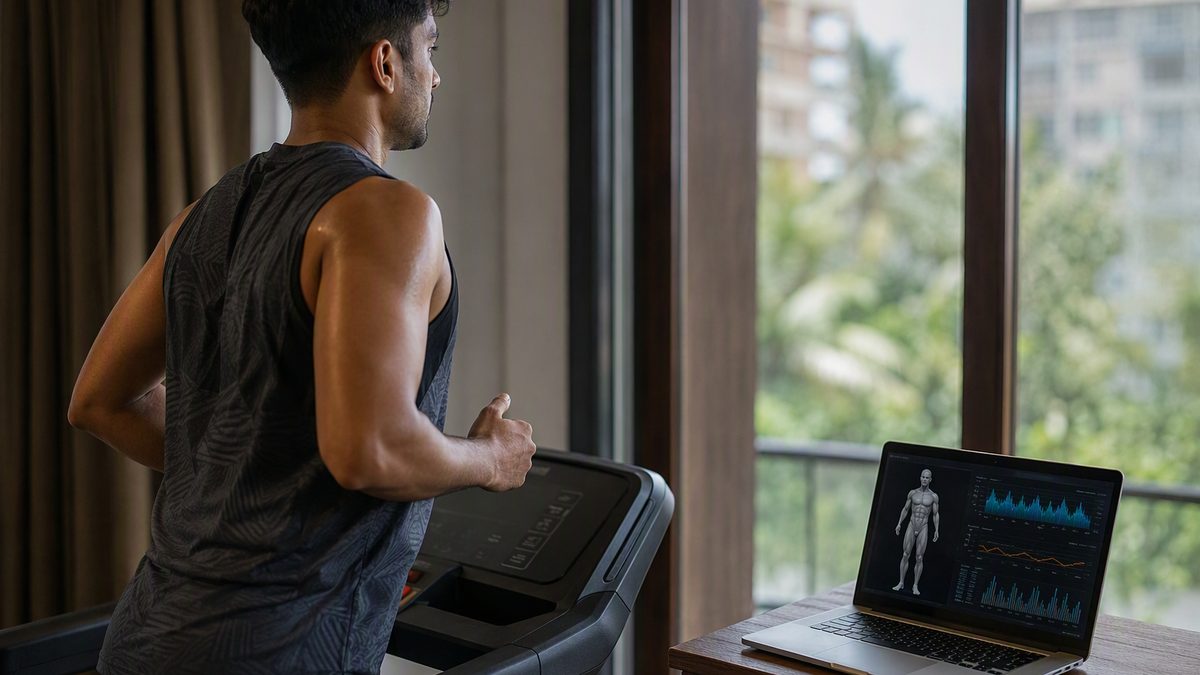
The myth lands the moment you go shopping: to get fit after 40, you supposedly need a 'digital twin' — an AI replica of your body that simulates your physiology and forecasts your future health. It sounds like the serious, grown-up way to restart, and it makes a simple decision feel complicated.
It is not true. There is no validated whole-body simulator for consumers, and you do not need one to begin. The genuinely useful part of this technology is far humbler: a device that makes tracking your sleep, heart rate and workouts easy, so you actually keep going. That habit of self-monitoring is one of the best-supported predictors of long-term success — and it is the opposite of complicated.
So let's strip the hype off and keep the help. Here is what the data really does for a returning exerciser in their 40s, and how to use it to ramp up without getting hurt.
1. The Myth: You Need a Body Simulator to Start at 42
The promise is seductive. Feed in your stats and a 'twin' will model exactly how you respond to training, predict your fat loss, and even estimate your lifespan. If that were real, starting would feel like flying a plane with a full cockpit. In reality, today's consumer products labelled 'digital twin' deliver mostly the basics: they describe your current state — readiness, sleep, activity — and offer rule-based nudges. The mechanistic simulation that forecasts your VO2max or your longevity from an arbitrary plan simply is not here yet, and the lifespan numbers some apps display are guesses dressed as data.
Why does this matter for you specifically? Because believing you need a sophisticated engine is just another way to overthink the start, and overthinking is how restarts stall. The thing that actually works at 42 is the same thing that worked at 22, only gentler: show up consistently, ramp gradually, and pay attention. A wearable helps with the 'pay attention' part. That's the whole job. It will not do the training for you, it will not forecast your future, and it will not make a four-session week into a five-session week through sheer encouragement — but it will make the simple act of tracking effortless, and for a returning exerciser that turns out to be the lever that matters most.
2. What the Data Actually Does for a Returning Exerciser
Strip away the simulation fantasy and a real, evidence-backed tool remains. App-based programs that include proper behavior-change techniques produce small-to-moderate improvements in activity and diet. The single most consistent active ingredient across that research is self-monitoring — simply keeping track. A wearable's honest value is that it lowers the friction of tracking, so you do it without thinking, and the related skills it nudges — goal-setting, monitoring, planning the week — are the self-regulation habits that separate people who stick with training from people who quit by March.
For someone returning after years away, that translates into three concrete benefits. It confirms you are actually moving more than you think you are (or less), which is humbling and useful in equal measure. It shows your resting heart rate drifting down over the weeks as your aerobic fitness returns — quiet, motivating proof the work is landing when the mirror is slow to cooperate. And it flags the nights your sleep cratered, which after 40, with more life stress and poorer sleep than a younger trainee, is often the real reason a session felt awful and you blamed yourself instead of your Tuesday-night insomnia. None of that requires a simulator. It requires consistency and an honest read of the trend.
3. Your Gradual-Ramp Protocol for the First 12 Weeks
The biggest beginner-over-40 mistake is going too hard in week one and treating soreness as progress. Your muscles can take a beating; your tendons, ligaments and joints adapt more slowly, which is why your knees and elbows often grumble before your muscles do. Use the data to govern the ramp, not to chase scores. Here is a grounded starting structure.
| Data you log | What it actually models | Your action over 12 weeks |
|---|---|---|
| Sessions per week | Consistency, the real driver of progress | Start at 3, hold there for a month before adding a 4th; do not jump to 5 |
| Steps / daily activity | Reliable movement trend (trust this over calorie estimates) | Nudge your weekly average up ~10% at a time, not in one leap |
| Resting heart rate (trend) | Months-long aerobic fitness; watch it drift down | Use the downward trend as motivation; spikes mean rest or illness |
| Total sleep time | Recovery and tomorrow's session quality | Aim for 7-9 hours; a sub-6 night means scale that day's session back |
| HRV (7-day rolling) | General readiness, age and stress adjusted | Several down days in a row: keep training but cut intensity, not the habit |
Notice there are no aggressive numbers here. The data's role is to keep you honest about doing a little, often, while your connective tissue catches up — not to push you past a body that is still re-learning how to train.
4. Don't Get Fooled: Estimates, Privacy and When to Ask a Doctor
Keep three reality checks in mind. First, accuracy varies by metric. Steps and heart-rate trends are reasonably reliable; calorie-burn estimates carry large errors and sleep-stage percentages are unvalidated guesses. Read the burn and the sleep stages as rough impressions, never gospel, and never set your diet by a wristband's calorie number. Second, a 'twin' concentrates a lot of sensitive health data in one place, and consumer fitness apps generally are not covered by health-privacy law — so check who owns your data, whether it's sold, and whether you can delete it before you commit.
Third, and most important for a returning exerciser: these tools are not medical devices and cannot replace a check-up. If you have been sedentary for years, or you carry blood-pressure issues or other conditions, a quick conversation with your doctor before ramping up is the sensible first rep. The app can encourage the habit; it cannot clear you to train. Build the habit deliberately and the rest follows — our guide to building fitness habits is a better foundation than any forecast on a screen.
Beginner-Over-40 Questions About Fitness Twins
Is it too late to see real results with one of these?
Not at all, and the technology has nothing to do with whether you succeed. What drives results after 40 is consistency, gradual progression and decent sleep, the same as at any age. A wearable simply makes the self-monitoring easier, and self-monitoring is one of the best-supported predictors of sticking with a plan. So skip the fancy 'simulator' framing, start with three sessions a week, and let the device show you the trend lines that keep you going.
Why do my joints hurt more than my muscles when I start?
Because connective tissue — tendons, ligaments, cartilage — adapts more slowly than muscle does, so the loads your muscles can handle outrun what your joints are ready for. That mismatch is sharpest in the first weeks back. The fix is a gradual ramp: add volume in small steps and use your data to govern it rather than ego. If a joint pain is sharp, swelling, or persists beyond normal soreness, that is a clinical question, not a training one.
Should I trust the calorie and biological-age numbers?
Treat both with heavy skepticism. Calorie-burn estimates from consumer devices carry large errors and should never set your diet. 'Biological age' and longevity forecasts are unvalidated marketing, not a measurement of your progress. The numbers worth trusting are step counts and heart-rate trends, which are reasonably reliable. Use those, read them as multi-day trends, and ignore the headline-grabbing forecasts that the marketing leans on.
Do I need different numbers than a 25-year-old?
Your baselines are your own, which is exactly why you ignore the app's general-population norms and watch your personal trend instead. After 40 you typically carry more life stress and worse sleep than a younger trainee, and your connective tissue adapts slower, so you ramp more gradually. The metrics are the same; the pace is gentler. Let the device record your normal for two weeks, then judge every reading against that, not against a younger stranger's chart.
Disclaimer: This article is for educational purposes only and is not medical advice. Consult a qualified healthcare professional before starting any supplement, nutrition, or training protocol — especially if you are pregnant or breastfeeding, under 18, taking medication, or managing a health condition.
Scientific References & Clinical Sources
- Schoeppe S, et al. Efficacy of interventions that use apps to improve diet, physical activity and sedentary behaviour: a systematic review. Int J Behav Nutr Phys Act, 2016. PMID: 27927218
- Burke LE, et al. Self-monitoring in weight loss: a systematic review of the literature. J Am Diet Assoc, 2011. PMID: 21185970
- Düking P, et al. Criterion-Validity of Commercially Available Physical Activity Tracker to Estimate Step Count, Covered Distance and Energy Expenditure during Sports Conditions. Front Physiol, 2017. PMID: 29018355
- Peake JM, et al. A Critical Review of Consumer Wearables, Mobile Applications, and Equipment for Providing Biofeedback, Monitoring Stress, and Sleep in Physically Active Populations. Front Physiol, 2018. PMID: 30002629
- Teixeira PJ, et al. Successful behavior change in obesity interventions in adults: a systematic review of self-regulation mediators. Obes Rev, 2015. PMID: 25907778

