💡 Key Takeaways
- Your 'twin' is a decision-reducer, not a simulator: one anchor trend, one default rule, applied identically in any time zone.
- Most premium 'digital twin' products are the same wearable plus a readiness score plus an app — much of the 'AI' is hard-coded heuristics and trend math.
- Alcohol at client dinners is often the single largest overnight HRV suppressor, so a bad morning reading is the wine, not your fitness.
- Read the 7-day rolling trend, never a jet-lagged single morning, and pair the wearable trends with your annual executive physical for the real biology.
It's 5:50am in a hotel three time zones from home. A board call looms at seven, a client dinner waits at nine, and your wearable is flashing a 'recovery' verdict it wants you to act on. Somewhere in your inbox is a pitch for a 'digital twin' that promises to model your entire physiology and forecast your longevity. You have neither the time nor the patience for either if they cannot survive an airport.
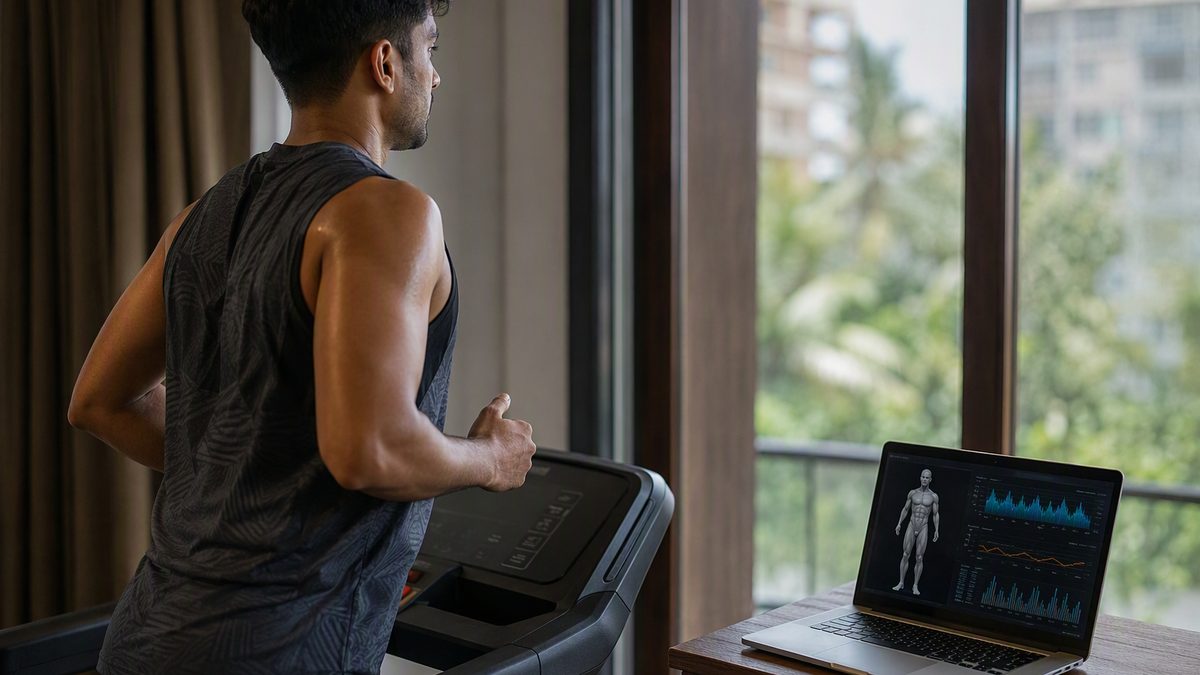
So let's be ruthless about what this technology is for. Stripped of the marketing, a digital twin is a model fed by your wearable data that estimates your current state and nudges your next decision. The full-body simulation and lifespan forecast are aspirational — not real for consumers, and not worth your attention. The piece that is real is exactly what a chaotic schedule needs: a single, portable rule that removes the morning negotiation.
This guide slots that rule into a 60-hour week and tells you which numbers earn a glance and which are noise.
1. Where a Data Model Fits a 60-Hour, Multi-City Week
Your calendar does not flex, so the system has to be invisible. The only measurement window you reliably own is sleep — and conveniently, an overnight ring or strap does all the work while you're unconscious. No morning ritual, no remembering to take a reading before coffee. You wake, and the trend is waiting.
Anchor it to three fixed moments. First, a ten-second glance at your resting-heart-rate and HRV trend before you decide the day's training. Second, the session itself, sized to that signal — a quality block on a recovered day, easy zone 2 or mobility on a depleted one. Third, a weekly look at the trend line, ideally on a flight, to catch the slow drift that travel and stress create across a month. That's the entire footprint. The 'twin' earns its keep by converting recovery from a thing you guess at while exhausted into a rule you set once and follow everywhere. Decisions are your scarce resource; this protocol spends as few as possible. The all-or-nothing instinct — a perfect training week or no week at all — is the executive's real enemy here, and a default-rules system quietly defeats it by always offering a smaller, recovery-appropriate option instead of a binary between a heroic session and skipping entirely.
2. The Honest Read: Mostly Heuristics, Not a Simulation
You evaluate vendors for a living, so apply the same eye here. 'Digital twin' is frequently a premium label on the same stack everyone uses: a wearable, a readiness score, and an app with nudges. Much of the 'AI' branding sits on top of hard-coded heuristics and rolling-average math. The tell is that the same physiology produces different scores across brands — if it were a validated simulation, it would converge, not diverge. You would not sign off on a forecasting model whose outputs changed depending on which logo was on the box; apply the same skepticism to your wrist.
That does not make it useless; it makes it modest. The defensible value is behavioral: faster feedback and easier self-monitoring improve consistency and adherence, which is where the real evidence sits — the same self-monitoring effect that shows up across the weight-loss and behavior-change literature. What you should not buy is the forecast layer — scenario 'what-ifs', biological-age readouts, and longevity projections are directional at best and unvalidated at worst, and a long-horizon lifespan number from a wristband is exactly the kind of confident-sounding output that deserves the least trust. Treat them as prompts to investigate, never as verdicts. For a clear-eyed view of where the category is genuinely heading, our take on modern fitness trends separates the durable shifts from the marketing froth.
3. Your Default-Rules Protocol for Any Time Zone
The point is to decide once and never re-litigate at 5am. Set your baseline over a normal fortnight at home, then run this everywhere — same rules, same effort doses, any city. The model reads two numbers; you match them to a row and execute.
| Data you log | What it actually models | Your default rule |
|---|---|---|
| Resting heart rate (overnight) | Recovery vs. your baseline; the most reliable single signal | 5+ bpm above for one morning: keep it easy. 2-3 mornings: deload the trip |
| HRV (7-day rolling) | Autonomic readiness trend, not a daily verdict | Trend down with high RHR: drop to zone 2 or mobility, no debate |
| Total sleep time | Your dominant recovery process; protect on travel | Under 6 hours: short easy session, no hard intervals |
| Morning after alcohol | Acute confounder, not training fatigue | Discount the score; train light, hydrate, move on |
| Green readiness day | Your normal high band | Schedule the hardest 20-40 minute quality session here |
There is no judgment call left in the moment, which is the entire design goal: autoregulation without decision fatigue. The model lowers friction; your defaults make the call.
4. Alcohol, Jet Lag, Stimulant Stacking and Your Annual Physical
Your lifestyle is a recovery-data minefield, and the model only helps if you know what's moving the numbers. Alcohol is frequently the single biggest acute suppressor of overnight HRV, so the morning after a client dinner reads poorly regardless of your fitness — that's the bottle, not your training. Jet lag and short hotel sleep elevate resting heart rate and drag the trend down for a few days until you adjust. Misreading these as training fatigue, then doubling down on caffeine and pre-workout to push through, trades a recovery problem for a stress problem — exactly the trap a chronically cortisol-elevated, sleep-restricted schedule sets for you.
Two limits to respect. These are not medical devices and are not cleared to diagnose anything; a green score never clears chest pain, palpitations or persistent fatigue, which are medical questions. And the wearable trend is not a substitute for real biology — your annual executive physical, with actual bloodwork, is the natural checkpoint to pair against the device's longevity hand-waving. Concentrating your health data into one premium profile also concentrates your privacy risk, so confirm who owns the data and whether it's sold before you commit.
Executive Questions About Fitness Digital Twins
What's the minimum effective way to use this when I travel?
Anchor on one metric and one rule set. Let an overnight ring or strap record while you sleep, glance at your resting-heart-rate and HRV trend before training, and match it to a default rule: green means your hard 20-40 minute session, red means easy zone 2 or mobility. That's it. No new system to learn each trip, no morning ritual. The whole point is to remove decisions, not add a dashboard you have to manage between meetings.
Does alcohol at client dinners ruin the data?
It skews the next morning more than almost anything else, because alcohol is often the single largest acute suppressor of overnight HRV. A low score after a dinner reflects the drinks, not your training fatigue. Don't over-correct by skipping everything. Name the confounder, train lighter, hydrate, and look at the weekly trend rather than that one distorted morning. Fewer drinks is also the most direct fix if the pattern keeps repeating across a travel-heavy month.
Is the 'digital twin' actually AI, or just marketing?
Mostly marketing on top of solid basics. Today's consumer products labelled 'digital twin' are largely the same wearable, readiness score and app, with much of the 'AI' being hard-coded heuristics and rolling-average math. The tell is that different brands turn identical physiology into different scores. The honest value is behavioral — easier self-monitoring and faster feedback that improve consistency — not a validated simulation of your body or a trustworthy lifespan forecast.
What single metric should I watch across time zones?
Your overnight resting-heart-rate trend. It's the most reliable consumer metric, needs no interpretation, and travels without recalibration: a rise of roughly five beats per minute or more above your baseline flags incomplete recovery, dehydration, alcohol or oncoming illness. Glance at your seven-day HRV trend as a backup. Pair both with your annual physical for the real biology, and treat any longevity or biological-age number on the app as a prompt to investigate, not a result.
Disclaimer: This article is for educational purposes only and is not medical advice. Consult a qualified healthcare professional before starting any supplement, nutrition, or training protocol — especially if you are pregnant or breastfeeding, under 18, taking medication, or managing a health condition.
Scientific References & Clinical Sources
- Plews DJ, et al. Training adaptation and heart rate variability in elite endurance athletes: opening the door to effective monitoring. Sports Med, 2013. PMID: 23852425
- Kiviniemi AM, et al. Daily exercise prescription on the basis of HR variability among men and women. Int J Sports Med, 2007. PMID: 17345075
- Burke LE, et al. Self-monitoring in weight loss: a systematic review of the literature. J Am Diet Assoc, 2011. PMID: 21185970
- Peake JM, et al. A Critical Review of Consumer Wearables, Mobile Applications, and Equipment for Providing Biofeedback, Monitoring Stress, and Sleep in Physically Active Populations. Front Physiol, 2018. PMID: 30002629
- Schoeppe S, et al. Efficacy of interventions that use apps to improve diet, physical activity and sedentary behaviour: a systematic review. Int J Behav Nutr Phys Act, 2016. PMID: 27927218

