💡 Key Takeaways
- Within about two weeks of consistent logging, you'll see a personal HRV and resting-heart-rate baseline — the read that tells you whether your nervous system is fresh enough for quality skill attempts.
- No wearable measures tendon health or leverage; the 'twin' tracks systemic recovery, while elbow and wrist load still needs your own honest logging and conservative progression.
- Trust the HRV and heart-rate trend, not single mornings — chasing daily wobble is overfitting noise and will have you skipping good skill days.
- Readiness scores are estimates, not validated simulations, and they say nothing about lifespan; use them to place hard skill work, not to forecast your future.
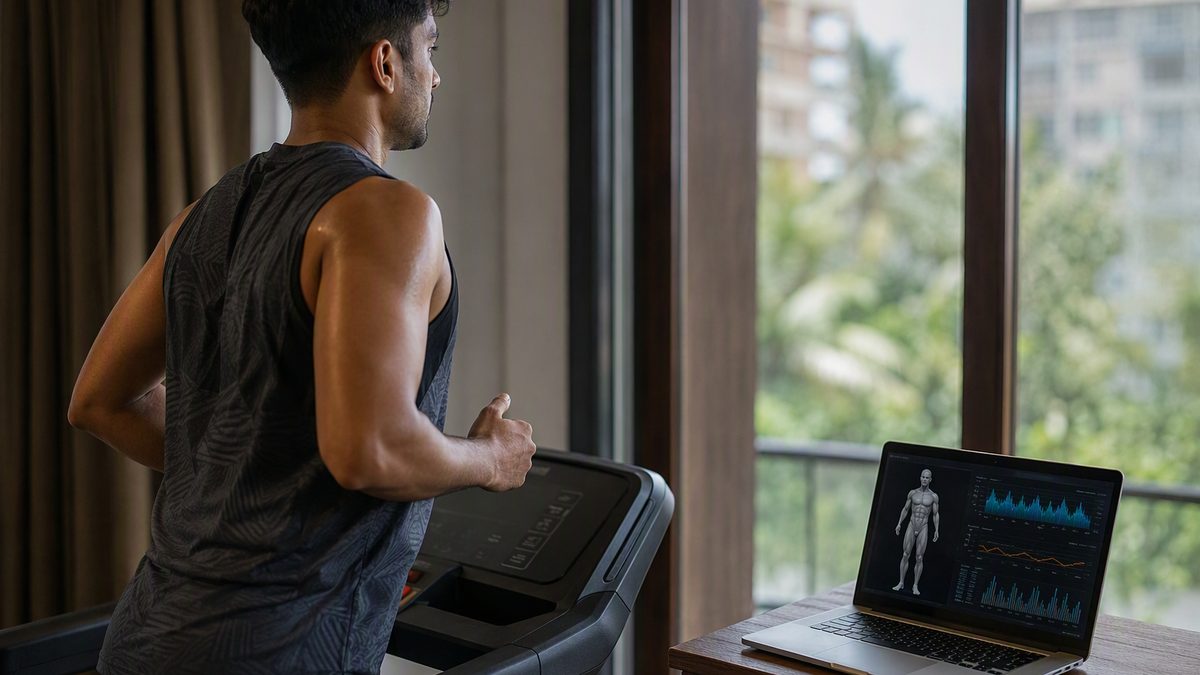
Here's what you can realistically measure, and when. Log a small, consistent set of signals for about two weeks and a personal baseline emerges: your normal resting heart rate, your HRV band, your usual sleep. From then on, the device can tell you something genuinely useful for skill work — whether your nervous system is fresh enough today to chase a clean muscle-up or a held planche, or whether you're better off doing light technique and easy volume.
What it can't measure matters just as much. There is no consumer 'digital twin' that simulates your tendons, your leverage ratios, or your lifespan. The whole-body physiological simulator marketed to longevity buyers does not exist yet. So we'll keep the claims honest: the data is a freshness gauge and a trend tracker, not an oracle.
This guide lays out what the numbers show, on what timeline, and how a bodyweight athlete should actually use them.
1. The Timeline: What a Bodyweight Athlete Can Read, and When
Expectations first, because that's what 'data-first' means. Day one tells you almost nothing — a single HRV reading is noisy and swings with posture, breathing and last night's sleep. By around two weeks of consistent logging, you have a personal baseline worth reading. From there, the meaningful signal is the multi-day trend, typically a 7-day rolling average, not any one morning. Elite-athlete data make this explicit: the rolling trend, not the daily wobble, is what tracks adaptation.
What that buys a calisthenics athlete is concrete. On a morning where your HRV trend sits in or above your normal band and your resting heart rate is at baseline, your nervous system is primed — that's the day to attempt maximal skills like a heavy front-lever progression or a fresh planche hold. When the trend is suppressed for several days, quality skill attempts will feel flat and you risk grinding them with degraded technique. That's a cue to drop to easy skill practice, mobility, and lower-intensity volume. The number doesn't replace feel; it sharpens it. Over time, comparing how a session went against where your trend sat that morning teaches you to read your own freshness more accurately, which is the real long-game payoff — eventually you internalise the signal and need the screen less, not more.
2. What It Can't See: Tendons, Leverage and the Honest Gap
This is where you have to be skeptical of the marketing. Your sport is governed by connective tissue and leverage, and the 'twin' is blind to both. Tendons and ligaments adapt far slower than muscle, which is exactly why elbow and wrist overuse is the classic straight-arm-training injury — and no wrist sensor detects an irritated tendon before it complains. The HRV-based readiness score reflects systemic, mostly autonomic recovery; it cannot tell you that your elbows have had enough straight-arm volume this week. A morning can read perfectly green while your right elbow is one planche session away from a multi-week layoff, and the device will never see it coming.
So pair the systemic signal with manual tracking the model can't do for you. Log straight-arm skill volume, note any joint niggles, and progress tendon-loaded work conservatively regardless of a green readiness score. The same goes for leverage: if you're considering adding bodyweight, understand the device tells you nothing about how that mass taxes every skill — that's a leverage decision you make with your eyes and your numbers, not a forecast the app provides. The marketing's grand promise is a model that simulates your whole body and projects your longevity; the reality is a recovery tracker that doesn't even know you train on rings. Ignore any 'biological age' or longevity output entirely — it's unvalidated, built on general-population assumptions, and irrelevant to your front lever.
3. A Readiness Protocol for Skill Days and Strength Blocks
Frequent training — four to six sessions a week, often daily skill practice — means freshness management is the whole game. Here's how to put your measurable signals to work, with the tendon-load piece tracked by hand because no sensor covers it.
| Data you log | What it actually models | Your action |
|---|---|---|
| HRV (7-day rolling) | Nervous-system readiness for quality skill attempts | In/above your band: attempt maximal skills. Suppressed 3+ days: easy technique only |
| Resting heart rate (trend) | Systemic recovery and aerobic fitness over weeks | 5+ bpm above baseline: deload the day; trend down over weeks is a good sign |
| Total sleep time | Dominant recovery for a fresh nervous system | Aim 7-9 hours; under 6 means no maximal skill grinding that day |
| Straight-arm skill volume (manual) | Tendon load the wearable can't see | Cap and progress conservatively; deload every 4-6 weeks regardless of score |
| Joint check-in (manual RPE/soreness) | Early overuse signal in elbows and wrists | Any persistent niggle: back off straight-arm work, don't push through a green score |
The split is deliberate. The device handles systemic readiness; your own log handles the tendon and leverage realities it can't measure. Together that's an honest autoregulation system for skill-based training.
4. Trends Over Noise: Avoiding the Overfitting Trap
The most common mistake with this data is reacting to single readings. Day-to-day HRV jumps around for reasons that have nothing to do with your training — a late meal, a warm room, a stressful text. A 'twin' that flips its recommendation on a one-morning dip is overfitting noise, and if you obey it you'll skip skill days you should have trained and grind ones you shouldn't. Anchor every decision to the rolling trend and your personal baseline instead.
Keep two limits in view. First, these are not medical devices and aren't cleared for the metrics they show; an elbow that hurts, a wrist that clicks painfully, or a pulley-style finger strain is a clinical question, not a readiness score. Second, accuracy varies — heart-rate and HRV trends are reasonably useful, but sleep-stage breakdowns are rough estimates, so don't over-engineer around them. Used as a freshness gauge that keeps a human in the loop, the data genuinely sharpens how you place hard skill work. Used as a body simulator or a longevity forecaster, it's overreach. Stay on the right side of that line and the technology earns its place in your training.
Calisthenics Questions About Fitness Digital Twins
Will extra weight tracked by the app hurt my strength-to-weight ratio?
The app won't tell you, and that's the point. A wearable measures recovery and activity, not leverage, so it can't model how added bodyweight taxes every skill from the planche to the muscle-up. That's a decision you make with training logs and honest assessment, not a forecast. For straight-arm skills especially, even useful muscle changes your leverage, so judge added mass by how your hardest holds feel, not by any number the device reports.
Does this help my tendons or just systemic recovery?
Only systemic recovery. The HRV-based readiness score reflects mostly autonomic, whole-body recovery — it is blind to your elbows and wrists. Tendons adapt far slower than muscle, and no wrist sensor detects an irritated tendon early. So track straight-arm volume and joint niggles by hand, progress that work conservatively, and deload on schedule regardless of a green score. Treat tendon health as a separate system the wearable simply cannot see.
Can I train skills every day if the app says I'm green?
Daily light skill practice is fine for many calisthenics athletes, but a green readiness score is not permission to attempt maximal skills daily. The score reads systemic recovery, not the tendon load that drives overuse injuries. Use green days to place your hardest fresh-nervous-system attempts, keep most daily practice light and technical, and build in regular deloads. The number sharpens your scheduling; it doesn't override conservative tendon management.
Do I need this if I don't lift weights or care about longevity numbers?
You don't need it, and you should ignore the longevity numbers entirely — they're unvalidated. The narrow thing a wearable does well for a bodyweight athlete is gauge nervous-system freshness from your HRV and heart-rate trend, which helps you place quality skill attempts on the right days. If you already read your readiness well by feel, the device just confirms it. Skip the body-simulation and lifespan framing; that part is marketing, not measurement.
Disclaimer: This article is for educational purposes only and is not medical advice. Consult a qualified healthcare professional before starting any supplement, nutrition, or training protocol — especially if you are pregnant or breastfeeding, under 18, taking medication, or managing a health condition.
Scientific References & Clinical Sources
- Plews DJ, et al. Training adaptation and heart rate variability in elite endurance athletes: opening the door to effective monitoring. Sports Med, 2013. PMID: 23852425
- Kiviniemi AM, et al. Daily exercise prescription on the basis of HR variability among men and women. Int J Sports Med, 2007. PMID: 17345075
- Peake JM, et al. A Critical Review of Consumer Wearables, Mobile Applications, and Equipment for Providing Biofeedback, Monitoring Stress, and Sleep in Physically Active Populations. Front Physiol, 2018. PMID: 30002629
- Düking P, et al. Criterion-Validity of Commercially Available Physical Activity Tracker to Estimate Step Count, Covered Distance and Energy Expenditure during Sports Conditions. Front Physiol, 2017. PMID: 29018355
- Burke LE, et al. Self-monitoring in weight loss: a systematic review of the literature. J Am Diet Assoc, 2011. PMID: 21185970

