💡 Key Takeaways
- A 'digital twin' is mostly a wearable plus readiness score plus app — its honest win is easier self-monitoring, which drives consistency.
- Spend two weeks building a baseline, then read your 7-day HRV trend to decide hard versus easy sessions on an upper/lower split.
- Trust resting-HR, HRV, and total-sleep trends; treat calorie burn and sleep-stage breakdowns as rough estimates.
- Sleep, protein, and consistency outrank any score or supplement — use the tool to protect those, not to add complexity.
Picture a normal week: four lifting sessions on an upper/lower or push-pull-legs split, evening gym slots squeezed around work, a couple of nights where sleep slips. That's the week a 'digital twin' actually has to fit into — not a lab, not a pro athlete's calendar. So let's slot it in honestly.
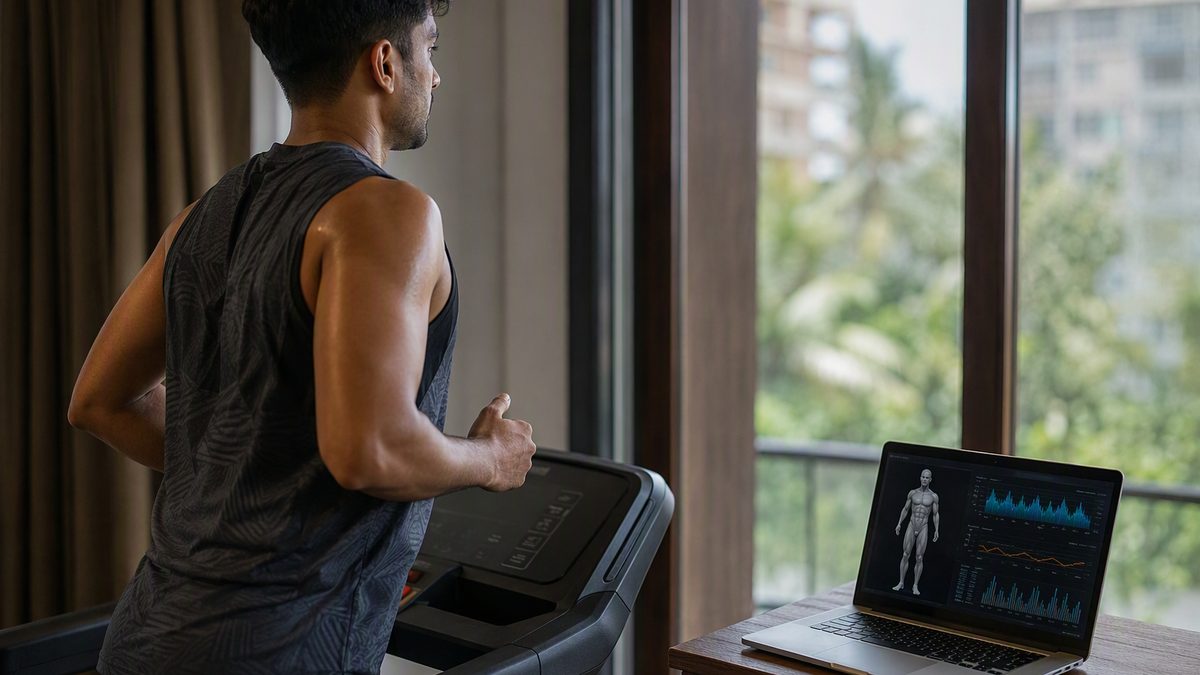
The futuristic promise — a model that simulates your body and predicts your gains — isn't real for any consumer product. What is real is the stack underneath: a wearable, a readiness score, and an app that make self-monitoring easier. For the everyday lifter, whose progress is limited mostly by consistency, sleep, and protein, that's exactly the right kind of help.
Here's where each piece lands in your week, and where to not bother.
1. Where It Slots Into Your Training Week
Think of the data as a morning glance, not a chore. Before your first coffee, check the overnight trend; that's the only timing that matters for the recovery signals. Then train your normal split.
- Monday (upper): green trend, push the planned top sets; suppressed trend after a rough weekend, keep the weights but trim a set or two.
- Midweek (lower): the heaviest systemic day — if your 7-day trend is suppressed, this is the session to ease first.
- Sleep-short nights: the app confirms what you suspect; auto-regulate down rather than forcing a planned PR attempt on five hours.
- Rest days: nothing to do but let the device keep building your trend; no readout requires action.
That's the whole integration. The point isn't to add steps to your week — it's to make a couple of existing decisions (hard or easy today?) better informed.
2. The Two-Week Setup Before Any Score Means Anything
Don't act on the data in week one. A wearable needs roughly two weeks of consistent wear to learn your personal baselines, and day-to-day HRV is noisy enough that single readings early on are meaningless. The signal that matters is the rolling average, which is what actually tracks how you're adapting.
| Signal | How to read it | Lifter action |
|---|---|---|
| HRV trend | 7-day rolling average vs baseline | Suppressed 3+ days: trim volume or deload; normal: train as planned |
| Resting heart rate | Multi-week direction | Drifting down: recovery and conditioning improving; spiking: stress, illness, poor sleep |
| Total sleep time | Hours/night, target 7-9 | Under 7h repeatedly: fix this before tweaking your program |
| Body weight | Weekly average, not daily | Use the trend to confirm your nutrition direction, ignore daily swings |
Notice body weight is read as a weekly average — daily numbers bounce with water and food and tell you nothing useful.
3. The Science: Why Self-Monitoring Earns Its Place
Here's why this is worth a slot in your week even without the sci-fi simulation. The strongest evidence in this whole space isn't for any twin engine — it's for self-monitoring itself, which is reliably linked to better outcomes. App-based tools that embed proven behavior-change techniques produce small-to-moderate improvements in physical activity and diet, and building self-regulation skills like goal-setting and monitoring is what makes habits stick.
For a recreational lifter, that's the realistic win: the tool lowers the friction of tracking, so you actually keep tracking, so you stay consistent. Consistency is what drives your results far more than program nuance. The effect sizes in the research are modest and inconsistent, so keep expectations honest — but a friendlier dashboard that keeps you showing up and eating enough protein is genuinely useful. Think of it this way: the difference between a lifter who progresses and one who stalls is rarely the program; it's whether they trained four times a week for two years or quit in month three. Anything that nudges you toward the former is worth more than any clever protocol you abandon. If you want help making the habit stick, our guide on building fitness habits pairs well with this.
4. Motivation Dips and the Supplement-Shelf Temptation
Here's where a tool helps a normal lifter most, and it isn't the science-fiction part. The everyday battle is consistency: the weeks when the gym is crowded, work is heavy, and motivation sags. A wearable that shows your streak, your rising step baseline, and a resting heart rate that's drifting down over months gives you visible proof that the boring work is paying off — and that feedback is genuinely linked to sticking with it. Seeing progress you'd otherwise miss is the realistic, evidence-backed win.
It also guards against a classic recreational-lifter trap: buying five supplements instead of fixing the basics. When you can see in your own data that your sleep is short or your training has been sporadic, the honest fix is obvious and it isn't another tub of powder. A digital twin can't simulate gains, and no readiness score substitutes for protein, sleep, and showing up. Let the dashboard point you back to the fundamentals on the weeks you're tempted to chase a shortcut. The tool's job is to keep you consistent and honest with yourself — not to sell you complexity you don't need, and certainly not to convince you that a fancier 'twin' subscription is the piece standing between you and the physique you're after.
- Motivation dip: look at your streak and resting-HR trend for proof the work is landing.
- Tempted to buy more supplements: check whether sleep or consistency is the real gap first.
- Plateau weeks: the data usually points to a missed fundamental, not a missing product.
5. Troubleshooting and What to Ignore
A few common snags. If your recovery score and your body disagree, trust your body plus the resting-HR trend — proprietary scores are black boxes with limited, brand-dependent accuracy. If the sleep-stage breakdown stresses you out, ignore it; those deep-versus-light percentages aren't validated to lab standards, so just look at total sleep time and consistent bed and wake times. And if you're tempted to chase the calorie readout for your cut or bulk, don't — energy-expenditure estimates carry large errors, so set intake from a sensible target and adjust by your weekly weight trend.
Two more honest notes. Any biological-age or longevity score is speculative and unvalidated — don't take it to heart either way. And privacy: most consumer fitness apps aren't covered by HIPAA, so check who owns your data, whether it's sold or used to train the vendor's models, and your deletion rights. These tools aren't medical devices; persistent pain or health concerns belong with a clinician, not an app.
Everyday Lifters' Questions About Digital Twins
Do I really need a digital twin to make progress?
No. For a recreational lifter, progress comes mostly from consistency, sleep, and enough protein — not from any tracking gadget. The honest value of a twin is that it makes self-monitoring easier, which can help you stay consistent. If a wearable keeps you showing up and eating enough, it's earning its place. If it adds stress or distraction, skip it. The basics outrank any score or device every time.
When will I see results in the mirror with this?
A tracker doesn't change that timeline — visible recomposition still takes months of consistent training and eating. What the tool can do is keep you consistent and confirm your weight is trending the right way week to week. Read body weight as a weekly average, not a daily number, since daily swings are mostly water and food. The mirror follows months of adherence, which is exactly what self-monitoring helps you sustain.
Should I act on the readiness score on a busy week?
Yes, but read the trend, not a single day. On a stressful, short-sleep week your 7-day HRV average will likely be suppressed — that's a legitimate cue to trim a set or two or push a heavy session later, rather than forcing a planned PR. One bad reading is usually just noise. The tool's best use on busy weeks is giving you permission to autoregulate down without feeling like you failed.
Is the cheaper wearable good enough for this?
For what matters here, usually yes. You mainly need reliable heart-rate, resting-HR, and total-sleep trends, which most decent devices capture well enough to show direction over weeks. The fancy extras — precise sleep stages, calorie burn, proprietary 'twin' scores — are the least validated parts and vary by brand anyway. Don't pay a premium for a 'digital twin' label on the same wearable-plus-app stack. Spend on consistency, not features.
Disclaimer: This article is for educational purposes only and is not medical advice. Consult a qualified healthcare professional before starting any supplement, nutrition, or training protocol — especially if you are pregnant or breastfeeding, under 18, taking medication, or managing a health condition.
Scientific References & Clinical Sources
- Burke LE, et al. Self-monitoring in weight loss: a systematic review of the literature. J Am Diet Assoc, 2011. PMID: 21185970
- Schoeppe S, et al. Efficacy of interventions that use apps to improve diet, physical activity and sedentary behaviour: a systematic review. Int J Behav Nutr Phys Act, 2016. PMID: 27927218
- Teixeira PJ, et al. Successful behavior change in obesity interventions in adults: a systematic review of self-regulation mediators. Obes Rev, 2015. PMID: 25907778
- Plews DJ, et al. Training adaptation and heart rate variability in elite endurance athletes: opening the door to effective monitoring. Sports Med, 2013. PMID: 23852425
- Peake JM, et al. A Critical Review of Consumer Wearables, Mobile Applications, and Equipment for Providing Biofeedback, Monitoring Stress, and Sleep in Physically Active Populations. Front Physiol, 2018. PMID: 30002629

