💡 Key Takeaways
- A 'digital twin' for you today is mostly a self-monitoring dashboard, not a validated simulator of your physiology or lifespan — useful, but modest.
- Anchor every signal to your wake-time, not the clock: read the 7-day HRV and resting-HR trend, never a single post-night reading you take half-asleep.
- No score offsets a sleep debt. Treat a red readiness day after nights as information to deload, not a number to beat with caffeine.
- Your twin aggregates dense, identifying health data and most wellness apps aren't HIPAA-covered — check who owns the data before you feed it everything.
Here is the question that probably brought you here: when do I check this thing on a night shift, and can a 'digital twin' actually tell me how to train when my schedule rotates every week? Short answer: it can tell you your recent trend, flag when you are under-recovered, and lower the friction of tracking — and that is genuinely worth something. What it cannot do is simulate your physiology, predict your lifespan, or out-think a 12-hour night on four hours of daytime sleep.
Most products sold as a digital twin are a wearable, a recovery score, and an app wrapped in ambitious language. For a 9-to-5 office worker that stack is convenient. For you, working rotating nights with the cafeteria shut at 3am and your body clock permanently arguing with the wall clock, the default settings are quietly wrong. This guide answers what the twin really delivers, how to read it around rotations, and where to stop trusting it.
1. What a Digital Twin Actually Is When You Work Nights
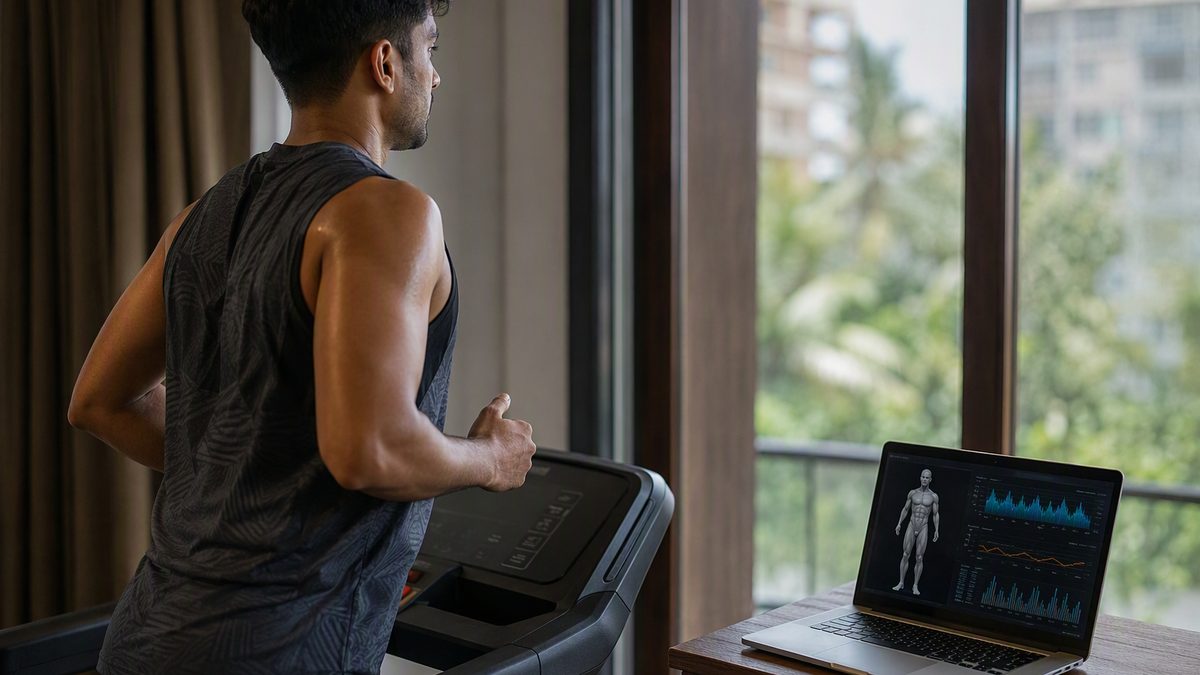
Borrowed from industry, a digital twin originally meant a live, sensor-fed virtual copy of a machine used to predict its behavior. Applied to a person, the pitch is a data model of your physiology — fed by your wearable, your sleep, sometimes labs and genetics — that estimates your current state, runs 'what-if' scenarios, and forecasts long-term health. Strip the marketing and what reaches your wrist today is the first piece only: a descriptive picture of recent readiness plus some rule-based nudges.
That distinction matters more for you than almost anyone, because shift work breaks the assumptions these models lean on. Rotating schedules push your circadian rhythm out of alignment, which blunts insulin sensitivity, raises cortisol, and fragments sleep — and the baselines the algorithm builds assume a stable day-night pattern you don't have. So treat the twin as a smart logbook that surfaces trends, not an oracle. Used that way it reinforces the one ingredient with the strongest evidence behind it: consistent self-monitoring, which reliably tracks with better health outcomes.
2. Anchoring Your Signals to Wake-Time, Not the Clock
The single most common mistake shift workers make with these tools is following clock-based advice literally — 'take your reading at 8am,' 'train in the morning.' On a night rotation, 8am is your bedtime. The fix is to anchor everything to your personal wake-time. Whenever you wake for your main sleep, that is your morning, and that is when a resting-HR and HRV snapshot is most comparable night to night.
Pick a small set of signals and read the rolling trend, never the single number. Day-to-day HRV is noisy even for people with perfect sleep; for you it will swing hard around a rotation. The meaningful signal is the multi-day direction of travel — a roughly 7-day rolling average — which is what actually tracks training adaptation in monitored athletes. An overnight average from a ring or chest strap also beats a single spot-check, because it averages out measurement noise. One practical rule for rotations: expect your baselines to reset for a few days after each schedule change, and don't let the app's red flags during that window scare you off training entirely — adjust, don't abandon.
3. A Rotating-Shift Protocol You Can Actually Run
This is the grounded version: a handful of reliable inputs, logged consistently, read as trends and tied to your wake-time rather than the clock. The doses below are starting points, not prescriptions.
| Signal | How to capture it | What to read | Shift-work cue |
|---|---|---|---|
| HRV trend | Overnight via ring or chest strap during main sleep | 7-day rolling average vs personal baseline | Reset baseline for 3-4 days after each rotation |
| Resting heart rate | Lowest overnight value, same sleep block nightly | Weeks-long direction, not single nights | 5-7 bpm above baseline + low HRV = ease off |
| Total sleep time | Wearable estimate, every main sleep + naps | Total hours toward 7-9; log naps separately | Aim 7-9h across main sleep plus pre-shift nap |
| Training load | Manual session log or wearable | Weekly volume trend | Schedule hard sessions on day/swing shifts, not post-night |
| Body weight | Same conditions weekly | Rolling weekly average | Watch for 3am-snacking drift, not daily wobble |
Trust the heart-rate and step trends most. Treat calorie burn and sleep-stage percentages as rough estimates — energy-expenditure readings carry large errors across devices, and stage scoring often lacks validation against lab sleep studies. For the behavior side of building this into a rotating life, the principles in building fitness habits apply: anchor to a fixed cue, keep the data collection effortless, and let the dashboard make the right choice the easy one.
4. Why No Score Replaces Sleep — and Where the Twin Goes Quiet
Sleep is the dominant recovery process every night, and shift work is, at its core, a chronic sleep-disruption problem. Adults need roughly 7-9 hours; you are structurally fighting to get there. No readiness algorithm, however slick, manufactures recovery that the sleep didn't provide — at best it tells you the debt is mounting. The honest use of a red day after nights is permission to deload, not a target to defeat with a third coffee. Caffeine inside roughly six hours of your sleep window will sabotage the very recovery the app is measuring.
Be just as skeptical of the long-horizon promises. Biological-age readouts and lifespan forecasts pulled from consumer data are speculative; treat any 'what-if' simulation as a prompt to look closer, not a verdict. And remember the category limit: these are not medical devices, are not diagnostic, and are not FDA-cleared for the fitness metrics they display. Shift populations carry documented higher baseline illness and injury risk — if your numbers point at something clinical, that is a conversation with a doctor, not a setting to tweak. Drowsy-driving home after a night is a real danger the dashboard will never catch.
5. The Privacy Stakes of One Profile Holding Everything
A digital twin is by design a dense pile of sensitive, identifying data — continuous heart rate, location-tagged activity, sleep, body metrics, possibly labs and genetics, the most sensitive category of all because it is irrevocable and shared with relatives. Most consumer fitness and wellness products are not covered by HIPAA, so your protection is whatever the company's privacy policy says, not health-privacy law. Concentrating everything into one profile raises the cost of any breach or quiet policy change.
Before you feed a twin your life, do the due diligence that matters for healthcare and emergency workers especially, given how identifiable location-tagged shift patterns are: find out who owns the raw data and the model; whether it is sold or shared with advertisers or used to train the vendor's systems; whether you can export and delete everything if you leave; and how genetic data is handled. None of this means avoid the tools — self-monitoring is the active ingredient and worth keeping. It means choose deliberately, share the minimum that still gives you the trend you need, and keep a human in the loop for the context no model can see: which week you are on, how the rotation actually felt, and what your gut already knows about your recovery.
Night-Shift Questions About Digital Twins
When do I take my readings on a night shift?
Anchor to your wake-time, not the clock. Whenever you wake for your main daytime sleep, that is your 'morning' — take any HRV or resting-HR snapshot then, the same way every cycle. Better still, use an overnight average from a ring or strap so the device captures your real main-sleep block automatically. Logging at a fixed clock time across rotating shifts produces noise, not signal, because you are comparing different points in your body clock each day.
Do rotating shifts ruin the consistency these tools need?
They strain it but don't ruin it. The trick is reading the multi-day rolling trend instead of single readings, and expecting your baseline to reset for three to four days after each rotation. During that reset window the app may flash warnings — adjust your training down rather than abandoning the data. Over weeks the trend still tells you whether you are accumulating fatigue. What you lose is the day-to-day precision a fixed-schedule worker gets; what you keep is the direction of travel.
Can a digital twin offset my bad sleep?
No, and any product implying it can is overselling. Sleep is the main recovery process and shift work chronically disrupts it; a readiness score measures the resulting debt but never repays it. The genuine value is honesty — a red day after nights is a signal to deload, not a number to beat. Use the twin to protect what sleep you do get: keep caffeine outside roughly six hours of your sleep window and treat consistent total sleep time as the metric that matters most.
Is my health data safe with these apps?
It depends entirely on the company, because most consumer fitness apps aren't covered by HIPAA — your protection is the privacy policy, not the law. A twin concentrates continuous heart rate, location-tagged activity, sleep and sometimes genetics into one profile, which is especially sensitive for shift workers whose location patterns reveal where they work and when. Before signing up, check data ownership, whether it's sold or used to train their models, and your export and deletion rights. Share the minimum that still gives you a usable trend.
Disclaimer: This article is for educational purposes only and is not medical advice. Consult a qualified healthcare professional before starting any supplement, nutrition, or training protocol — especially if you are pregnant or breastfeeding, under 18, taking medication, or managing a health condition.
Scientific References & Clinical Sources
- Peake JM, et al. A Critical Review of Consumer Wearables, Mobile Applications, and Equipment for Providing Biofeedback, Monitoring Stress, and Sleep in Physically Active Populations. Front Physiol, 2018. PMID: 30002629
- Plews DJ, et al. Training adaptation and heart rate variability in elite endurance athletes: opening the door to effective monitoring. Sports Med, 2013. PMID: 23852425
- Burke LE, et al. Self-monitoring in weight loss: a systematic review of the literature. J Am Diet Assoc, 2011. PMID: 21185970
- Schoeppe S, et al. Efficacy of interventions that use apps to improve diet, physical activity and sedentary behaviour: a systematic review. Int J Behav Nutr Phys Act, 2016. PMID: 27927218

