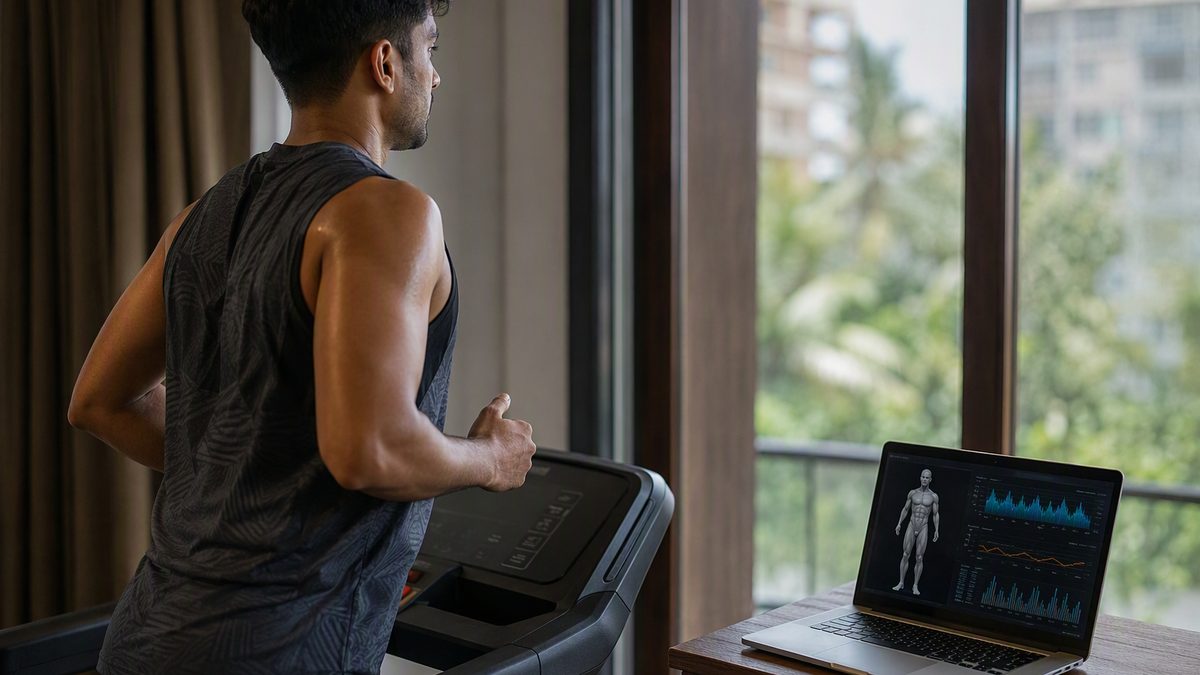
💡 Key Takeaways
- A digital twin tracks recovery trends, but your real edge is the inputs it can't measure — log leucine-aware protein and pair it with periodic iron, ferritin, and B12 labs.
- It's a self-monitoring dashboard, not a body simulator. The honest value is consistency and surfacing trends, not predicting your performance or lifespan.
- Read the 7-day HRV and resting-HR trend, not single mornings. A persistent sag can flag under-recovery — but only labs can confirm low iron or B12.
- Most fitness apps aren't HIPAA-covered and dietary logs are sensitive too. Check who owns and sells your data before pooling labs, food, and biometrics in one profile.
The problem vegetarian athletes keep running into isn't training — it's that the metrics most likely to limit you live below the surface, where a wrist sensor can't see them. Plant-based eating naturally runs lower in creatine, carnosine, B12, iron, and zinc, and the consequences of letting one slide — flat sessions, stubborn fatigue, slow recovery — look exactly like ordinary overtraining on a dashboard. A 'digital twin' that only watches your heart rate and sleep will happily show you a sagging recovery trend without ever telling you the real reason is your ferritin.
That gap is the whole story here. Used well, a personal data model is genuinely helpful for plant-based athletes — but its biggest value isn't the recovery score. It's the discipline of logging the inputs that actually differentiate your training (leucine-aware protein, the foods that drive iron and B12) and pairing the wearable trends with periodic bloodwork the device can't run. This guide is about closing that plate-to-data gap honestly, without overselling what the twin can do.
1. The Inputs a Twin Sees — and the Ones That Actually Limit You
A digital twin is, at bottom, a data model fed by your inputs: continuous wearable signals like HRV, resting heart rate and sleep, plus whatever you log manually. The honest limitation for a vegetarian athlete is that the signals most likely to cap your performance aren't continuous and aren't on your wrist. Low ferritin, marginal B12, suboptimal leucine intake — these are episodic, lab-and-logbook inputs, and a model that can't see them will misread their downstream effects as generic fatigue.
That's why your version of a twin has to be built deliberately around the right inputs. The wearable handles recovery-state trends; your food logging handles the differentiator. Plant proteins digest slower and carry less leucine per serving than animal sources, so tracking protein by leucine-relevant quality, not just grams, is the input that matters for you — exactly the kind of context the device can't infer. A twin is only as good as what you feed it, and gaps degrade every output, so for plant-based athletes the logging discipline is the edge. The behavior-change literature is clear that consistent self-monitoring is the active ingredient, and that's precisely where a tool earns its place — making the tracking you actually need easier to sustain. The nutrition-tracking side connects naturally to the fitness apps guide.
2. Why Periodic Labs Beat the Wearable for Plant-Based Athletes
Here's the reframe that matters: for you, the most valuable data isn't continuous at all. A wearable gives you daily readiness trends, but it cannot measure iron status, ferritin, B12, or vitamin D — and those are the markers most likely to quietly limit a vegetarian athlete. Iron from plants is non-heme and less readily absorbed, B12 essentially requires supplementation, and both deficiencies produce exactly the flat, fatigued, slow-to-recover pattern that a dashboard will blame on training load. Periodic bloodwork is the episodic input that sets the context every wearable trend should be read against.
So treat labs as part of your twin, not separate from it. A wearable's resting-HR and HRV trend that's been suppressed for weeks despite sensible training is a prompt to check bloodwork, not just to deload harder. The model surfaces the trend; the labs explain it. This is also where input honesty matters most — no algorithm can verify whether your protein log is accurate or whether you've actually been hitting B12, so the discipline of real logging plus scheduled labs is what makes the whole picture trustworthy. The continuous data tells you something's off; the periodic data tells you what.
3. Building a Plant-Based Athlete's Data Model
A useful twin for you pairs reliable wearable trends with the nutrition and lab inputs that actually differentiate plant-based training. The setup below is a grounded starting point, not a prescription — and notice the highest-value rows are the ones the wearable can't measure.
| Input | How to capture it | Cadence | What it tells your twin |
|---|---|---|---|
| HRV + resting HR | Overnight via ring or chest strap | Daily, read as 7-day trend | Recovery state; sustained sag prompts a labs check |
| Total sleep time | Wearable estimate | Daily, toward 7-9 hours | Dominant nightly recovery process |
| Protein, leucine-aware | Food log, quality not just grams | Daily | The plant-based differentiator the device can't infer |
| Iron, ferritin, B12, vit D | Blood panel via clinician | Periodic (e.g. yearly or if fatigued) | Context labs that explain otherwise-puzzling trends |
| Body weight | Same conditions, morning | Weekly rolling average | Fueling adequacy across training |
Trust the heart-rate and step trends from the wearable; treat its calorie and sleep-stage numbers as rough estimates, since energy-expenditure readings carry large device errors and sleep staging often isn't lab-validated. The blood-panel row sits at the center of your model precisely because it's the input that resolves ambiguity the continuous data can't. Read the HRV trend as a multi-day rolling average rather than reacting to single mornings, which are noisy for everyone.
4. Debunking 'Plant-Based Athletes Can't Recover' With Honest Data
One genuine upside of building a real data model: it lets you answer the tired 'you can't build muscle or recover on plants' noise with your own evidence instead of vibes. When your protein log shows you're hitting leucine-relevant targets, your labs confirm iron and B12 are in range, and your resting-HR trend is drifting down over a block — that downward trend generally reflecting improving aerobic fitness — you have a concrete, personal answer. The data won't make plant-based training magically superior, but it will stop you from blaming your diet for problems that are actually programming, sleep, or fueling.
The flip side is staying honest about the tool's ceiling. A digital twin doesn't simulate your physiology or predict your performance, and the biological-age and longevity numbers some apps display are speculative — useful only as rough prompts. It's a black-box readiness score plus trend math, not a validated engine, and the same body can score differently across brands. For a vegetarian athlete the realistic, defensible win is modest and real: better consistency, faster feedback, and a system that nudges you to keep the logging and the labs current. That's worth having precisely because your limiters are the kind that hide until you measure them.
5. The Privacy Cost of Pooling Labs, Food and Biometrics
Because your most useful twin combines bloodwork, detailed food logs, and continuous biometrics, it's worth naming the privacy cost of concentrating all of that in one place. A digital twin is a dense aggregation of sensitive, identifying health data, and lab results plus dietary patterns are part of that picture, not just heart rate. Most consumer fitness and nutrition apps aren't covered by HIPAA, so your protection is the company's privacy policy rather than health-privacy law, and pooling everything into a single profile raises the stakes of any breach or quiet policy change.
Do the due diligence before you commit: find out who owns the raw data and the model, whether your information is sold or shared with advertisers or used to train the vendor's systems, and whether you can export and delete it if you leave — portability matters when years of labs and logs live there. Where you can, keep clinical bloodwork in a system you control and feed the app only what it needs to give you a usable trend. None of this is a reason to skip tracking; self-monitoring is the ingredient with the strongest evidence, and for plant-based athletes the logging discipline is the whole advantage. It's a reason to be deliberate about which data goes where, and to keep a clinician — not an algorithm — reading your labs.
Plant-Based Athlete Questions About Digital Twins
Do vegetarian athletes get more out of a digital twin?
Not from the wearable scores — those track the same recovery trends for everyone. Your real edge is the logging discipline a twin encourages, applied to the inputs that actually limit plant-based athletes: leucine-aware protein and periodic iron, ferritin, and B12 labs. The device can't measure those, so a twin's value for you is mostly about consistency and surfacing trends that prompt a bloodwork check. Used that way, it's genuinely useful — just not because the algorithm does anything plant-specific.
How do I hit leucine targets without meat, and can the app track it?
The app can track protein you log, but it usually counts grams, not leucine quality, which is the metric that matters for plants — they carry less leucine per serving and digest slower. Lean on higher-quality plant sources like soy and combine proteins across meals, and log honestly, since no algorithm can verify your intake. Treat the food log as the differentiating input you feed the twin, and read its recovery trends against whether you're genuinely hitting your protein quality, not just volume.
Which labs should I check, and can a wearable replace them?
Check iron, ferritin, B12, and vitamin D periodically — these are the markers most likely to limit a vegetarian athlete, and a wearable can't measure any of them. Plant iron is less absorbable and B12 needs supplementation, so deficiencies are common and they mimic overtraining on a dashboard. No wearable replaces bloodwork; instead, use a persistently suppressed HRV or resting-HR trend as a prompt to get labs done. The continuous data flags a problem; only the labs explain it.
Is my data safe if I pool labs, food logs, and biometrics?
Treat it carefully. A twin combining bloodwork, diet, and continuous biometrics is a dense, identifying health profile, and most consumer apps aren't covered by HIPAA — your protection is the privacy policy, not the law. Before pooling everything, check who owns the data, whether it's sold or used to train their models, and your export and deletion rights. Where possible, keep clinical labs in a system you control and feed the app only what it needs for a usable trend. Share the minimum.
Disclaimer: This article is for educational purposes only and is not medical advice. Consult a qualified healthcare professional before starting any supplement, nutrition, or training protocol — especially if you are pregnant or breastfeeding, under 18, taking medication, or managing a health condition.
Scientific References & Clinical Sources
- Burke LE, et al. Self-monitoring in weight loss: a systematic review of the literature. J Am Diet Assoc, 2011. PMID: 21185970
- Schoeppe S, et al. Efficacy of interventions that use apps to improve diet, physical activity and sedentary behaviour: a systematic review. Int J Behav Nutr Phys Act, 2016. PMID: 27927218
- Peake JM, et al. A Critical Review of Consumer Wearables, Mobile Applications, and Equipment for Providing Biofeedback, Monitoring Stress, and Sleep in Physically Active Populations. Front Physiol, 2018. PMID: 30002629
- Düking P, et al. Criterion-Validity of Commercially Available Physical Activity Tracker to Estimate Step Count, Covered Distance and Energy Expenditure during Sports Conditions. Front Physiol, 2017. PMID: 29018355

