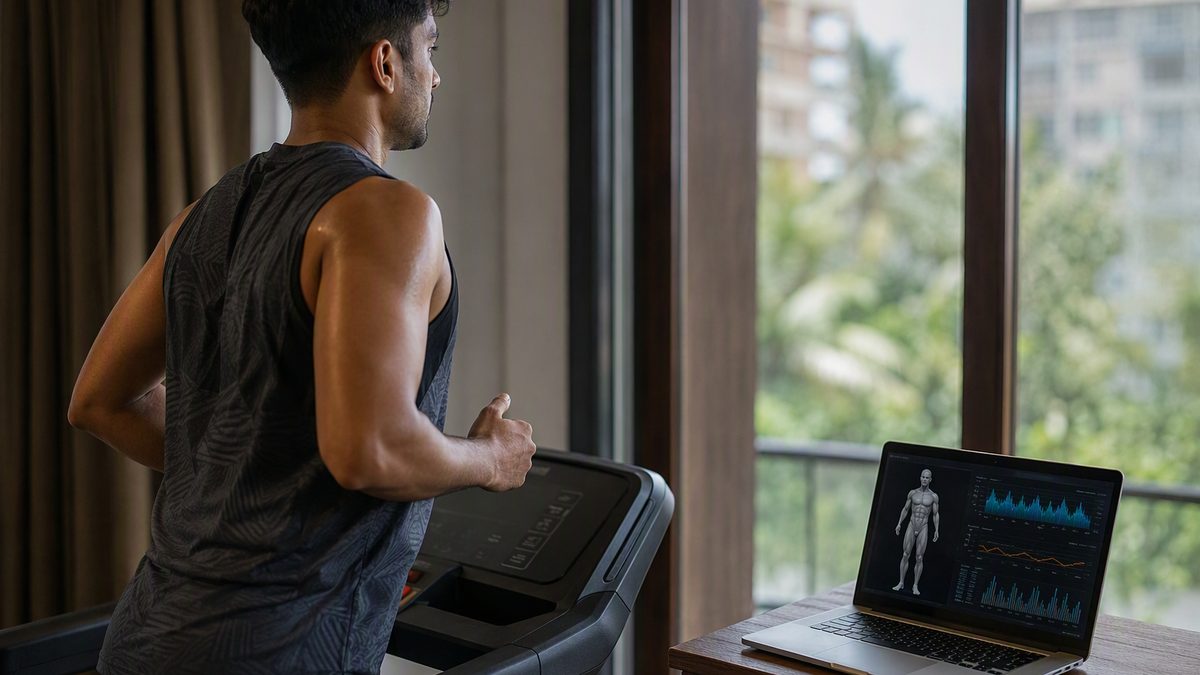
💡 Key Takeaways
- The myth that data tracking is 'not yogic' cuts both ways — HRV and breath awareness are biofeedback, and a digital twin is a self-monitoring dashboard, not a body simulator.
- It won't predict your practice or your lifespan. The honest value is making recovery trends and hot-class fluid losses visible so you adjust intentionally.
- Read the 7-day HRV trend, not single mornings. Long isometric holds and daily practice accumulate load that a multi-day trend catches before strain does.
- Hot-yoga sweat losses of 1-2 liters are real and a wearable can't measure them — log body weight before and after, and don't let any score replace electrolytes.
There's a belief common in studios worth examining: that quantifying the body with wearables and 'digital twins' is fundamentally at odds with a yoga practice — too clinical, too ego-driven, not yogic. It's a fair instinct, and it's also worth turning over, because yoga has always been a practice of interoception: feeling the breath, sensing the nervous system shift from effort to ease. HRV tracking is, at its core, the same thing rendered in numbers — a window into the rest-and-digest balance you already cultivate on the mat.
That doesn't mean the marketing deserves your trust. A 'digital twin' promising to simulate your physiology or forecast your longevity is selling something that doesn't exist. What the honest version of the tool offers a dedicated practitioner is narrower and genuinely useful: making your recovery trends and your hot-class fluid losses visible so you practice with intention rather than guesswork. This guide separates the overreach from the real, without asking you to abandon the philosophy that brought you to the mat.
1. The Myth That Tracking Is Un-Yogic
Start with the objection itself. The worry is that a data model reduces a contemplative practice to scores and turns awareness into another thing to optimize. But consider what HRV actually measures: the beat-to-beat variation in your heart that reflects autonomic balance — higher resting HRV generally signaling greater parasympathetic, rest-and-digest activity. That is a direct, measurable read on the exact shift toward calm that pranayama and restorative practice aim to produce. Far from being anti-yogic, it's biofeedback for the nervous-system states yoga has worked with for centuries.
The honest framing is that a digital twin doesn't replace your felt sense — it complements it. On a morning when the mat feels heavy and you can't say why, a suppressed multi-day HRV trend can confirm accumulated load and give you permission to take a gentler practice without guilt. Used this way, the data serves the practice rather than competing with it. What makes it work is the same self-regulation skill yoga already builds — observing, then adjusting — which happens to be the mechanism with the strongest evidence behind app-based behavior change. The trap is letting numbers override sensation; the skill is letting them inform it.
2. What the Twin Measures Around Daily and Fasted Practice
Many yogis practice daily or near-daily, often in the morning and often fasted by tradition, and that shapes what a data model can usefully tell you. Take your HRV and resting-heart-rate reading on waking, before practice and before food — that's the most consistent, comparable moment, and it conveniently fits a fasted morning rhythm. The signal worth reading is the trend across days, because long isometric holds and high chaturanga volume accumulate load on wrists, shoulders and the nervous system that no single morning reading reveals.
Day-to-day HRV is genuinely noisy, so resist reacting to one low number. The meaningful measure is the roughly 7-day rolling average, which is what actually tracks adaptation in monitored athletes; a twin that reacts to single-day wobble is chasing noise, not signal. For a practitioner whose flexibility often outpaces stability, this trend view is quietly valuable — a steadily suppressed HRV across a week of intense practice or a teacher-training block is a real cue to add recovery, before accumulated load turns into a hyperextension strain. Know the limits of the inputs, too: trust heart-rate and step trends, but treat calorie burn and sleep-stage percentages as rough estimates, since those carry large errors and often aren't validated against lab standards.
3. A Mat-Friendly Data Model for Hot and Daily Practice
A grounded setup keeps a few reliable signals and reads them as trends, with one input built specifically for hot-class fluid losses. The protocol below is a starting point, not a prescription.
| Signal | How to capture it | What to read | Yoga-specific cue |
|---|---|---|---|
| Morning HRV | Seated, on waking, before food and practice | 7-day rolling average vs baseline | Fits a fasted morning rhythm naturally |
| Resting HR | Overnight low via ring or strap | Multi-day direction | Creeping upward flags accumulated practice load |
| Total sleep time | Wearable estimate, nightly | Hours toward 7-9, consistent timing | Dominant recovery process; protect it during trainings |
| Body weight, hot class | Weigh before and after a hot session | Difference = fluid lost to replace | 1-2 L sweat loss is common; rehydrate to match |
| Subjective check-in | Energy, joint feel, 1-10 each morning | Trend across the week | Hypermobility means stability cues matter more than range |
The before-and-after body-weight row is the one that earns its place specifically for you: hot classes can cost 1-2 liters of sweat, an amount a wearable cannot measure, and the simplest honest gauge is the scale. Each kilogram lost is roughly a liter of fluid to replace, with electrolytes — not water alone — especially if you also practice fasted. The behavior-building scaffolding that keeps a daily-practice tracking habit sustainable is the same covered in the fitness habits guide.
4. Hot-Yoga Hydration: The Number a Wearable Can't See
This deserves its own emphasis because it's where the tool's limits and your safety meet. A digital twin tracks heart rate and sleep, but it has no way to measure the 1-2 liters of fluid a hard hot class can pull out of you, and the fasted-morning tradition many practitioners follow compounds the risk of a dehydration spiral. No readiness score offsets that — a green recovery reading on a morning you walk into a hot room under-hydrated is meaningless for the fluid problem ahead. The before-and-after weigh-in is the input that actually matters here, and it's one you have to add yourself.
Replace what you lose with fluid and electrolytes, not water alone, since heavy sweating costs sodium too. This is the safety center of the whole topic for yogis, and it's a useful reminder of the general principle: a twin only knows what it can measure or what you log, and the things most likely to harm you — dehydration, a hyperextended joint, pushing a hold past stability — are often exactly the things the sensor can't see. Keep your felt sense in charge. The data is a prompt to check the scale and reach for electrolytes, not a substitute for noticing you're light-headed.
5. Where the Tool Stops, and What It's Doing With Your Data
Be clear about the ceiling. A digital twin does not simulate your physiology, predict your practice, or forecast your lifespan — there's no validated consumer model that does, and the biological-age and longevity numbers some apps display are speculative, useful only as rough prompts to reflect, not verdicts. These tools are also not medical devices: not diagnostic, not cleared for the metrics they show. A hypermobility injury, persistent joint pain, or anything that alters how you move belongs with a clinician, not an algorithm. The autoregulation value is real but modest — better awareness and consistency, not novel biology.
And consider the data itself, which sits a little uneasily with a practice oriented toward non-attachment and simplicity. A twin concentrates continuous heart rate, location-tagged activity, sleep, body metrics and sometimes more into one dense, identifying profile. Most consumer wellness apps aren't covered by HIPAA, so your protection is the company's privacy policy, not health-privacy law. Before you commit, check who owns the data, whether it's sold or used to train the vendor's systems, and whether you can export and delete it. Share the minimum that still gives you a usable trend — a deliberate, low-attachment relationship with the tool, which is rather in keeping with the practice anyway.
On-the-Mat Questions About Digital Twins
Does a digital twin fit a fasted morning practice?
Yes, and conveniently so. The most consistent moment to take an HRV and resting-heart-rate reading is on waking, before food and before practice — which is exactly when a fasted morning yogi is already up. That timing gives the cleanest, most comparable data day to day. Just read the multi-day trend rather than a single morning, and remember the reading reflects recovery, not whether to eat. The hydration question matters more than the fasting one, especially before hot classes.
Is tracking compatible with a yogic or ayurvedic approach?
It can be, if you hold it lightly. HRV is biofeedback on the same rest-and-digest states pranayama cultivates, so the data complements interoception rather than opposing it. The conflict only arises if numbers start overriding your felt sense or becoming another attachment. Keep the tool in a supporting role — a prompt to rest when the trend is suppressed — and share the minimum data, in a deliberate, low-attachment way. Used that way, it sits comfortably alongside a contemplative practice rather than against it.
Will it help with hot-yoga fatigue and fluid loss?
Indirectly, and only if you add the right input. A wearable can't measure the 1-2 liters of sweat a hard hot class costs, so the tool itself won't catch your dehydration. What helps is weighing yourself before and after class — each kilogram lost is roughly a liter to replace with fluid and electrolytes, not water alone. A recovery score won't offset under-hydration, especially if you practice fasted. Use the scale as your real hot-class metric and let the twin track longer recovery trends.
Do yogis even need a digital twin?
Need, no — a dedicated practice builds plenty of body awareness on its own. The honest value is modest: it makes recovery trends and hot-class fluid losses visible so you adjust with intention, and it reinforces the observe-then-adjust skill yoga already trains. If you're drawn to data, it can deepen your awareness; if you're not, you lose little by skipping it. What it absolutely isn't is a body simulator or a longevity oracle, so don't let the marketing convince you it's essential.
Disclaimer: This article is for educational purposes only and is not medical advice. Consult a qualified healthcare professional before starting any supplement, nutrition, or training protocol — especially if you are pregnant or breastfeeding, under 18, taking medication, or managing a health condition.
Scientific References & Clinical Sources
- Schoeppe S, et al. Efficacy of interventions that use apps to improve diet, physical activity and sedentary behaviour: a systematic review. Int J Behav Nutr Phys Act, 2016. PMID: 27927218
- Plews DJ, et al. Training adaptation and heart rate variability in elite endurance athletes: opening the door to effective monitoring. Sports Med, 2013. PMID: 23852425
- Peake JM, et al. A Critical Review of Consumer Wearables, Mobile Applications, and Equipment for Providing Biofeedback, Monitoring Stress, and Sleep in Physically Active Populations. Front Physiol, 2018. PMID: 30002629
- Burke LE, et al. Self-monitoring in weight loss: a systematic review of the literature. J Am Diet Assoc, 2011. PMID: 21185970

