💡 Key Takeaways
- HRV biofeedback is 10 minutes of slow breathing at ~6 breaths/min — a portable, default rule that works the same in a hotel room as at home and reliably lowers in-the-moment stress.
- Make your morning HRV trend the single metric you watch; on a recovered day push the hard session, on a suppressed day swap it for easy work — that autoregulation is the real edge.
- Alcohol at client dinners is usually the biggest overnight HRV suppressor — a low reading the morning after is the wine, not your fitness, so don't deload over it.
- Across time zones, anchor the reading to your wake-up, not the clock, and use a 7-day rolling average so jet lag and one bad night don't dominate the signal.
06:10, hotel gym, two time zones from home, a board call in ninety minutes. This is the environment your training has to survive — unpredictable, sleep-short, and run on default rules rather than fresh decisions. The last thing you need is another protocol that assumes a calm 9-to-5 life you do not have.
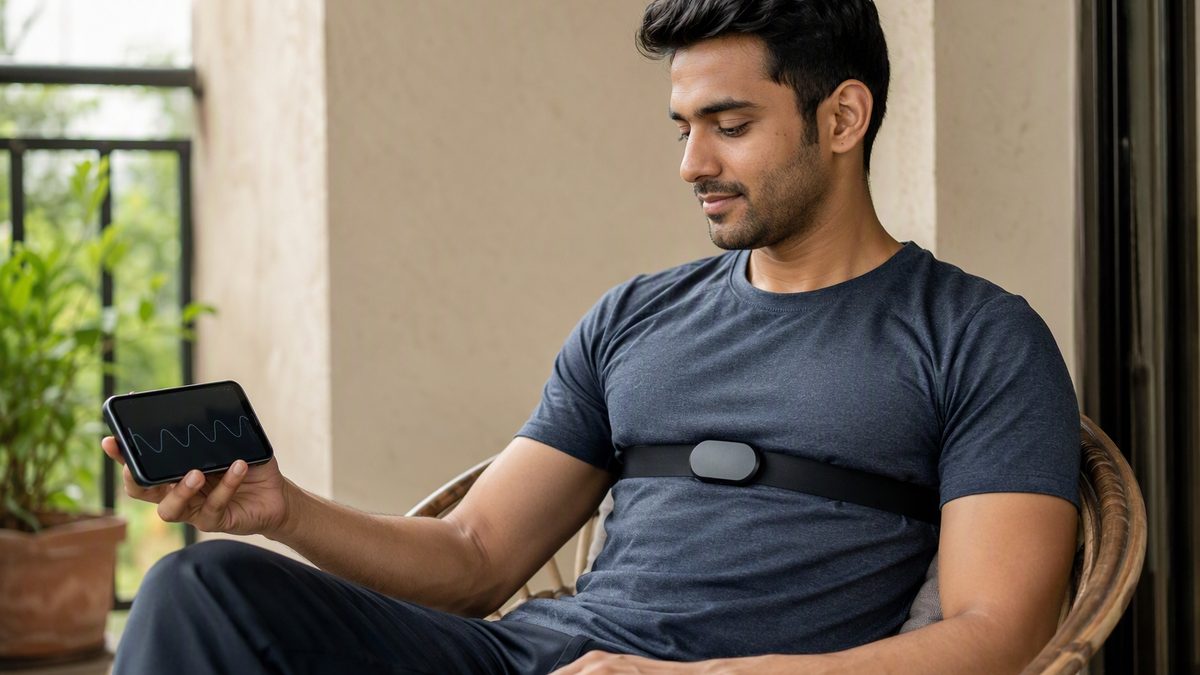
HRV biofeedback fits precisely because it asks for almost nothing: ten minutes, a chair, and a phone. You breathe slowly while watching your heart rate rise and fall, deliberately working the recovery side of your nervous system that your week keeps grinding down. Paired with a glance at your morning HRV trend to decide whether today is a hard or easy day, it becomes a low-friction system for managing both stress and training when your calendar is the boss.
This guide drops the practice straight into your actual week — flights, dinners, early calls — and tells you honestly what to expect from it.
1. Where 10 Minutes Slots Into a 60-Hour Week
Walk through a normal day. You wake — that is your fixed measurement window: a one-minute HRV reading from your ring or strap before you reach for coffee or email, taken the same way every day so the data stays clean. Mid-morning, between a deep-work block and back-to-back calls, is the natural home for a single ten-minute breathing session; it doubles as a reset that sharpens the next two hours. If the day got away from you, the alternative is the wind-down slot — ten minutes after the last email and before sleep, which also helps you actually fall asleep after a stimulating evening.
The genius for your life is that none of this requires a decision. Same dose, same trigger, anywhere: wake reading, mid-morning or pre-sleep breathing, done. It survives the airport, the client dinner, the 6am call, because there is nothing to plan and no gear to pack beyond what is on your wrist. Consistency on most days beats an occasional perfect long session — which is exactly the trade-off a 60-hour week forces anyway.
2. The Resonance Breathing Itself, in Plain Terms
The mechanism is worth thirty seconds of your attention because it explains why ten minutes is enough. Your heart speeds slightly as you breathe in and slows as you breathe out — the slowing is your vagus nerve braking the heart. At about six breaths a minute (five seconds in, five seconds out, no breath-hold), that rise-and-fall hits its maximum and the calming branch of your nervous system gets its strongest, cleanest signal. That is the resonance frequency, and hitting it is the entire skill.
Operationally: open a pacer, breathe smoothly with it, and if your device shows a live heart-rate wave, make that wave swing as wide as you can each breath. No straining, no holding. Over a few weeks you may settle toward a slightly slower personal pace, often between 4.5 and 6.5 breaths a minute. Be clear-eyed on returns. You will feel calmer during and just after most sessions — that part is reliable. Lasting shifts in baseline stress are modest and build slowly. So value it as a dependable reset and stress-management habit, not a performance hack, and never let it become one more thing you stack on top of unaddressed sleep debt.
3. Reading HRV Across Time Zones and Client Dinners
Travel and entertaining are where executives misread the data, so standardise and contextualise. Anchor every reading to your wake-up, not local clock time, take it in the same position, and trust the 7-day rolling average over any single morning. The table is your default operating procedure.
| Trigger | Action | Dose / timing | Why |
|---|---|---|---|
| Every wake-up | HRV reading, same posture, before caffeine and email | 1 min daily | Clean trend across cities |
| Mid-morning gap | Resonance breathing, ~6 breaths/min, no hold | 10 min | Primary stress reset |
| Pre-sleep (fallback) | Resonance breathing, dim room | 10 min | Down-regulate after a stimulating evening |
| Trend normal or up | Run the hard hotel-gym or home session | 1-3 quality sessions/week | Train when recovered |
| Trend suppressed | Easy aerobic, mobility, or rest instead | As flagged | Don't add load to a depleted system |
| Morning after drinks | Expect a low reading; don't over-react | — | Alcohol, not fatigue, is suppressing it |
The single most important line is the last one. Alcohol is often the biggest acute HRV suppressor there is, so the morning after a client dinner your number will dip — that reflects the drinks, not a training problem, and it is not a reason to deload. Read it, note the cause, and carry on. Jet lag and one short night work the same way: the rolling average absorbs them so you are not whipsawed by noise. A late heavy meal, a hot hotel room, and a stressful negotiation all nudge it too, which is precisely why context beats any single number. One more device note: a chest strap captures the heart-beat interval most accurately, a ring works well over still overnight windows, and a wrist optical sensor is fine at rest but noisier with motion — pick one and stop comparing across them, because the numbers simply do not line up between devices.
4. The One Metric to Watch — and What It Can't Fix
You asked the right question already: what single metric should you watch? Your 7-day HRV trend and its direction. Not today's value, not a comparison to a colleague's Whoop — yours is yours, and HRV is not comparable between people. A stable or rising trend says your system is keeping up; a multi-day slide without an obvious cause says the week is winning and something — sleep, load, alcohol, or stress — needs to give. That is a cleaner readiness signal than how you happen to feel after three espressos.
Be honest about the limits. This is a wellness and training tool, not medicine. It can help you manage everyday stress and time your hard days; it cannot offset chronic sleep restriction, and stacking stimulants over sleep debt while a breathing app keeps you calm is a trap, not a strategy. If you are on a heart-rate-affecting medication or have an irregular rhythm, the numbers can read oddly — treat them as informational only. Persistent unexplained low HRV, palpitations, or chest symptoms belong in your next executive physical, not in an app. Within those lines, it is one of the highest-leverage ten-minute habits you can default into.
Questions Busy Executives Ask
What's the minimum effective routine when I'm travelling constantly?
A one-minute morning HRV reading and one ten-minute resonance-breathing session most days. That is the whole floor. The reading tells you whether to push or ease your one hard hotel-gym session; the breathing manages stress and helps you sleep. It needs no gear beyond your watch or ring, so it survives airports and time zones. Consistency on most days matters far more than the occasional perfect long session you'll never reliably get.
Does alcohol at client dinners ruin this?
It doesn't ruin the practice, but it will dent the data — alcohol is often the single biggest overnight HRV suppressor. The morning after, expect a lower reading; that reflects the drinks, not your fitness or training fatigue, so don't deload over it. Note the cause, take an easier session if you also slept poorly, and let your 7-day rolling average smooth it out rather than reacting to the one number.
Can I keep this consistent across time zones?
Yes, if you anchor the reading to your wake-up rather than the local clock and keep the same body position each time. Jet lag and short nights will show as dips, but a 7-day rolling average absorbs them so you're not whipsawed by noise. The breathing session has no timing requirement at all — slot it into any gap. Anchoring to wake-time, not clock-time, is the key to a usable trend on the road.
What single metric should I actually watch?
Your 7-day HRV trend and its direction — nothing else. A single day is noisy; comparisons to a colleague's number are meaningless because HRV is individual. A stable or rising trend means you're keeping up; a multi-day slide with no obvious cause means the week is winning and sleep, load, or stress needs attention. Pair it with how you feel and your resting heart rate for a quick, reliable readiness read.
Disclaimer: This article is for educational purposes only and is not medical advice. Consult a qualified healthcare professional before starting any supplement, nutrition, or training protocol — especially if you are pregnant or breastfeeding, under 18, taking medication, or managing a health condition.
Scientific References & Clinical Sources
- Plews DJ, et al. Training adaptation and heart rate variability in elite endurance athletes: opening the door to effective monitoring. Sports Med, 2013. PMID: 23852425
- Kiviniemi AM, et al. Daily exercise prescription on the basis of HR variability among men and women. Int J Sports Med, 2007. PMID: 17345075
- Peake JM, et al. A Critical Review of Consumer Wearables, Mobile Applications, and Equipment for Providing Biofeedback, Monitoring Stress, and Sleep in Physically Active Populations. Front Physiol, 2018. PMID: 30002629
- Düking P, et al. Criterion-Validity of Commercially Available Physical Activity Tracker to Estimate Step Count, Covered Distance and Energy Expenditure during Sports Conditions. Front Physiol, 2017. PMID: 29018355

