💡 Key Takeaways
- Use your morning HRV trend to place quality work: hard metcons and heavy lifts on normal/high days, easy aerobic or skill on suppressed days — autoregulation that protects you from grinding every WOD.
- Resonance breathing at ~6 breaths/min for 10-20 min down-regulates your nervous system after high-intensity metcons and between two-a-days — reliable acute calm, modest long-term gains.
- HRV reads autonomic recovery, not glycogen or muscle damage — chronic carb under-fueling for your volume will still wreck performance even on a green day.
- A single low reading is noise (alcohol, poor sleep, a brutal session yesterday); react only to your 7-day rolling trend, and respect rhabdo and hydration limits regardless of the number.
Tuesday, 6am, the whiteboard says heavy back squats then a 12-minute chipper, and your PM session is gymnastics skill work. This is the week HRV has to survive — five or six training days stacking strength, metcon, and gymnastics on one recovery budget, with the constant temptation to red-line every piece. The question isn't whether you can do the work; it's whether today is the day to express it.
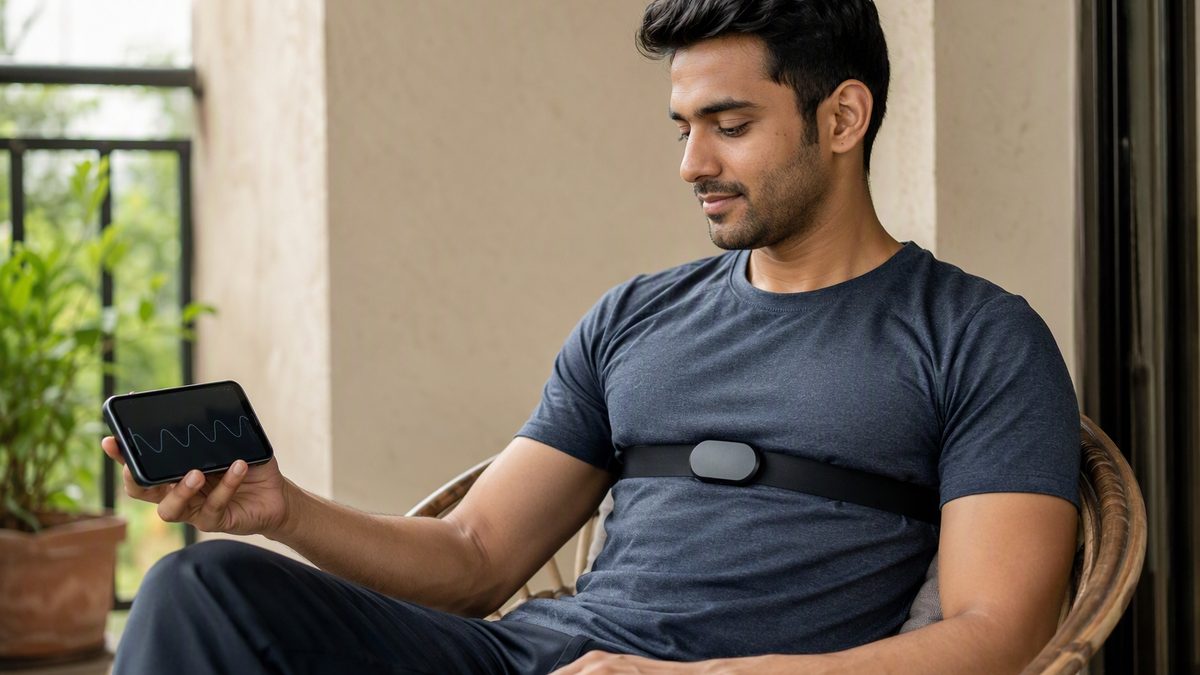
That's exactly what your morning HRV trend answers. It reads how recovered your nervous system is, so you can place quality work on the days your body is ready and pull intensity on the days it isn't. Paired with resonance breathing — slow paced breathing that actively trains the recovery side of your nervous system between sessions — it becomes a practical autoregulation system for the highest mixed-modal load of any athlete.
This guide drops both into your real training week, explains the physiology, and stays honest about what HRV can and can't see in a sport that chews through glycogen.
1. Where HRV Fits a 5-6 Day Mixed-Modal Week
Your week already has a rhythm; HRV just sharpens the dial. Each morning, before the box, take a one-minute reading the same way every day — same time on waking, same position, before caffeine. That number, read as a trend, tells you whether today's planned quality work goes ahead or gets shifted. On a normal or rising trend, attack the heavy lifts and the high-intensity metcon as programmed. On a suppressed trend after a brutal session or bad sleep, swap the red-zone piece for easy aerobic, technique, or mobility and bank the intensity for a recovered day.
The breathing slots into the cracks. Ten to twenty minutes of resonance breathing after a high-intensity metcon helps pull your nervous system out of the post-WOD wired state; another block before sleep on two-a-day nights helps you actually recover for the AM session. The discipline that pays off is consistency — measuring every morning and breathing most days — not occasional heroics. That mirrors how you already know progress works in the box: showing up beats peaking once.
2. Reading the Trend Without Sabotaging Your Programming
The classic CrossFit error is treating every WOD as a test; the classic HRV error is treating every reading as a verdict. Both are over-reactions. Standardise the measurement and watch direction, not single values — the table is your operating procedure.
| Morning trend | Quality session decision | Resonance breathing | Watch for |
|---|---|---|---|
| High or rising | Heavy lifts + hard metcon as programmed | 10-20 min post-session | Don't red-line just because it's green |
| Normal / stable | Proceed as planned, full effort | 10 min pre-sleep | Trust it; this is your baseline |
| Single low day | Keep plan unless you feel awful — it's likely noise | 10-20 min, evening | Alcohol or one hard day yesterday |
| Multi-day decline | Cut intensity: easy aerobic, skill, mobility | 10-20 min, 1-2x daily | Accumulating fatigue or under-fueling |
Two rules keep you sane. First, a single low value is noise — posture, hydration, a few drinks, or yesterday's chipper can drop it, so don't deload over one morning. Second, react to a multi-day slide, especially without an obvious one-off cause: that's real accumulating fatigue and a cue to pull back before it becomes an injury. Measure at ~6 breaths/min only for the breathing practice itself; for your baseline reading, breathe normally, because paced breathing inflates a baseline and corrupts the trend.
3. The Science: Why Slow Breathing Moves the Needle
The engine is respiratory sinus arrhythmia. Your heart speeds slightly on the inhale and slows on the exhale, a vagally driven effect. At around six breaths a minute, the oscillations in heart rate, breathing, and blood pressure synchronise and amplify — the cardiovascular resonance frequency — producing the biggest swing in heart rate per breath and the largest acute rise in HRV. Breathing there is literally training the baroreflex and vagal control of your heart, which is the recovery machinery a high-volume athlete leans on hardest.
HRV itself is the beat-to-beat variation in your heartbeat — a window onto autonomic balance, where more vagal influence means higher variation. The go-to metric for short recordings is rMSSD, weighted toward the parasympathetic side and fairly stable; apps often log its natural log to tame skew, and values are individual, so only your own trend matters. The evidence is honestly modest: HRV-guided training has matched or slightly beaten fixed plans in several studies by concentrating hard work on ready days, and biofeedback reliably calms you in-session with smaller lasting effects. It's a refinement of good programming, not a magic edge — useful framing if you're scanning the latest fitness trends for a shortcut that doesn't exist.
4. What HRV Can't See: Glycogen, Rhabdo, and Hydration
Here's the limit that bites CrossFitters specifically: HRV reads autonomic recovery, not fuel. You can post a green morning while running on chronically depleted glycogen, because under-fueling carbs for your volume is a metabolic problem, not an autonomic one. A green light is permission to train hard, not evidence you've eaten enough — so keep your carbohydrate intake matched to the work regardless of the number. The data times your hard days; it doesn't fuel them.
The safety lines stand independent of HRV too. Extreme-intensity metcons carry a real, if rare, rhabdomyolysis risk — dark urine, severe localised swelling, and disproportionate pain after a high-volume eccentric piece are medical emergencies no recovery score overrides. High-sweat metcons demand real hydration; don't let a good reading lull you into skipping it. And if you're on a heart-rate-affecting medication or have an irregular rhythm, the numbers can read oddly. Treat HRV as one input alongside how you feel, your resting heart rate, and your sleep — a smarter way to place training, not a substitute for fueling, hydrating, or listening to genuine warning signs.
Two final habits keep the data clean across a competitive block. Stick to one device and don't compare your numbers to a teammate's — HRV is individual and not comparable between people, and readings drift between gadgets. And resist reading too much into a single biofeedback session: the in-session HRV jump is an acute effect, not a new baseline, so judge progress by your weekly trend rather than one good screen. Pair that discipline with carbs matched to your volume and honest sleep, and HRV becomes a quiet edge in placing the quality work that actually moves your numbers.
CrossFit Competitors' HRV Questions
Will this help my Fran time, or just my strength?
Neither directly — HRV tools don't build your engine or your lifts. What they do is help you place hard quality work on days your nervous system is recovered, so the sessions that actually improve Fran land when you can hit them hardest. Over a block, training your tough metcons on ready days and easing off on flat ones tends to beat grinding every day. The breathing aids recovery between sessions; it won't shortcut conditioning.
How do I time it around two-a-days?
Take the HRV reading once, on waking, before either session — that's your trend input for the day. Slot resonance breathing into the gaps: 10-20 minutes after a hard AM or PM metcon to down-regulate, and another block before sleep on two-a-day nights to recover for tomorrow's first session. Keep the morning baseline reading at normal breathing; only use ~6 breaths/min for the actual practice, since paced breathing during a baseline reading inflates it.
Does it matter during the Open?
It can help you arrive at each Open workout fresher by guiding your week's load and managing nerves with breathing, but don't over-read it during a high-stress competition stretch — anxiety and disrupted sleep will suppress HRV without meaning you're unfit. Use the trend to plan your retest timing and recovery days, and use resonance breathing to settle pre-workout. Just remember it reads autonomic state, not your actual capacity on the day.
What about workouts where I hit the red zone hard?
HRV won't protect you from the red zone's real risks — it reads recovery, not muscle damage or hydration status. Extreme-intensity, high-volume metcons carry a small rhabdomyolysis risk: dark urine, severe swelling, or disproportionate pain afterward needs medical attention no matter what your morning score said. Hydrate properly for high-sweat pieces regardless of a green reading. Use HRV to decide whether to enter the red zone today, then respect the safety signals independently.
Disclaimer: This article is for educational purposes only and is not medical advice. Consult a qualified healthcare professional before starting any supplement, nutrition, or training protocol — especially if you are pregnant or breastfeeding, under 18, taking medication, or managing a health condition.
Scientific References & Clinical Sources
- Kiviniemi AM, et al. Daily exercise prescription on the basis of HR variability among men and women. Int J Sports Med, 2007. PMID: 17345075
- Plews DJ, et al. Training adaptation and heart rate variability in elite endurance athletes: opening the door to effective monitoring. Sports Med, 2013. PMID: 23852425
- Peake JM, et al. A Critical Review of Consumer Wearables, Mobile Applications, and Equipment for Providing Biofeedback, Monitoring Stress, and Sleep in Physically Active Populations. Front Physiol, 2018. PMID: 30002629
- Düking P, et al. Criterion-Validity of Commercially Available Physical Activity Tracker to Estimate Step Count, Covered Distance and Energy Expenditure during Sports Conditions. Front Physiol, 2017. PMID: 29018355

