💡 Key Takeaways
- HRV biofeedback is just slow paced breathing at about 6 breaths a minute while watching a heart-rate readout, low-risk and not a supplement or drug, but loop in a parent and don't let it override sleep or food.
- Your HRV number is yours alone, it can't be compared to a teammate's, and it shifts with your growth, so track only your own trend over weeks.
- Acute calm before a game or a test is the well-supported effect; lasting baseline changes are modest, so use it as a stress skill, not a performance hack.
- Minors' health data is sensitive, keep parents in the loop on any tracking app, and remember sleep (8-10 hours) and real meals do far more for a growing athlete than any breathing metric.
The question a lot of teenage athletes type is blunt: is HRV biofeedback safe for someone my age, and does my HRV number actually mean anything yet? Fair questions, because your feed is full of pro athletes and influencers talking about HRV like it's a secret weapon.
The honest three-sentence answer: yes, HRV biofeedback is low-risk, because it's nothing more than breathing slowly while watching your heart rate, no pills, no drugs, nothing to fail a drug test. But your HRV number is personal to you and shifts as you grow, so it can't be compared to a teammate's and only your own trend matters. And the biggest wins for a growing athlete are sleep and food, not a breathing app, so treat this as a calm-down skill, not a shortcut, and keep a parent in the loop.
This page answers what it actually is, whether it's safe at your age, what your number means while you're still growing, and how to use it around school, practice and games without overthinking it.
1. What It Actually Is (No Pills, No Drug-Test Worry)
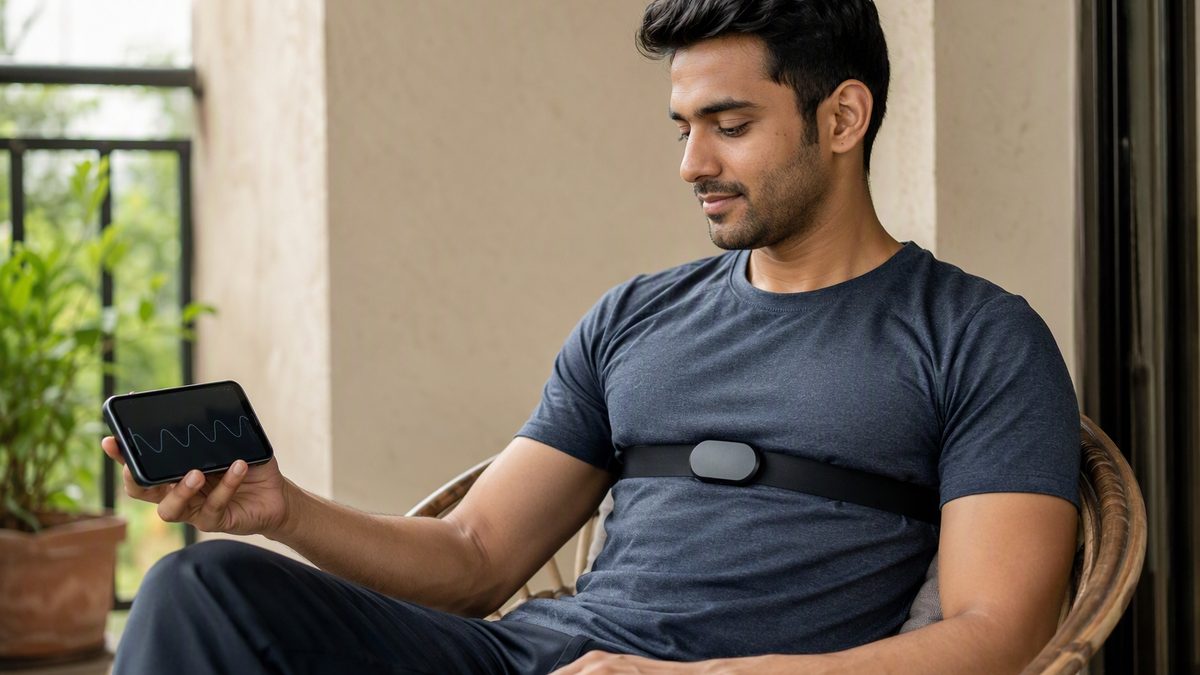
First, what HRV biofeedback is not. It is not a supplement, a powder, or anything you swallow, so there's nothing here to clear with an anti-doping list, and nothing to hide from a coach. It's a skill. You breathe slowly, about six breaths a minute, roughly five seconds in and five seconds out, while watching a live readout of your heart rate or HRV, and you try to make your heart rate swing up and down as much as possible with each breath.
Here's why that works. Your heart speeds up a little when you breathe in and slows when you breathe out. Around six breaths a minute, those swings line up with your breathing and blood pressure and get bigger, which is your body's natural resonance. Doing it on purpose trains the calming, rest-and-digest side of your nervous system, the vagal side, to take more control. HRV, the beat-to-beat variation in your heartbeat, is basically a window onto that balance.
Because it's just breathing, the risk is very low. The main rule is gentle: keep the breaths smooth, never strain, and stop if you feel dizzy or short of air. And before you make it a habit, tell a parent what you're doing, the same way you'd tell them about any new training routine. This isn't medical advice, and a tracking app holding your heart data is something a parent should know about.
2. Does the Number Even Mean Anything While You're Growing?
This is the part most teens get wrong because of social media. Your absolute HRV number depends heavily on age, genetics and fitness, and it is not comparable to anyone else. A teammate's higher number does not mean they're fitter or healthier than you, and your lower number doesn't mean you're behind. Only your own trend over time tells you anything useful, so ignore the comparison entirely.
On top of that, you're still growing, which adds noise. Your body, hormones and fitness are all changing, so your baseline isn't fixed the way an adult's is. Single readings are noisy anyway, swayed by posture, sleep, hydration and measurement error, so one low morning means almost nothing. Track a seven-day rolling trend and watch its direction, not any single day, and read it next to how you actually feel and your resting heart rate.
And about that fancy watch or ring: for HRV, a chest strap is the accurate reference, while wrist and ring sensors are noisier, especially during movement. Their calorie and recovery scores are rough estimates, not medical readings. So use any device for your own relative trend, never to compare with a friend or to treat a low score as a diagnosis. Honestly, you don't need a device at all to do the breathing, the calming effect happens whether or not you're tracking a number.
3. Fitting It Around School, Practice and Game Day
The realistic place this helps you is stress, not pace. Acute calm before something nerve-wracking is the well-supported effect, so the smart uses are pre-game nerves, pre-test anxiety, and winding down at night when your brain won't shut off after a late game. The table maps it onto a normal student-athlete week.
| Moment in your week | Breathing pace | How long | What it's for |
|---|---|---|---|
| Pre-game nerves | ~6 breaths/min (5s in, 5s out) | 5 min before warm-up | Settle nerves, steady focus |
| Before a big test or presentation | ~6 breaths/min | 3-5 min at your desk | Lower test-day anxiety |
| Wind-down after a late game | ~6 breaths/min, long exhale | 10 min in bed, lights off | Fall asleep faster |
| Building the habit (most days) | ~6 breaths/min, no breath-hold | 10-15 min | Practice the skill, refine your pace |
Keep it simple and don't let it crowd out what actually moves the needle. Teens need 8-10 hours of sleep and rarely get it, and real meals fuel your growth and your training far more than any breathing metric. Breathing is a calm-down tool that slots into your routine, not a replacement for sleep or food, and copying a pro's elaborate HRV setup is exactly the kind of influencer trap to skip. If you want help making good habits stick, our guide to building fitness habits is a sensible place to start.
4. Keeping Parents in the Loop and the Medical Line Clear
Two boundaries matter at your age. First, privacy and oversight. Your health data, heart rate, sleep, stress, is sensitive, and you're a minor, so a parent should know which app you're using and what it collects. This page isn't medical advice, and bringing a parent and, where relevant, a coach or clinician into the conversation is the grown-up move, not a babyish one. They can also help you keep perspective when a number worries you.
Second, the medical line. HRV biofeedback is a self-regulation skill, not a treatment, and a wearable's HRV is a prompt to pay attention, never a diagnosis. If you have real anxiety that's affecting your life, a heart condition, palpitations, chest pain or breathlessness, that's a conversation with a doctor and a parent, not something to breathe away with an app. Don't let a green score talk you out of seeing a clinician when something feels wrong.
And keep the confounders honest, because they hit teens hard. Energy drinks late in the day, short sleep, skipped meals and stress all suppress HRV, so a low reading after a 2am phone session reflects that, not your training. The fix isn't a fancier breathing protocol, it's the boring basics, sleep, food, and telling the adults around you what's going on.
HRV Biofeedback Questions Teen Athletes Ask
Is HRV biofeedback safe for my age?
Yes, it's low-risk because it's just slow breathing while watching your heart rate, no supplement, no drug, nothing to fail a test. The only rule is gentle: keep breaths smooth, never strain, and stop if you feel dizzy. Tell a parent what you're doing, since a tracking app holds your health data and you're a minor. If you have any heart or breathing condition, check with a doctor and a parent first.
Will it stunt my growth or change my hormones?
No. HRV biofeedback is breathing, not a chemical, so there is no plausible way it affects growth plates, height or hormones, that worry belongs to actual supplements and drugs, not to slow breathing. What genuinely supports your growth is sleep and food. If anyone is selling you pills or powders alongside 'HRV training,' that's the part to question with your parents, not the breathing itself.
Do I even need this if I eat well and sleep enough?
Need is strong, no. Sleep (8-10 hours) and real meals do far more for a growing athlete than any breathing metric, so if those are solid, you're already ahead. HRV biofeedback is a nice extra skill for calming pre-game or pre-test nerves and winding down after late games. Use it for that, but never let it replace, or distract you from, the basics that actually fuel your training and growth.
Should my parents and coach know I'm tracking this?
Yes. You're a minor, and your heart-rate, sleep and stress data is sensitive, so a parent should know which app you use and what it collects. There's no reason to hide breathing practice, and looping in a parent (and your coach if it affects training) is the responsible move. They can also help you keep perspective, since a single low HRV reading is noisy and means little on its own at your age.
Disclaimer: This article is for educational purposes only and is not medical advice. Consult a qualified healthcare professional before starting any supplement, nutrition, or training protocol — especially if you are pregnant or breastfeeding, under 18, taking medication, or managing a health condition.
Scientific References & Clinical Sources
- Plews DJ, et al. Training adaptation and heart rate variability in elite endurance athletes: opening the door to effective monitoring. Sports Med, 2013. PMID: 23852425
- Kiviniemi AM, et al. Daily exercise prescription on the basis of HR variability among men and women. Int J Sports Med, 2007. PMID: 17345075
- Peake JM, et al. A Critical Review of Consumer Wearables, Mobile Applications, and Equipment for Providing Biofeedback, Monitoring Stress, and Sleep in Physically Active Populations. Front Physiol, 2018. PMID: 30002629
- Düking P, et al. Criterion-Validity of Commercially Available Physical Activity Tracker to Estimate Step Count, Covered Distance and Energy Expenditure during Sports Conditions. Front Physiol, 2017. PMID: 29018355

