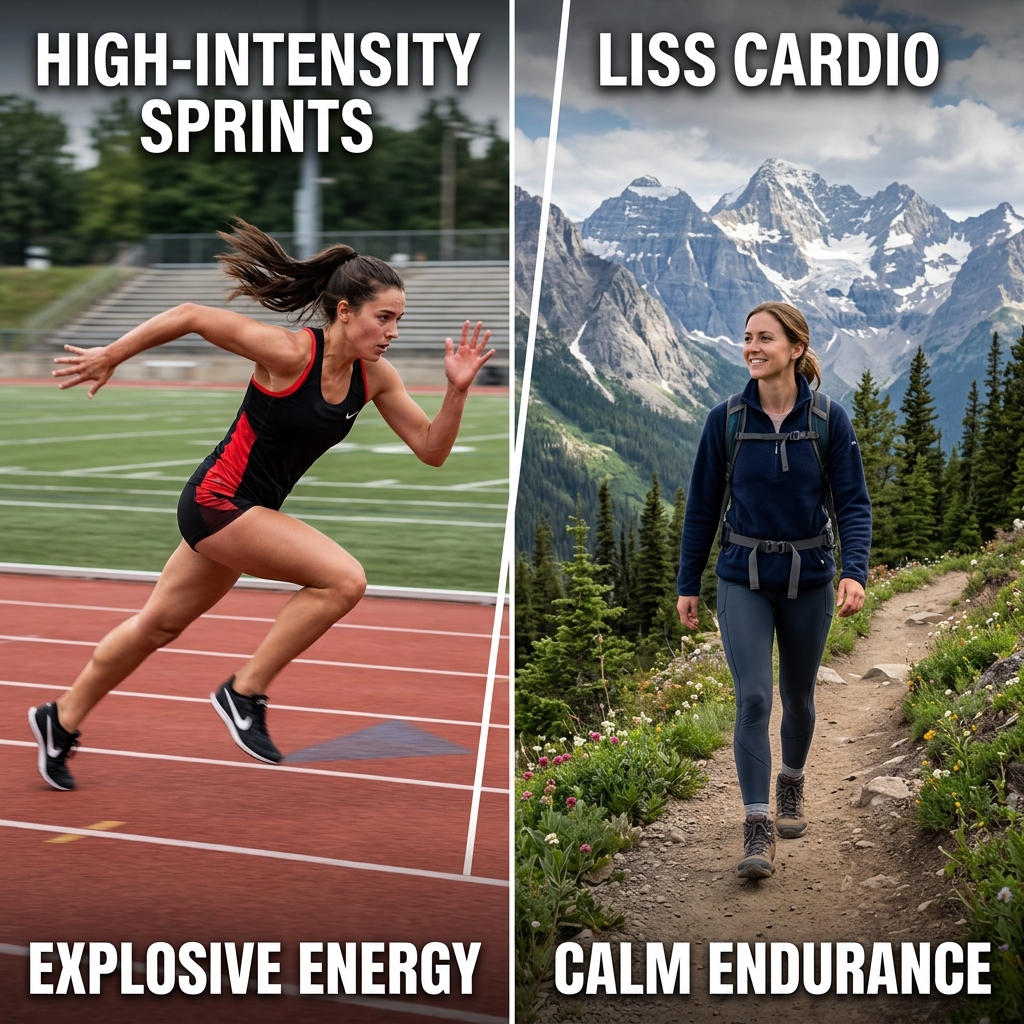
Cardio is polarizing: some athletes do hours of steady-state running; others swear by 20-minute HIIT sessions. The truth: both work, for different purposes. This guide breaks down HIIT (high-intensity interval training), LISS (low-intensity steady-state), when to use each, and how to program cardio without sacrificing strength or muscle.
HIIT vs LISS: Fundamental Differences
HIIT (High-Intensity Interval Training)
- Structure: Alternating hard efforts (85-95% max HR) with recovery periods (50-60% max HR)
- Duration: 15-30 min total (including warm-up/cool-down)
- Examples: 30 sec sprint / 30 sec rest (repeats 10-20x), or Tabata (20 sec max effort / 10 sec rest)
- Energy system: Anaerobic + aerobic; burns glycogen + fat
- Fat loss: Burns 25-30% MORE calories per minute than LISS
- EPOC (afterburn): Elevated metabolic rate for 24-48 hours post-workout (modest effect, ~5-10% extra burn)
LISS (Low-Intensity Steady-State Cardio)
- Structure: Constant, moderate effort (55-70% max HR) for extended duration
- Duration: 30-60 min
- Examples: Jogging, cycling, swimming at conversational pace
- Energy system: Aerobic; burns fat primarily (30-50% comes from fat oxidation)
- Fat loss: Burns fewer calories per minute but more total calories per session (longer duration)
- Recovery: Parasympathetic activation; actually facilitates recovery
Which is Better for Fat Loss?
Short answer: HIIT is more efficient time-wise; LISS burns more total fat.
Comparison (30-minute session):
- HIIT: 15 min total time (5 min warm-up + 10 min intervals + 5 min cool-down) = 200-250 cal burned
- LISS: 30 min steady-state = 250-300 cal burned
The winner: For fat loss with minimal time, HIIT wins. For total fat oxidation and recovery, LISS wins.
The Optimal Cardio Program (Combining Both)
Program Structure
- HIIT: 1-2x weekly (15-20 min per session)
- LISS: 2-3x weekly (20-40 min per session)
- Total weekly cardio: 60-100 min
Why this combination works:
- HIIT provides time-efficient calorie burn + metabolic boost
- LISS provides additional fat oxidation + parasympathetic recovery
- Together: maximum fat loss while preserving muscle and strength
Sample Weekly Structure
- Monday: Strength training (push) + LISS walk (20 min post-workout)
- Tuesday: HIIT session (20 min)
- Wednesday: Strength training (pull) + LISS cycle (30 min post-workout)
- Thursday: LISS run (40 min, easy pace)
- Friday: Strength training (legs) + HIIT finisher (15 min post-workout)
- Saturday: LISS activity (hike, swim, cycle, 45-60 min)
- Sunday: Rest or light mobility
HIIT Protocols: Science-Backed Structures
Tabata (Optimal for time constraints)
- 20 sec max effort + 10 sec rest, repeat 8x (4 min total per exercise)
- Do 3-4 different exercises, rest 1 min between exercises
- Total: 16-20 min
- Effect: Massive calorie burn, VO2 max improvement
- Example: 20 sec burpees / 10 sec rest (8x), rest 1 min, 20 sec jump squats / 10 sec rest (8x)
30:30 Protocol (Easier to sustain)
- 30 sec hard effort + 30 sec recovery, repeat 10-15x
- Less aggressive than Tabata; better for beginners
- Total: 10-15 min intense work
- Example: 30 sec sprint / 30 sec jog (repeats 12x)
Pyramid Intervals (Advanced)
- 30 sec / 1 min / 2 min hard efforts with equal recovery
- Then reverse: 2 min / 1 min / 30 sec
- Total: 20 min intense work
LISS Protocols
Zone 2 Cardio (Recovery-Focused)
- Heart rate: 55-70% max HR (where you can hold a conversation)
- Duration: 30-60 min
- Benefit: Builds aerobic base, increases mitochondrial density, aids recovery
- Best for: Beginners, off-season, recovery weeks
Tempo/Threshold Cardio (Performance-Focused)
- Heart rate: 70-85% max HR (challenging but sustainable)
- Duration: 20-40 min
- Benefit: Improves lactate threshold, endurance capacity
- Best for: Athletes training for cardiovascular events
Common Cardio Mistakes
Mistake #1: Too Much HIIT
More than 2-3x weekly HIIT increases injury risk, impairs recovery, and eats into strength gains. HIIT is supplementary, not primary.
Mistake #2: Doing HIIT on Strength Days
Hard cardio before or after heavy lifting impairs strength performance and recovery. Do HIIT on separate days or use 10-minute finishers maximum post-workout.
Mistake #3: Zero Cardio on a Bulk
Cardiovascular fitness maintains conditioning without killing gains. 20-30 min LISS 2-3x weekly doesn't impair muscle growth.
Mistake #4: Steady-State Only, No Intensity
Pure LISS aerobic work is inefficient for fat loss if time is limited. Add 1-2x weekly HIIT for acceleration.
Cardio & Muscle Preservation
Will cardio kill your gains? No, if programmed correctly.
Key principles:
- Keep cardio volume 60-100 min/week (above this impairs strength recovery)
- Prioritize strength training (don't let cardio crowd it out)
- Eat sufficient calories/protein (cardio + deficit is brutal on muscle)
- LISS is better for muscle preservation than HIIT (less catabolic)
Example: 12-Week Fat Loss Protocol with Cardio
Training: 4x strength weekly + 3x cardio (1 HIIT, 2 LISS)
Nutrition: 400-500 cal deficit, 1g protein per lb, track macros
Expected result: 8-12 lbs fat loss, minimal muscle loss, improved conditioning
Research Backing HIIT & LISS Effectiveness
Key studies validating cardio modalities:
- Gibala et al. (2006): Journal of Applied Physiology showed HIIT (6x30 sec sprints) improved VO2 max 25% comparable to 40 minutes steady-state cycling. Proves HIIT's time-efficiency
- Stensvold et al. (2016): Medicine & Science in Sports & Exercise meta-analysis found HIIT more effective for fat loss (especially visceral/belly fat) vs LISS alone
- Helgerud et al. (2007): Found maximal oxygen uptake improvements with 4x(4 min HIIT + 3 min recovery) format; still superior to continuous moderate-intensity
- Kessler et al. (2012): American Journal of Physiology shows LISS preserves muscle better than HIIT during calorie deficit (important for strength athletes)
Translation: HIIT is superior for time-efficient fat loss and cardio adaptation; LISS is superior for muscle preservation. The optimal approach combines both.
Cardio During Different Training Phases
Cutting Phase (Fat Loss Goal):
- 2-3x weekly LISS (20-40 min): Preserves muscle during deficit
- 1x weekly HIIT (15-20 min): Accelerates fat loss beyond dietary deficit alone
- Total: 60-90 min weekly cardio
- High protein intake (1.1-1.3g per lb) critical to mitigate muscle loss
Bulking Phase (Muscle Gain Goal):
- 2x weekly LISS (20-30 min): Maintains conditioning, supports cardiovascular health
- Zero HIIT (recovery-intensive; competes with muscle-building stimulus)
- Total: 40-60 min weekly cardio maximum
- Excessive cardio during surplus reduces muscle gain efficiency
Maintenance/Recomposition Phase:
- 2x weekly LISS (30 min) + 1x HIIT (20 min)
- Total: 80-100 min weekly cardio
- Balanced approach supports both strength & conditioning
Advanced Measurement: Tracking Cardio Adaptations
Metrics showing you're improving (beyond just calories):
- Resting Heart Rate: Target -5 bpm improvement over 8 weeks. Lower RHR = better cardiovascular efficiency
- Heart Rate Recovery: After HIIT session, measure HR 2 minutes post-workout. Better athletes recover faster (drop 50+ bpm)
- VO2 Max Estimation: Use the 12-minute run test. Cover your max distance weekly. 10%+ improvement in 8 weeks indicates real fitness gains
- Power Output: If cycling, track watts for same effort. 20+ watt improvement = increased fitness
Don't just chase calories. Track fitness metrics. They're more reliable indicators of adaptation than calorie estimates (which are often inaccurate).
Common HIIT vs LISS Misconceptions
Myth #1: "HIIT burns fat for 48 hours after (afterburn effect)"
Reality: EPOC (excess post-exercise oxygen consumption) exists but is modest (~5-10% extra calorie burn). It's not magical. 30-minute LISS burns more total calories than 15-minute HIIT; total calories burned matter most for fat loss.
Myth #2: "Cardio kills muscle growth"
Reality: Moderate cardio (60-100 min/week) doesn't impair muscle gain if calories/protein are adequate. Extreme cardio (200+ min/week) competes with recovery. It's a volume issue, not a modality issue.
Myth #3: "LISS is always better for preservation"
Reality: Intensity, not modality, determines muscle loss. 2x weekly 40-minute LISS = same muscle loss risk as 2x weekly HIIT if calories/protein are controlled. Both work; pick what you'll stick with.