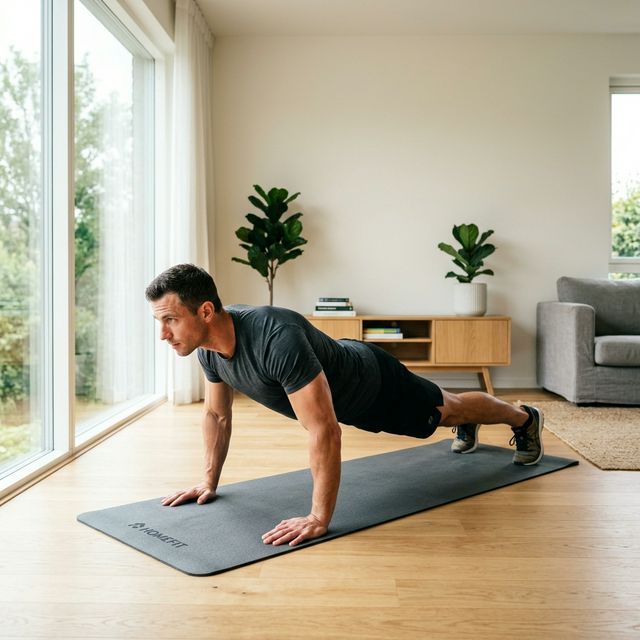
You can build serious muscle at home. Not "get in shape" — actual, visible muscle gain. The key is understanding progressive overload with bodyweight, smart equipment choices, and programming that matches gym intensity. This guide covers everything from zero-equipment training to a modest home setup that rivals many gyms.
Can You Actually Build Muscle at Home?
Yes. The two drivers of muscle growth are:
- Progressive overload: Gradually increasing difficulty over time (more reps, harder variations, slower tempo)
- Sufficient protein & calories: Nutrition, not location
A home gym with dumbbells can match a commercial gym. Bodyweight alone can build muscle if you progress smartly. The limiting factor is usually programming and commitment, not equipment.
Equipment Hierarchy: What to Buy (And When)
Zero Equipment (Free)
- Push-ups, pull-ups (if you have a door frame), squats, lunges, planks, dips (on a chair)
- Time to plateau: 8-12 weeks (you'll max out reps quickly)
- Muscle potential: Build 5-10 lbs muscle with perfect programming and nutrition
Minimal Equipment (Essential, $200-400)
- Adjustable dumbbells: 5-50 lbs ($200-300). Single best investment for home training
- Pull-up bar: Door-mounted ($20-50)
- Resistance bands: $30-50
- Bench (optional, foldable): $100-150
Time to plateau: 6+ months (sufficient for significant muscle gain)
Moderate Setup ($800-1,500)
- Adjustable dumbbell set (5-80 lbs)
- Barbell + weight plates (140 lbs minimum)
- Squat rack or power rack
- Adjustable bench
- Pull-up bar
Potential: Match a commercial gym. Build 20-30+ lbs muscle over 12 months of proper training.
Progressive Overload at Home: The Strategy
With Dumbbells
- Week 1-2: 20 lb dumbbells for dumbbell press, 8 reps per set
- Week 3-4: 20 lbs, 10 reps per set (added reps)
- Week 5-6: 25 lbs, 8 reps per set (increased weight, reset reps)
- Pattern repeats: Every 6-8 weeks, you get heavier
With Bodyweight
- Push-ups: Standard → Diamond → Pseudo-planche → Archer push-ups (progressively harder)
- Squats: Standard → Pistol squat progression (single-leg)
- Pull-ups: Assisted (bands) → Standard → Weighted (wear a backpack with books)
- Tempo: Slow down the eccentric (lowering) phase. 3-second lowering increases difficulty
Sample Home Workout Programs
Zero Equipment Upper/Lower (4x weekly, Bodyweight)
Upper Body Day: 3 sets each
- Push-ups: 10-15 reps (or progression)
- Pull-ups (or rows using door): 5-10 reps
- Dips (on chair): 8-12 reps
- Pike push-ups: 8-12 reps
- Plank: 45-60 sec
Lower Body Day: 3 sets each
- Squats: 15-20 reps
- Reverse lunges: 10-12 reps each leg
- Single-leg deadlifts: 8-10 reps each
- Calf raises: 15-20 reps
- Glute bridges: 12-15 reps
Dumbbell Program (3x weekly, Full-Body)
Day 1 & 3: Lower focus
- Dumbbell goblet squats: 4x8-12
- Dumbbell deadlifts: 4x5-8
- Bulgarian split squats: 3x8-10 each
- Dumbbell rows: 3x8-12
Day 2: Upper focus
- Dumbbell bench press: 4x8-12
- Dumbbell rows: 4x8-12
- Shoulder press: 3x8-10
- Dumbbell curls + tricep extensions: 3x10-12
Common Home Training Mistakes
Mistake #1: Never Increasing Difficulty
Doing the same push-ups for 6 months builds no new muscle. Progress: increase reps to 20, then add weight, then try harder variations.
Mistake #2: Avoiding Leg Training
Legs are easy at home: squats, lunges, deadlifts (with dumbbells) build serious muscle. No excuses.
Mistake #3: Workout Too Short
Home workouts should be 45-60 min with proper rest between sets. 10-15 min "quick workout" won't build muscle.
Mistake #4: Poor Form Due to No Feedback
Film yourself. Compare to YouTube tutorials. Bad form = no muscle growth + injury risk.
Sample 12-Week Bodyweight Progression Plan
Week 1-4: Master form. 3x per week upper/lower split. Standard push-ups, squats, rows.
Week 5-8: Progress. Push-ups → Diamond. Squats → Single-leg focus. Rows → Archer rows. Add 2-3 reps weekly.
Week 9-12: Advanced variations. Pseudo-planche push-ups. Pistol squat progressions. Weighted dips (backpack with weight).
Expected muscle gain: 3-5 lbs visible muscle if nutrition is perfect (surplus, 1g protein/lb), training consistent
Nutrition for Home Training
Location doesn't matter. Nutrition does.
- Protein: 0.8-1.0 g per lb bodyweight (critical for muscle growth)
- Calories: Slight surplus (+300 cal) for muscle gain, or maintenance for recomposition
- Meal prep: Even more important at home (no gym environment to motivate)
Home Gym Setup Guide ($300 Minimal Investment)
Priority 1 ($200-300): Adjustable dumbbells (5-50 lbs). Absolute game-changer. Enables hundreds of exercises.
Priority 2 ($20-50): Pull-up bar. Door-mounted. Essential for pull-ups, hanging exercises.
Priority 3 ($30-50): Resistance bands. Add difficulty to bodyweight movements.
Priority 4 (Optional, $100-150): Bench. Enables dumbbell pressing variations.
Total minimal gym: $300-500. Potential: Build 15-20 lbs muscle in 12 months with proper training + nutrition.**
Research on Home vs Gym Training: Muscle Building Outcomes
Studies comparing training environments:
- Schoenfeld et al. (2014): Journal of Sports Sciences showed untrained subjects gained similar muscle using bodyweight exercises vs gym equipment IF relative intensity (proximity to failure) was matched
- Lasevicius et al. (2018): Journal of Sports Sciences: muscle growth similar between bodyweight (progressive variations) and resistance training when volume and intensity were equated
- Implication: Location irrelevant. Progressive overload + adequate stimulus + protein + calories = growth, regardless of where training happens
Progressive Overload Strategies for Home Training (No Equipment)
Beyond "more reps" — here are six ways to progress:
1. Tempo Manipulation: Push-ups normally 2 sec down, 1 sec up. Extend to 3-4 seconds down, 2 second pause at bottom. Same reps, dramatically harder (increases time under tension 50-100%).
2. Range of Motion Increase: Regular push-up → deficit push-up (hands on plates, chest lower toward ground). Squat → full range pistol squat. More distance = more stimulus.
3. Variation Progression: Push-ups → Diamond push-ups → pseudo-planche push-ups → full planche progressions. Each variation harder than last with same movement pattern.
4. Isometric Holds: Add 2-3 second pause at hardest position (bottom of push-up, parallel in squat). Massively increases difficulty without equipment.
5. Single-Limb Variations: 2-leg squats → Bulgarian split squats → pistol squat progressions. 1-leg variations 2-3x more challenging than bilateral.
6. Volume Accumulation: Weekly reps tracked. Week 1: 50 total push-up reps. Week 4: 70 reps in same sets. Simple but effective.
Research backing tempo training: Schoenfeld et al. (2015) in Sports Medicine showed increasing time under tension (slow tempo, 3-5 second eccentric) drives muscle growth similarly to heavy loads. Bodyweight with slow tempo = serious stimulus.
Common Home Training Mistakes
Mistake #1: Endless Reps With No Intensity
100 push-ups daily won't build muscle if they're easy. Progressive overload matters. Once 20 reps feels easy, move to a harder variation.
Mistake #2: Skipping Pulling/Back Work (No Pull-Up Bar)
Consequence: Anterior-dominant development (chest, shoulders forward, bad posture). $20 pull-up bar fixes this. If truly unavailable, resistance bands for rows work, but suboptimal.
Mistake #3: Ignoring Nutrition
You can't outtraining a bad diet. Home training doesn't excuse missing protein/calorie targets. If anything, nutrition becomes MORE important (less gym environment cues/accountability).
Mistake #4: No Periodization
12 weeks of random bodyweight movements = slow progress. Structure: 4 weeks foundation, 4 weeks progression, 4 weeks peak difficulty. Reset and repeat.
Remote Coaching & Accountability for Home Athletes
Home training lacks external accountability. Solutions:
- Track workouts in app: Strong, Hevy, or even Google Sheets. Visible progress motivates continuation
- Film sets: Send form videos to online coach for feedback (many coaches offer $50-100 form checks)
- Join online communities: Reddit r/bodyweightfitness, Discord servers for accountability
- Use spreadsheet templates: Pre-built progressions remove decision fatigue (r/bodyweightfitness has free routines)