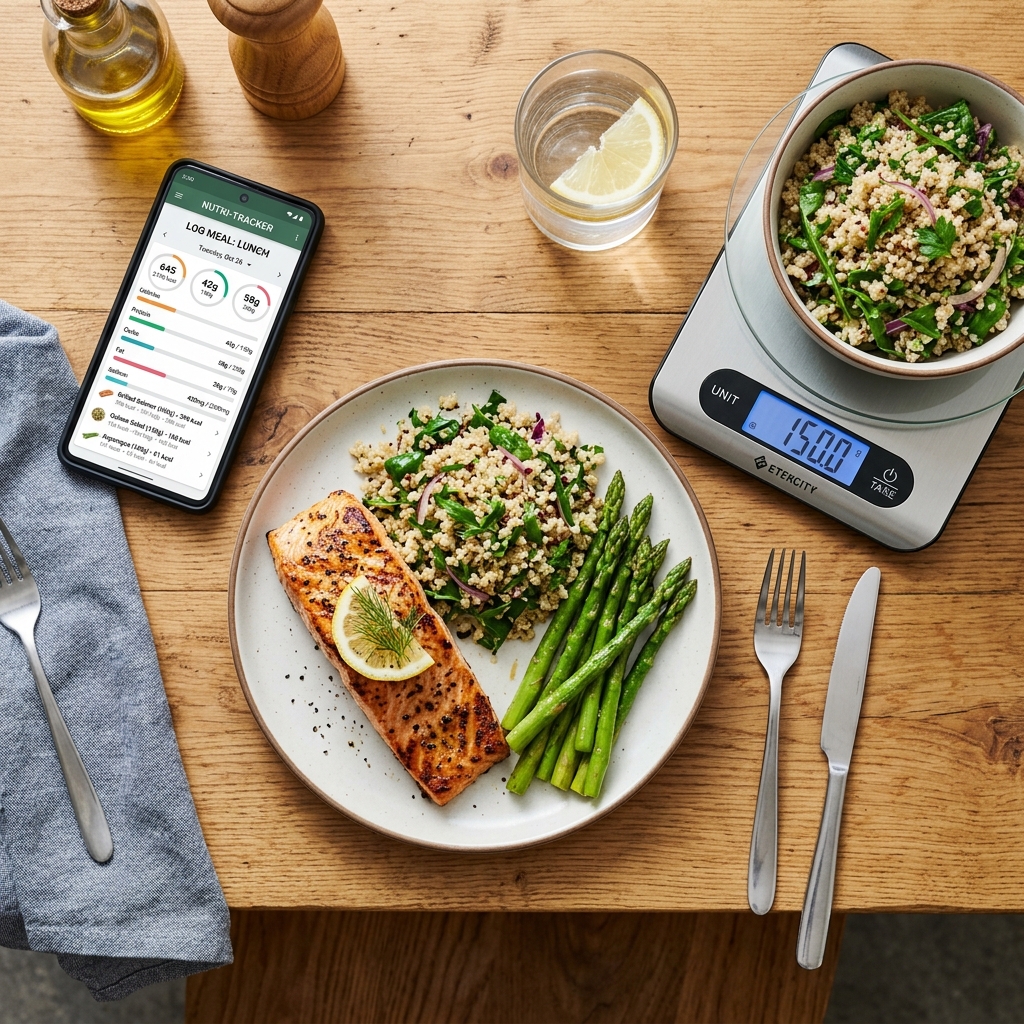
If you've ever wondered why some people can eat a lot and still lose fat while others starve themselves and barely see results — the answer almost always comes down to macros. Not just how much you eat, but what you eat.
This guide will teach you everything you need to know about tracking macronutrients for fat loss — from understanding what macros are, to calculating your personal targets, to actually tracking them consistently without losing your mind.
What Are Macros (Macronutrients)?
Macronutrients are the three types of nutrients your body needs in large amounts to function:
- Protein (4 calories per gram) — Builds and repairs muscle, keeps you full, and has the highest thermic effect (your body burns ~25% of protein calories just digesting it)
- Carbohydrates (4 calories per gram) — Your body's primary energy source, fuels workouts, and supports brain function
- Fats (9 calories per gram) — Essential for hormone production, nutrient absorption, and cell health
Step 1: Calculate Your TDEE (Total Daily Energy Expenditure)
Before setting macro targets, you need to know how many calories your body burns each day. This is your TDEE.
How to calculate TDEE
- Find your BMR (Basal Metabolic Rate) — the calories your body burns at rest. The Mifflin-St Jeor equation is the most accurate:
- Men: BMR = (10 × weight in kg) + (6.25 × height in cm) − (5 × age) + 5
- Women: BMR = (10 × weight in kg) + (6.25 × height in cm) − (5 × age) − 161
- Multiply by your activity factor:
- Sedentary (desk job, no exercise): BMR × 1.2
- Lightly active (1–3 days/week): BMR × 1.375
- Moderately active (3–5 days/week): BMR × 1.55
- Very active (6–7 days/week): BMR × 1.725
BMR = (10×80) + (6.25×178) − (5×28) + 5 = 1,777 cal
TDEE = 1,777 × 1.55 = ~2,754 calories/day
UltraFit360 does this calculation automatically during onboarding — just enter your height, weight, age, and activity level.
Step 2: Set Your Calorie Deficit
For fat loss, you need to eat fewer calories than your TDEE. A good starting point:
- Moderate deficit: TDEE minus 400–500 calories → lose ~0.5 kg/week
- Aggressive deficit: TDEE minus 700–800 calories → lose ~0.7–1 kg/week (short-term only)
In our example: 2,754 − 500 = ~2,250 calories per day for fat loss.
Step 3: Set Your Macro Split
Now divide those calories across the three macronutrients. For fat loss while preserving muscle, the optimal split is:
| Macro | Recommended | Our Example (2,250 cal) |
|---|---|---|
| Protein | 1.6–2.2g per kg bodyweight | 160g (640 cal = 28%) |
| Fat | 0.8–1.2g per kg bodyweight | 75g (675 cal = 30%) |
| Carbs | Remaining calories | 234g (936 cal = 42%) |
Why protein is king for fat loss
- Preserves muscle during a calorie deficit — without adequate protein, your body burns muscle for energy
- Highest satiety — protein keeps you fullest for longest, reducing cravings
- Highest thermic effect — your body uses ~25% of protein calories just for digestion
Step 4: Track Your Meals (The AI Way)
Traditional tracking means weighing every ingredient and manually entering numbers. It's tedious — most people quit within a week.
How UltraFit360 makes it effortless
- 📷 Snap a photo — AI identifies every ingredient, estimates portions, instant macro breakdown. One tap to log.
- ⌨️ Type it out — "2 rotis with paneer curry and a glass of buttermilk" → AI parses each item with accurate macros.
- Search — For packaged foods, search and log with one tap.
Instead of 10 minutes per meal, AI gets it done in under 10 seconds. Learn more about how AI photo meal logging works.
Step 5: Monitor, Adjust, and Stay Consistent
- Hit your protein target — Most important macro. Aim for ±10g of your daily target.
- Stay within calorie range — Within ±100 calories is great.
- Let carbs and fats flex — As long as calories and protein are on point, the carb/fat ratio can vary.
- Weigh in weekly — Don't obsess over daily fluctuations. Compare weekly averages.
- Adjust every 2–3 weeks — Not losing 0.3–0.7 kg/week? Reduce calories by 100–200.
Common Macro Tracking Mistakes to Avoid
- Not tracking cooking oils — A tablespoon of oil is 120 calories. This is the #1 hidden calorie source.
- Underestimating portion sizes — Eyeballing leads to 20–40% underestimation. Use AI photo logging or a food scale.
- Only tracking on "good" days — The weekends count. Track everything, even if you're over your targets.
- Setting protein too low — 1.6g/kg is the minimum if you're exercising.
- Being too restrictive — You can eat your favourite foods and still hit your macros. Flexible dieting is sustainable.
Track Macros Effortlessly with AI
Snap a photo or type what you ate — UltraFit360 calculates calories and macros instantly.