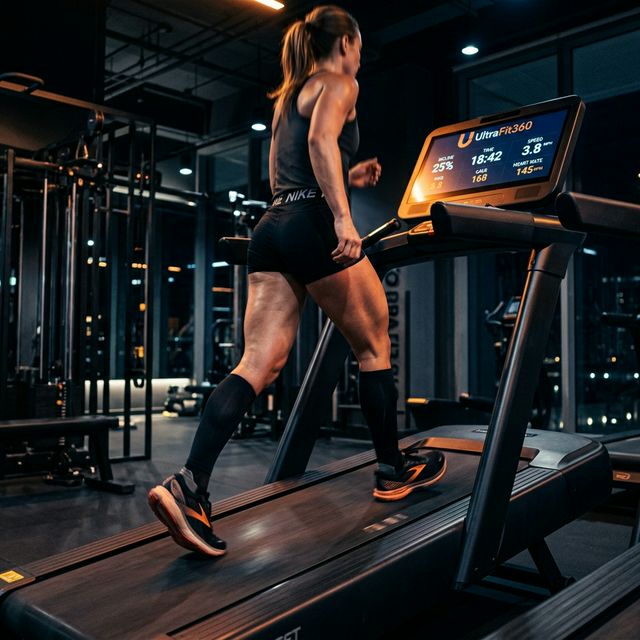
Treadmill walking has a reputation problem. Steady-state cardio at a flat grade looks boring on paper, and the calorie numbers seem underwhelming compared to a hard run or a HIIT session. Add a meaningful incline, however, and the math changes completely. Incline walking recruits more muscle, drives your heart rate into productive fat-burning territory, and does it all without the joint stress that keeps so many people sidelined. The 12-3-30 protocol — 12 percent incline, 3 miles per hour, 30 minutes — turned this idea into a viral sensation for good reason. But the method is just a starting point, and understanding the physiology behind it lets you use incline walking as a long-term fat-loss tool, not just a trending workout.
Why Incline Walking Burns More Fat Than Flat Walking
The core mechanism is simple: moving your body mass uphill requires more muscular work than moving it on a flat surface. Research consistently shows that walking at a 10–15 percent grade at moderate speed elevates oxygen consumption and calorie expenditure significantly compared to flat walking at the same pace. Estimates vary by body weight and fitness level, but the increase in energy cost at a steep incline can be substantial — often 50 percent or more above flat-grade walking at the same speed.
More importantly, incline walking tends to keep you in an aerobic heart-rate zone — roughly 60–75 percent of your maximum heart rate — where fat is the dominant fuel source. High-intensity sprints push you into zones where carbohydrate becomes the primary fuel and recovery debt accumulates. Incline walking threads the needle: it is hard enough to burn meaningful calories, easy enough to sustain without blowing up, and slow enough that most people can maintain it day after day without needing extended recovery.
- Higher gross calorie burn than flat walking at the same speed
- Aerobic zone maintenance supports fat oxidation throughout the session
- Low joint impact compared to running, reducing injury risk over time
- Sustainable frequency — many people can do it five or six days a week
The 12-3-30 Method Explained
The protocol is exactly what it sounds like: set the treadmill to a 12 percent incline, walk at 3 miles per hour, and go for 30 minutes. No running, no intervals, no complicated programming. The settings were popularized on social media but they are not arbitrary — 12 percent is steep enough to challenge the cardiovascular system and recruit the glutes and hamstrings aggressively, while 3 mph is slow enough that nearly anyone can walk at it rather than needing to jog. Thirty minutes lands in the sweet spot for aerobic fat-burning stimulus without excessive recovery demand.
For someone who is deconditioned, carries extra weight, or is returning from injury, 12-3-30 as written may be too aggressive out of the gate. That is not a failure — it is information. A steep incline at any speed can spike heart rate well above the aerobic zone in beginners, which defeats part of the purpose. Start where the protocol is actually achievable.
Reasonable starting modifications:
- Reduce the incline to 6–8 percent until the 30 minutes feels manageable, then increase gradually
- Shorten the duration to 15–20 minutes and build up week by week
- Slow the speed to 2.5 mph if 3 mph causes you to grip the rails (more on that below)
- Use rest intervals — walk flat for 2 minutes, steep for 3 minutes, and progress toward continuous incline over several weeks
Heart-Rate Zones and Why They Matter Here
Heart-rate zones give incline walking its strategic value. Zone 2 — approximately 60–70 percent of your maximum heart rate — is often called the fat-burning zone because at this intensity the body preferentially oxidizes fat for fuel, mitochondrial density improves with consistent training, and you can sustain the effort long enough to accumulate real work. A rough estimate for maximum heart rate is 220 minus your age, though individual variation is significant.
The goal during incline walking is to stay in Zone 2 or low Zone 3 (70–80 percent of max HR). If your heart rate is climbing into Zone 4 or higher, the incline or speed is too aggressive for your current fitness level. This is not a vanity metric — training too hard too often leads to accumulated fatigue, reduced recovery, and a pattern that most people abandon within a few weeks.
Practical application:
- Use a chest strap or optical heart-rate monitor during sessions to track zones in real time
- If heart rate exceeds your Zone 3 ceiling for more than a few minutes, reduce the incline or slow down
- As fitness improves over weeks, you will find that the same incline and speed produce a lower heart rate — that is adaptation, and it is the signal to progress
- Conversely, if a session keeps you in Zone 1 throughout, increase the incline by 1–2 percent
Form and the Rail Rule
The single most common error in incline treadmill walking is holding the side rails. It feels natural — the incline is challenging and the rails offer security — but gripping them negates much of the calorie burn and completely changes the biomechanics of the movement. When you hold the rails, you shift load off your legs and onto your arms, reduce the demand on your core, and artificially lower your heart rate. Studies on treadmill gripping confirm that calorie expenditure drops substantially when users hold on, even at steep grades.
If you need to hold the rails to complete the workout, the settings are too aggressive. Lower the incline or speed until you can walk with your arms swinging freely at your sides.
Additional form cues to keep in mind:
- Lean forward slightly from the ankles, not by bending at the waist — a slight forward lean is natural on an incline, but hunching over eliminates glute engagement
- Drive through your heel and midfoot rather than toe-striking, which reduces calf strain on prolonged sessions
- Keep your core lightly braced throughout — incline walking is a surprisingly effective anti-rotation and core-stability workout when done with attention
- Let your arms swing naturally — a bent-elbow swing helps maintain momentum and adds a small upper-body cardiovascular component
- Look forward, not down at your feet — a neutral head position keeps the cervical spine aligned and reduces upper-back tension
Posterior Chain Benefits Beyond Calorie Burn
One underappreciated advantage of incline walking is what it does for the posterior chain — the glutes, hamstrings, and calves. Flat treadmill walking, like most forward locomotion on level ground, underloads the glutes for most people. Add a meaningful incline and the mechanics shift: each step requires more hip extension, which directly loads the gluteus maximus and hamstrings. Over time, consistent incline walking contributes to better hip mobility, stronger glutes, and improved posture — benefits that carry over into every other movement you perform.
This makes incline walking particularly valuable for people who sit for long periods during the day. Prolonged sitting tends to weaken the glutes and tighten the hip flexors. An incline walking session counters that pattern without requiring a complex strength program or advanced coordination.
Progressing Beyond 12-3-30
Once 12-3-30 feels comfortable — meaning you can complete it while staying in Zone 2 and without holding the rails — it is time to evolve the stimulus. The body adapts to repeated stress, and a protocol that challenged you in week one will produce diminishing returns by week twelve if nothing changes.
Progression options, in order of simplicity:
- Extend duration — increase to 35, then 40, then 45 minutes at the same settings before changing anything else
- Increase incline — move from 12 to 13 or 14 percent; most treadmills cap at 15 percent, which represents a meaningful challenge even for fit individuals
- Increase speed — bump from 3.0 to 3.2 or 3.5 mph; this will raise your heart rate and requires careful monitoring to stay in the aerobic zone
- Add weighted vest — a 10–20 lb vest increases load without changing treadmill settings and adds bone-density stimulus as a bonus
- Introduce incline intervals — alternate 2 minutes at 15 percent with 2 minutes at 6 percent to create cardiovascular variation within a single session
What you should not do is chase novelty by switching methods every few weeks. Incline walking produces results through consistency and progressive overload applied patiently over months, not through constantly rotating protocols.
Building Incline Walking Into a Fat-Loss Plan
Incline walking works best as a complement to a resistance training program, not a replacement for it. Muscle tissue is metabolically expensive to maintain — it raises your resting metabolic rate and improves the body's ability to partition nutrients toward lean mass rather than fat. Incline walking burns calories in the session; resistance training changes the underlying metabolic environment. Together, they are more effective than either alone.
Practical structure for most people:
- Three to four incline walking sessions per week, each 30–45 minutes
- Two to three resistance training sessions per week on separate or alternating days
- At least one full rest day per week — recovery is where adaptation actually happens
- Nutrition that supports the activity level without creating excessive deficit, which undermines muscle retention
Sleep and stress management matter more than most people expect. Chronic sleep deprivation elevates cortisol, which increases fat storage and decreases fat mobilization — directly opposing what your incline walking sessions are trying to accomplish. No training protocol outworks a body that is chronically sleep-deprived and over-stressed.
Logging your incline walks in UltraFit360 — including duration, incline, speed, and heart-rate zone data — lets you see your aerobic fitness improving in real time, catch sessions where you drifted too high or too low in intensity, and build the progressive overload history that turns a viral treadmill trend into a genuine long-term result.
Transform Your Fitness Journey
Log your workouts, track your diet, and get AI coaching insights — all with UltraFit360.