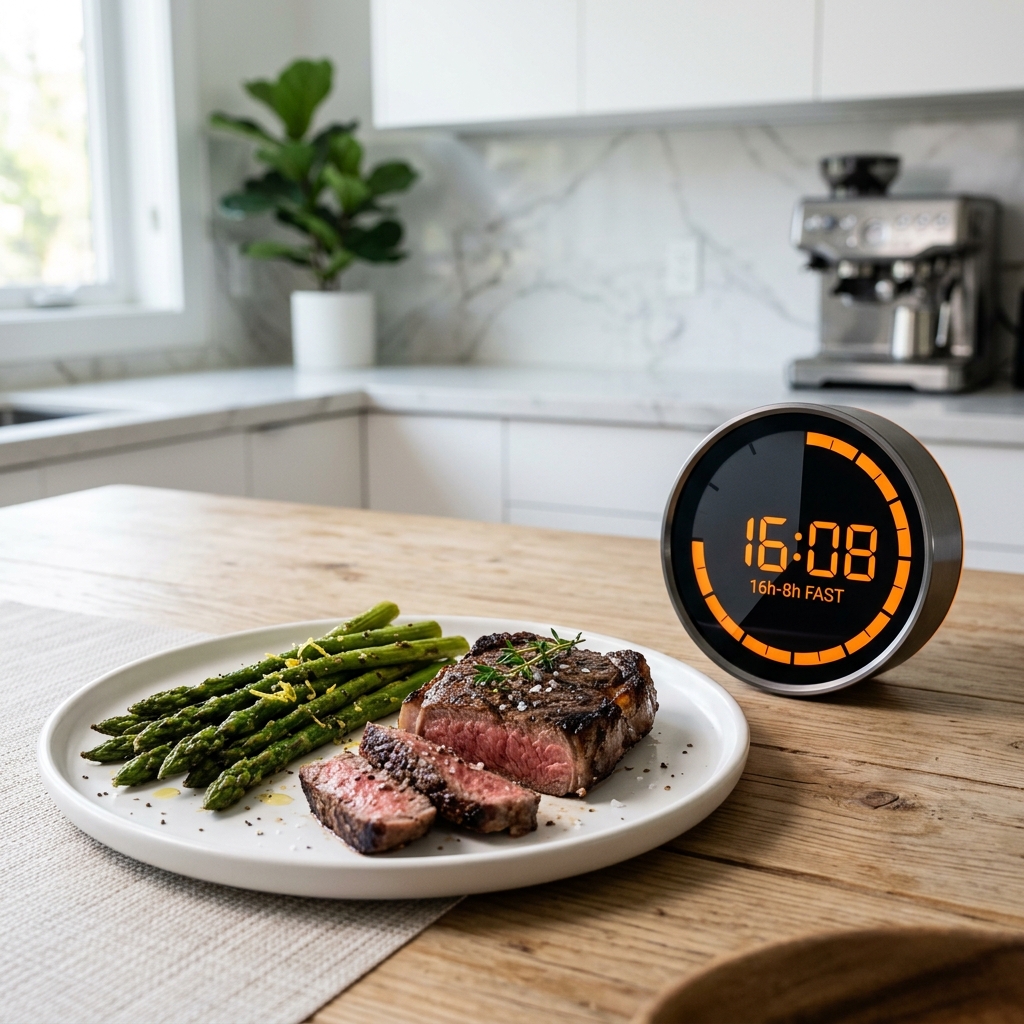
Intermittent fasting has moved well beyond trend status. Millions of people use it to manage weight, simplify their eating habits, and feel more in control of their relationship with food. But for anyone who lifts weights or cares about staying lean and strong, one question keeps surfacing: does fasting eat into the muscle you've worked hard to build? The answer is more nuanced than a simple yes or no — and understanding the real drivers of muscle retention will help you fast intelligently rather than fearfully.
What Actually Determines Whether You Keep Muscle
Before examining fasting specifically, it helps to be clear about what drives muscle retention in any dietary context. Three factors matter most, in roughly this order of importance:
- Total daily protein intake: Your muscles need amino acids to repair and rebuild. If you consistently fall short on protein across the day, you will lose muscle — regardless of your meal timing.
- Total calorie balance: A large, sustained calorie deficit accelerates muscle loss. A modest deficit, or eating at maintenance, gives your body far less reason to break down muscle tissue for fuel.
- Resistance training stimulus: Muscle is metabolically expensive. Your body keeps it only if there's a clear signal that it's needed. Regular strength training sends that signal and remains the single most powerful tool for muscle preservation during any kind of diet.
Intermittent fasting doesn't change these fundamentals. What it changes is the structure around them — specifically, when you eat. Whether that structure helps or hurts you depends on how well you hit those three targets within your eating window.
The Short-Term Hormonal Picture
One concern people raise is the hormonal environment during a fast. Overnight and into the morning, insulin is low, growth hormone rises, and the body draws more heavily on stored fat. Some degree of muscle protein breakdown also occurs, which sounds alarming — but this is normal physiology that happens every night while you sleep. The key is what happens when you eat: protein intake triggers muscle protein synthesis and amino acids help shift the balance back toward net muscle retention.
For typical fasting windows of 14 to 16 hours — including sleep — the hormonal shifts are modest and well within what the body handles routinely. Longer fasts of 24 hours or more, or very aggressive calorie deficits during the eating window, are where the math starts to work against muscle maintenance. This is why most recreational athletes do well with a 16:8 approach (16 hours fasting, 8 hours eating) but would need to be more careful with extended protocols like OMAD (one meal a day).
Protein Distribution Within Your Eating Window
For years, sports nutrition guidance emphasized spreading protein evenly across four to six meals throughout the day, based on the idea that muscles can only use roughly 20 to 40 grams of protein per meal for synthesis. That guidance is worth revisiting in a fasting context.
More recent evidence suggests that muscle protein synthesis is stimulated meaningfully even from larger single doses of protein, and that total daily protein remains the dominant factor over distribution. That said, there are practical reasons not to compress all your protein into one sitting:
- Larger single protein doses do appear to be absorbed and used, but digestion takes longer and appetite suppression can make it harder to hit your total.
- Spreading protein across two or three meals within an 8-hour window is generally easier to execute and keeps amino acid availability elevated across more of the day.
- If your window is shorter — say 4 to 6 hours — prioritizing protein at each meal and including a leucine-rich source (chicken, eggs, Greek yogurt, cottage cheese) helps maximize each synthesis opportunity.
A reasonable target for most active adults is 1.6 to 2.2 grams of protein per kilogram of bodyweight per day. Within an 8-hour window, hitting this target across two or three meals is entirely achievable and sufficient for muscle maintenance even while in a moderate deficit.
Training Fasted vs. Training Fed
One of the more debated topics in this space is whether to train in a fasted state or wait until after eating. The practical answer depends on what you're training for and how you personally feel during early-morning sessions.
For low-to-moderate intensity cardio, training fasted tends to increase fat oxidation during the session. For strength training, the picture is more complicated. Some people lift perfectly well after an overnight fast. Others notice reduced power output, difficulty concentrating, or early fatigue — all of which undermine training quality, which is the very thing that protects your muscle.
- If you train fasted: Consider consuming 10 to 20 grams of protein (such as a small serving of Greek yogurt or a protein shake) in the early part of your eating window, as close to your workout as schedule allows. Some protocols use a small pre-workout protein dose without fully breaking the fast, though whether this meaningfully blunts fasting benefits is debated.
- If you train fed: Try to time your first meal within an hour or two before your session, prioritizing protein and carbohydrates for energy and amino acid availability.
- Post-workout nutrition matters: Within your eating window, getting a protein-rich meal within a couple of hours of your session supports recovery. The so-called "anabolic window" is wider than previously thought, but eating enough protein after training remains important.
If fasted training consistently leads to poor sessions — missed reps, reduced volume, or dreading the gym — adjust your schedule. No hormonal benefit from fasting outweighs the cost of subpar training intensity.
The Calorie Deficit Problem
Intermittent fasting works for many people primarily because compressing eating into a shorter window naturally reduces calorie intake. That's often the point. But it also means it's easy to drift into a steeper deficit than intended, which is where muscle loss risk increases.
A deficit of roughly 300 to 500 calories per day is generally considered the sweet spot for fat loss while preserving lean mass, especially when combined with adequate protein and resistance training. Going significantly below this — even unintentionally because the eating window feels short — can accelerate muscle breakdown.
Practical steps to avoid accidental undereating:
- Track your intake for at least a few days when starting a fasting protocol to establish where you're actually landing on calories and protein.
- If you're losing weight faster than about 0.5 to 1 percent of bodyweight per week, consider adding a calorie-dense but protein-rich food (nut butters, eggs, full-fat dairy) to your eating window.
- Monitor strength levels in the gym. A consistent drop in what you can lift is often the earliest real-world signal that something in your nutrition is off.
Who Intermittent Fasting Suits — and Who Should Be Cautious
Intermittent fasting is not universally appropriate, and it's worth being honest about who tends to do well with it and who should approach it carefully.
Well-suited for IF:
- People who aren't hungry in the morning and find skipping breakfast natural rather than a struggle.
- Those who prefer fewer, larger meals to many small ones throughout the day.
- Individuals focused primarily on fat loss or body recomposition who are consistent with resistance training.
- People with relatively stable training schedules who can time workouts flexibly.
Should approach with care or avoid:
- Athletes in high-volume training phases (marathon prep, twice-daily sessions) who have elevated total energy and protein needs that are difficult to meet in a compressed window.
- Anyone with a personal or family history of disordered eating, as restrictive time windows can become a vehicle for harmful behaviors.
- Pregnant or breastfeeding women, whose nutrient needs and meal frequency requirements are higher.
- People with certain medical conditions, including diabetes, for whom significant changes in meal timing require medical supervision.
- Teenagers and young adults who are still growing and need consistent nutrient availability throughout the day.
The honest message here is that fasting is a tool, not a mandate. If it creates stress, disrupts your relationship with food, or consistently undermines your training, a different eating structure that hits the same protein and calorie targets will serve your muscle retention just as well.
The Bottom Line on Fasting and Muscle
The research on intermittent fasting and muscle retention consistently points to the same conclusion: when total protein intake is adequate, calories aren't excessively restricted, and resistance training continues, muscle loss is not an inevitable consequence of fasting. The structure of when you eat matters far less than the quality and quantity of what you eat during your window.
Fasting can be a genuinely useful tool for some people — it simplifies decision-making, reduces overall intake without constant calorie counting, and works well with busy schedules. But it's not magic, and it's not mandatory. The fundamentals of muscle retention are the same whether you eat two meals in eight hours or five meals across sixteen hours: hit your protein, don't slash calories too aggressively, and keep lifting.
If you want to take the guesswork out of fasting without sacrificing your strength gains, UltraFit360 can help you log your meals, track your daily protein within your eating window, and monitor your training performance over time — so you have real data showing whether your approach is working, not just a feeling.
Transform Your Fitness Journey
Log your workouts, track your diet, and get AI coaching insights — all with UltraFit360.