💡 Key Takeaways
- Anchor your eating window to wake time, not clock time — on nights your window simply rotates with you
- Muscle retention comes from ~1.6-2.2 g/kg protein plus resistance training, not from the fasting schedule itself
- Rotating shifts break consistency; on swing days keep protein high even if the window timing shifts
- Fasting cannot offset shift-work sleep debt — sleep is the dominant variable, and a too-steep deficit makes it worse
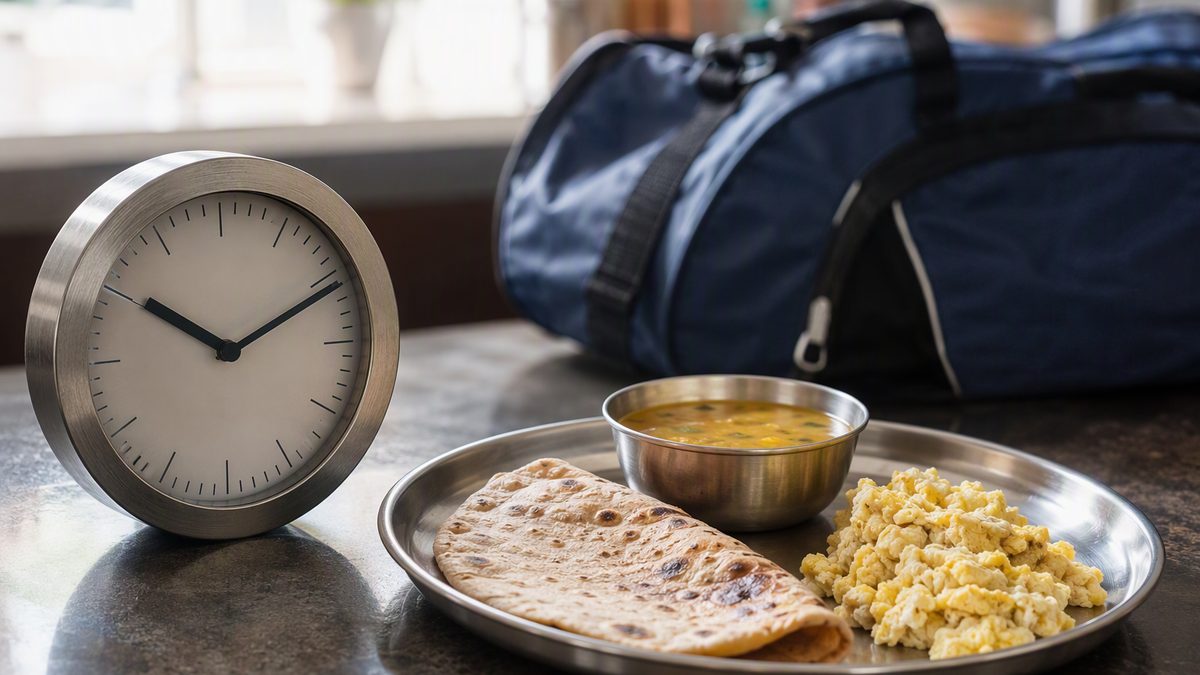
'When do I take a fasting window on night shift?' If that is the question driving you here, the short answer is this: you anchor the window to when you wake up, not to a clock. If your day starts at 6pm before a night shift, your eating window opens then and closes before your morning sleep — the same pattern a day-worker runs, just rotated. And the harder truth underneath it: fasting will not protect your muscle through shift chaos. Protein and training will.
Shift work already stacks the deck — circadian misalignment blunts your metabolism, fragments sleep, and elevates cortisol. Layering a rigid 8am fasting rule on top of that, copied from a 9-to-5 influencer, is how shift workers get it wrong. Below is how to make a window rotate with you, why protein and lifting do the real work, and the honest limit on what fasting can fix when you are running on broken sleep.
1. Anchor the window to wake time, not clock time
The single mistake that wrecks fasting for shift workers is taking timing advice literally. 'Eat noon to 8pm' assumes your morning is at dawn. Yours might be at 4pm. So translate every instruction into 'hours after you wake' and the protocol travels with you.
On a stretch of night shifts, your wake might be 5pm. A 16:8 window then runs roughly 6pm to 2am — first meal after waking, last meal before your post-shift wind-down, fasting through your daytime sleep. On day shifts it rotates back to a daytime window. The pattern is identical; only the clock changes.
Two things make this survivable. Plan around the 3am problem: hospital cafeterias and factory canteens close, so your in-window meals need to be prepped and carried, not found. And do not chase a perfectly fixed window across a rotating roster — consistency of behavior (hit your protein, keep lifting) matters far more than consistency of clock time, which your schedule simply will not allow.
There is a circadian wrinkle worth naming honestly. Eating in the biological night — which a night-shift window forces — appears to be metabolically less favorable than daytime eating, because shift work itself blunts insulin sensitivity and raises cortisol. That is not a reason to skip meals on nights; under-fueling a 12-hour shift is worse. It is a reason to keep your food quality solid and your portions sensible rather than reaching for the vending machine at 3am. The window is a structure to organize good choices around your wake time, not a license to run on caffeine and whatever the break room offers.
2. Why protein and lifting hold muscle, not the fast
It is worth being blunt about what fasting does and does not do, because shift workers are sold a lot of metabolic mythology. Fasting helps fat loss mainly by limiting total calories — a shorter window caps intake — not through any special fat-burning effect. Matched for calories and protein, it performs like ordinary calorie restriction. The fast is an adherence tool, not a muscle mechanism.
What actually protects muscle is the same on every shift pattern:
- Total daily protein. Roughly 1.6-2.2 g per kg of bodyweight per day to retain muscle. This target does not change because your hours are weird — it just has to land inside whatever window your shift allows.
- Resistance training. Lifting is the signal that keeps muscle. Two or three sessions a week, slotted before or after shifts or on swing days, does more for your lean mass than any fasting schedule.
- Distribution. Spread protein across 3-4 feedings of about 20-40 g inside the window so muscle-building stays switched on rather than spiking once.
Get those three right and the eating schedule is secondary. Miss them — which is easy when a 3am meal is impossible and the window is tight — and fasting will not save your muscle. It may make loss worse by crowding protein out.
3. A rotating-roster protocol that survives nights and swing days
Here is a window anchored to wake time across the three situations a shift worker actually faces. Note how the clock moves but the structure holds.
| Shift type | 16:8 window (anchored to wake) | Protein plan inside window |
|---|---|---|
| Day shift (wake 6am) | ~10am-6pm | 4 feedings of ~25-35 g; lift before or after shift |
| Night shift (wake 5pm) | ~6pm-2am | Prepped meals carried in; 3-4 feedings of ~30 g around the shift |
| Swing/changeover day | Flex window; do not force the clock | Prioritize hitting daily protein over exact timing |
| Day off (recovering sleep) | Let it float to your real wake time | Same protein total; don't crash-fast to 'catch up' |
| Pre-sleep (any shift) | Last meal near your wind-down | ~30-40 g slower protein to support recovery during sleep |
The pre-sleep feeding is genuinely useful here: whenever your sleep falls, ending the window with a slower-digesting protein helps you hit the daily target and supports overnight recovery. Closing your window near your wind-down lets the last meal double as that feeding — a clean fit whether your bed time is 7am or 11pm.
4. What fasting can't fix: sleep debt and over-cutting
Two safety lines matter more than any timing optimization.
First, fasting cannot offset shift-work sleep deprivation. Sleep is the dominant health and recovery variable for your population — broken sleep already blunts insulin sensitivity, raises cortisol, and impairs recovery. No eating window repairs that. Treat protocols as support around your sleep, never a substitute for it, and never use a fasting structure as an excuse to skip meals when you are already exhausted. Watch caffeine too: nothing within about six hours of your sleep window, whenever that window falls.
Second, a tight window plus a hectic shift makes it dangerously easy to under-eat sharply, which is the worst case for muscle. Keep any deliberate weight loss modest — around 0.5-0.7% of bodyweight per week — with protein high. Use simple monitoring: log daily protein against your target, track bodyweight over weeks, and watch your strength in key lifts. Falling strength plus a fast-dropping scale means back off the deficit and eat more before continuing. If you have any condition like insulin-treated diabetes, fasting needs a clinician's input first — the hypoglycemia risk on an irregular schedule is real. For most shift workers, building consistent fitness habits around sleep beats chasing a perfect fasting clock.
Questions from the night shift
When do I take a fasting window on night shift?
Anchor it to your wake time, not the clock. If you wake at 5pm before a night, a 16:8 window runs roughly 6pm to 2am — eat after waking, finish before your wind-down, fast through your daytime sleep. The pattern is identical to a day-worker's; only the hours rotate. Carry prepped meals because canteens close at 3am, and keep hitting your daily protein regardless of how strange the timing looks.
Does rotating shifts ruin the consistency fasting needs?
It ruins clock-time consistency, but that is not what matters. What protects muscle is behavioral consistency — hitting roughly 1.6-2.2 g/kg of protein and keeping up resistance training — and those travel across any roster. Let the window float with your wake time and stop trying to fix it to a fixed hour your schedule won't allow. On swing days, prioritize total daily protein over perfect timing.
How do I time meals and training after a 12-hour night?
After a long night, open your window with a real protein feeding, train before or after the shift on days you have energy, and close the window with a slower-digesting protein meal before you sleep — it doubles as a recovery feeding. Don't stack a steep fast on top of a brutal night; if you are wrecked, eating enough matters more than the window. Sleep first, then fuel.
Can fasting offset my bad shift-work sleep?
No. Sleep is the dominant variable for shift workers, and no eating schedule repairs the metabolic and recovery cost of broken sleep. Fasting is at most an adherence tool for controlling calories — it is not a sleep substitute or a metabolic fix. Use it only if it fits your life without adding stress, keep any deficit modest, and protect sleep above all. If exhaustion is constant, that is the problem to solve first.
Disclaimer: This article is for educational purposes only and is not medical advice. Consult a qualified healthcare professional before starting any supplement, nutrition, or training protocol — especially if you are pregnant or breastfeeding, under 18, taking medication, or managing a health condition.
Scientific References & Clinical Sources
- Morton RW, et al. A systematic review, meta-analysis and meta-regression of the effect of protein supplementation on resistance training-induced gains in muscle mass and strength in healthy adults. Br J Sports Med, 2018. PMID: 28698222
- Phillips SM, Van Loon LJ. Dietary protein for athletes: from requirements to optimum adaptation. J Sports Sci, 2011. PMID: 22150425
- Trommelen J, van Loon LJ. Pre-sleep protein ingestion to improve the skeletal muscle adaptive response to exercise training. Nutrients, 2016. PMID: 27916799
- Garthe I, et al. Effect of two different rates of weight loss on body composition and strength and power-related performance in elite athletes. Int J Sport Nutr Exerc Metab, 2011. PMID: 21558571
- Paddon-Jones D, et al. Protein, weight management, and satiety. Am J Clin Nutr, 2008. PMID: 18469287

