
In the high-octane world of fitness social media, "Grind Culture" is king. We are bombarded with slogans like "No Days Off," "Go Hard or Go Home," and "Pain is Weakness Leaving the Body." This relentless drive for volume has led to an epidemic of overtraining, burnout, and chronic injury. But in 2026, a new philosophy is taking root: JOMO—The Joy of Missing Out.
In a fitness context, JOMO isn't about being lazy or skipping workouts because you're bored. It’s about the intelligent choice to "miss out" on a grueling, high-strain session in favor of deep, restorative recovery. It’s the realization that you don't grow in the gym; you grow while you sleep. Today, we’re exploring why choosing JOMO might be the most "hardcore" thing you can do for your long-term progress.
Redefining the "Rest Day"
The traditional "Rest Day" is often seen as a passive event—a day spent on the couch, completely inactive. While horizontal rest has its place, it’s not always the most efficient way to recover. Enter Active Recovery.
Active recovery involves performing low-intensity movement that increases blood flow to your muscles without adding systemic stress. Think of it as "flushing the system." By choosing a 30-minute mobility flow or a brisk walk over a fourth heavy lifting session, you are literally speeding up the repair process of your tissues. JOMO is the mental strength to recognize when your body needs a "flush" rather than another hit of "heavy metal."
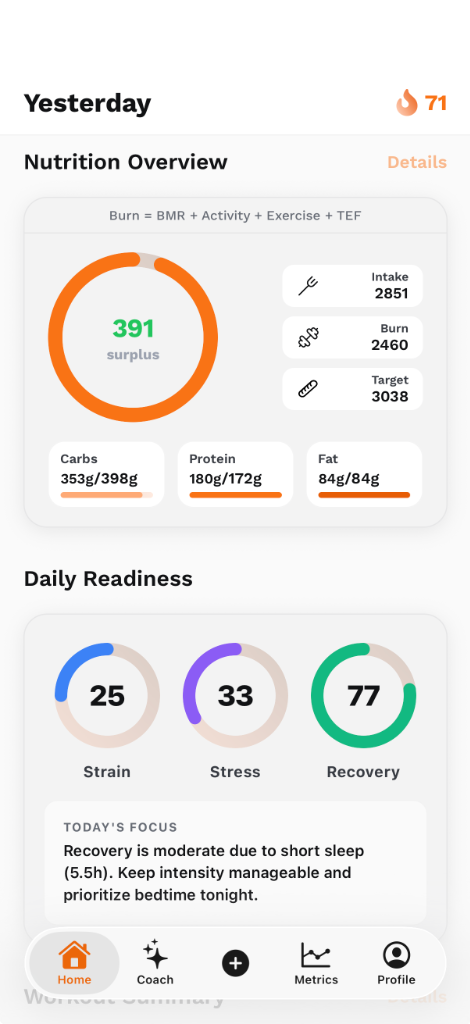
When your Recovery Score is in the red, JOMO is your best training strategy.
Listening to the SSR Signal
At UltraFit360, we track your Strain, Stress, and Recovery (SSR). This data provides an objective mirror of your internal state. Gym guilt often kicks in when we feel "fine" mentally but our physiological data says otherwise.
If your Heart Rate Variability (HRV) is low and your resting heart rate is elevated, your central nervous system is in a sympathetic (fight or flight) state. Pushing through a heavy workout in this state is like redlining a car engine that’s low on oil. JOMO is the act of trusting the data over the "voice in your head" that says you're being soft.
The Psychology of JOMO: Overcoming Gym Guilt
The hardest part of JOMO isn't the physical recovery—it's the mental shift. We’ve been conditioned to believe that more is always better. To embrace JOMO, you must view recovery as part of the workout, not an interruption to it.
- Reframe the Day: Instead of "I'm skipping the gym," say "I'm optimizing my recovery."
- Focus on Longevity: Remind yourself that one missed workout is nothing compared to a three-month layoff caused by an overuse injury.
- Enjoy the Immersion: Use the time you would have spent at the gym to cook a high-quality meal, spend time with family, or simply get an extra hour of sleep.
Low-Impact JOMO Activities
| Activity | Benefit | Intensity Level |
|---|---|---|
| Zone 2 Walking | Increases blood flow, burns fat, lowers stress. | Low (2/10) |
| Mobility/Yoga | Releases tissue tension, improves range of motion. | Low (3/10) |
| Leisurely Swimming | Decompresses joints, improves lymphatic drainage. | Low-Medium (4/10) |
| Foam Rolling | Facilitates myofascial release. | Very Low (1/10) |
Conclusion: The Long Game Wins
JOMO isn't about doing less; it's about doing what's necessary to do more in the long run. By embracing the joy of missing out on unproductive, high-stress sessions, you ensure that every minute you do spend in the gym is high-quality and high-impact. In 2026, the elite athletes and fitness enthusiasts are those who know when to push and, more importantly, when to pull back.
Embrace the JOMO. Trust your data. Grow stronger while you rest.
Optimize Your Recovery Cycle
Don't guess when you should rest. UltraFit360 analyzes your physiological data to give you a personalized Readiness Score every morning.