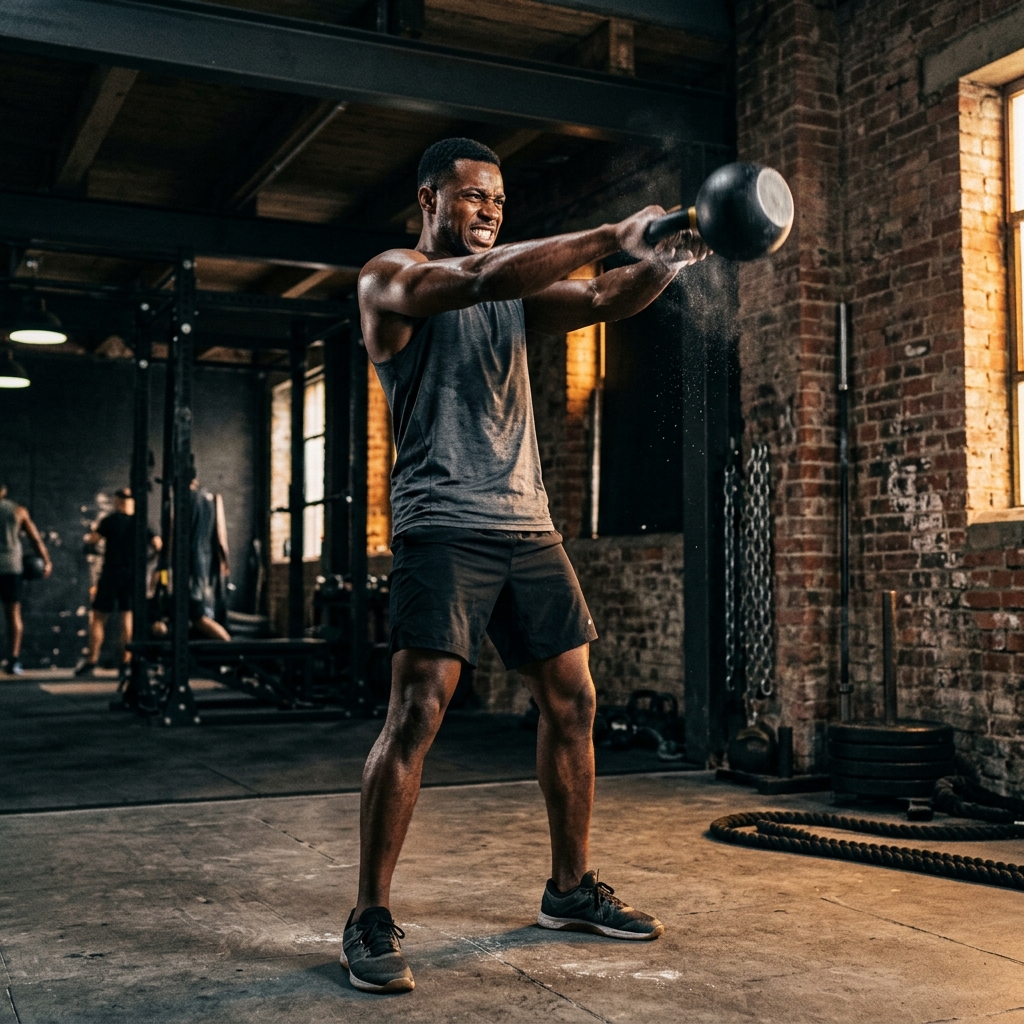
Walk into any serious gym and you'll find them stacked in a corner — those cannonball-shaped weights with a handle welded on top. Kettlebells look simple, almost primitive, yet they deliver a training stimulus that barbells and dumbbells simply cannot replicate. The offset center of mass forces your stabilizers to work overtime, the ballistic movements build explosive power, and a single bell can take you from strength work to cardio without setting foot on a treadmill. Whether you're training at a commercial gym or carving out space in your living room, kettlebells are one of the most versatile tools in fitness.
Why Kettlebells Belong in Your Training
The case for kettlebells goes well beyond novelty. Their design creates a unique mechanical challenge: the weight hangs below the handle, shifting the center of mass away from your grip. This means every rep demands active stabilization through your wrist, elbow, shoulder, and core — muscles that often go underloaded with fixed-path machines or even standard free weights.
- Posterior chain development. The hip hinge is at the heart of kettlebell training. Swings, cleans, and deadlifts drive repeated, powerful hip extension, directly targeting your glutes, hamstrings, and spinal erectors — the muscles most responsible for athletic performance and healthy posture.
- Conditioning without cardio equipment. High-rep swings and circuits elevate your heart rate rapidly and keep it there. You build aerobic capacity and muscular endurance simultaneously, cutting the time you need in the gym without sacrificing results.
- Space efficiency. A single kettlebell can replace an entire rack of dumbbells for most conditioning work. This makes kettlebells ideal for home training, travel, or small-footprint gym setups.
- Carryover to real-world movement. Kettlebell exercises train rotation, hip hinge, carry, and press patterns that map directly onto how your body moves in sport and daily life.
Five Foundational Movements
Kettlebell training has a deep library of exercises, but five movements form the foundation. Master these and you'll have everything you need to build strength, power, and conditioning for years.
The Kettlebell Swing. The swing is the cornerstone of kettlebell conditioning. It trains explosive hip extension — the same pattern behind a sprinter's stride, a vertical jump, and a powerful throw. Set the bell about a foot in front of you. Hinge at the hips, grip the handle with both hands, and hike the bell back between your thighs. Drive your hips forward forcefully, allowing the bell to float to chest height. Let gravity pull it back and hinge to catch the momentum. Keep your spine neutral throughout — this is a hip hinge, not a squat. Your arms are just ropes; the power comes from your hips.
The Goblet Squat. Hold the bell vertically by the horns at chest height. Stand with feet shoulder-width apart, toes turned out slightly. Squat down, keeping your elbows inside your knees and your chest tall. Drive through your whole foot to stand. The goblet squat is the most approachable squat variation for beginners and doubles as a superb thoracic mobility drill.
The Kettlebell Clean. The clean brings the bell from the floor (or a swing position) into the rack — resting in the crook of your arm at shoulder height. The key is keeping the bell close to your body on the way up and guiding it into the rack smoothly rather than letting it flip and crash against your forearm. A good clean is quiet; you should barely feel the bell arrive.
The Kettlebell Press. From the rack position, brace your core, squeeze your glutes, and press the bell overhead until your arm is fully locked out. Lower under control. The press reveals shoulder stability deficits quickly — if the bell wobbles or you arch excessively through your lower back, reduce the load and build from there.
The Turkish Get-Up. Perhaps the most complex movement in the toolkit, the get-up takes you from lying on the floor to standing — all while holding a kettlebell overhead. It trains shoulder stability, hip mobility, rotational strength, and total-body coordination in a single, slow, deliberate sequence. Start with a light bell or even a shoe balanced on your fist until you understand the pattern. Break it into stages: roll to elbow, post to hand, sweep the leg through, lunge to stand, then reverse the sequence back to the floor.
Choosing the Right Starting Weight
Picking the wrong weight is the most common mistake beginners make. Too light and you won't develop the hip drive needed to make swings feel natural. Too heavy and your form breaks down before you've built the movement patterns.
- Swings and hip hinge work: Men often start well with a 16 kg (35 lb) bell; women typically with a 12 kg (26 lb) bell. If you have a solid deadlift base, bump up one size.
- Goblet squat: Start lighter than you think — 8–12 kg for most people. The goal early on is depth and posture, not load.
- Press: Expect to press roughly half of what you can swing. A 12 kg press is reasonable for someone swinging 24 kg.
- Turkish get-up: Begin with no weight or a very light bell (4–8 kg). The movement is complex and unforgiving of technical sloppiness under load.
A good rule of thumb: you should be able to complete a full set with clean form and feel like you could have done two or three more reps. If you're grinding through every rep, the weight is too heavy for skill-building work.
Beginner Programming: 4 Weeks to Build the Foundation
Kettlebell training rewards consistency and progressive overload just like any other strength modality. The following template works three days per week with at least one rest day between sessions. Each session takes 30–40 minutes.
- Warm-up (5 minutes): Hip circles, thoracic rotations, bodyweight goblet squat holds, arm circles.
- A — Goblet Squat: 3 sets of 8 reps. Rest 90 seconds.
- B — Two-Hand Swing: 5 sets of 10 reps. Rest 60 seconds between sets.
- C — Single-Arm Press (each side): 3 sets of 5 reps. Rest 90 seconds.
- D — Turkish Get-Up (each side): 3 sets of 1 rep, moving deliberately. Rest 2 minutes.
- Conditioning finisher (Week 3–4 only): 5 rounds of 10 swings, rest 30 seconds.
In weeks one and two, focus entirely on movement quality. Add the conditioning finisher in weeks three and four once the patterns feel grooved. Progress load only when you can complete all prescribed reps with clean form across all sets.
Training Safely: What to Watch For
Kettlebell training is safe when performed with sound technique, but a few common errors can lead to strain if left uncorrected.
- Rounded lower back during swings. This is the most dangerous error. Keep your spine neutral by bracing your core before each rep and thinking about "protecting your armpits" to engage your lats. If your back rounds, reduce the weight.
- Squatting the swing. The swing is a hinge, not a squat. If your torso stays too upright and your knees drift forward, you lose the posterior chain stimulus and load your spine incorrectly. Push your hips back and let your chest angle forward on the downswing.
- Banging the forearm on cleans. This happens when the bell swings out wide rather than tracking close to the body. Practice the "zipper" cue — imagine drawing the bell straight up along your centerline.
- Pressing through shoulder impingement. If you feel a pinch at the top of the press, check that your shoulder is packed (not shrugged) and that the bell is balanced directly over the joint, not drifting forward.
- Rushing the Turkish get-up. This movement should be slow and deliberate. Treat each step as its own mini-exercise. Hurrying through the transitions is when wrists and shoulders get compromised.
If you're new to lifting, consider one or two sessions with a kettlebell-certified coach before training solo. A short investment in learning correct patterns pays dividends for years.
Progressing Beyond the Basics
Once you've built a foundation with the five core movements, the options for progression are broad. Double kettlebell work — using two bells simultaneously for front squats, cleans, and presses — dramatically increases the loading potential and introduces new coordination challenges. Longer swing intervals develop cardiovascular endurance in ways that shorter sets cannot. The single-leg deadlift adds a balance and stability demand that exposes hip weakness on each side independently.
You can also manipulate the structure of your sessions. Density blocks — completing as many rounds as possible of a short circuit in a fixed time window — are a time-efficient way to build work capacity. Ladders, where you increase reps each round then return to one, are a classic kettlebell programming tool for building volume without grinding through long sets at a fixed rep count.
The beauty of kettlebell training is that a lifter with two or three bells and a few square meters of space has nearly unlimited room to progress. The tool stays the same; the programming, the load, the complexity, and the density all scale with you.
Tracking your sessions is what separates consistent progress from spinning your wheels. Log your swing sets, note which weight you pressed, and record your get-up reps in UltraFit360 — the app keeps your history in one place so you can see exactly when to add load, when to back off, and how far you've come since you picked up that first kettlebell.
Transform Your Fitness Journey
Log your workouts, track your diet, and get AI coaching insights — all with UltraFit360.