💡 Key Takeaways
- Honest verdict: lactate threshold testing is built for endurance, so for skill-and-strength calisthenics it's a minor tool — useful only for your conditioning days, not your planche or muscle-up work.
- A finger-prick meter ($200-400, strips $1-2) measures blood lactate during steady efforts; it tells you almost nothing about a 6-second max-effort skill attempt.
- If you add high-rep circuit or running conditioning, knowing LT1 keeps those days truly easy so they don't steal recovery from skill practice.
- Sweat-patch lactate wearables are unvalidated; don't make training calls from them.
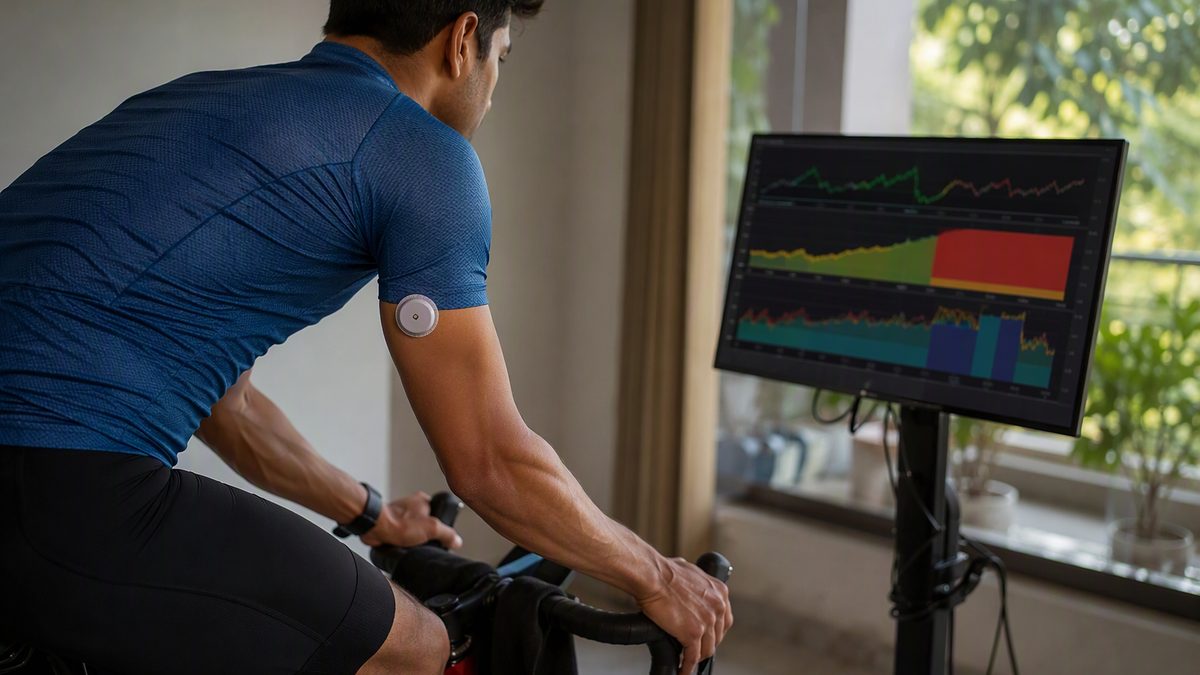
Here's what a lactate test would actually show a calisthenics athlete, and when. During a graded effort — say a steady run or bike that ramps every few minutes — blood lactate stays near baseline while it's easy, then rises clearly past a first marker (LT1), then climbs steeply past a second (LT2). The pace at those two points defines aerobic and threshold zones. You'd see the curve within the 30-minute test, and a rightward shift across weeks if your conditioning improved.
Now the honest part: almost none of that maps onto a front lever, a clean muscle-up, or a planche hold. Those are near-maximal, short, neural and tendon-limited efforts. Lactate threshold is an endurance metric, and skill-strength work lives in a different energy system entirely. So the real question for you isn't how to test — it's whether the data is worth collecting at all.
This guide is straight about that. It covers what the numbers measure, the narrow slice of your training where they help, which sensors are real, and why for most of your week the test is beside the point.
1. What the Data Shows in 30 Minutes
Run a graded test and you'd watch a predictable story unfold. Start easy and your blood lactate sits around 1 mmol/L, your resting baseline. Step the effort up and at some point lactate lifts clearly above that baseline — that's LT1, the aerobic threshold, the top of genuinely easy work. Push harder and you reach LT2, conventionally near 4 mmol/L, the fastest effort you can hold in metabolic steady state before lactate and fatigue run away. The pace, power, or heart rate at those two points is the entire output.
What you would not see is anything about your hardest skills. A maximal planche attempt or a heavy weighted pull-up is over in seconds and runs almost entirely on the phosphagen system — stored energy that doesn't produce the lactate signature a threshold test reads. Lactate testing characterizes sustained aerobic and glycolytic work, which is why it's a core tool for runners and cyclists and a peripheral one for a skill athlete. Treating lactate as a fuel and a signal rather than a waste product is good physiology, but the signal it carries is about endurance pacing, not straight-arm strength. Knowing that up front saves you from over-collecting data that won't change how you train your levers.
2. The Narrow Slice Where It Actually Helps You
There's one real use case. Many calisthenics athletes bolt conditioning onto their skill work — high-rep burpee or pull/push circuits, sprint intervals, or running for general fitness and to stay lean for better leverage ratios. That conditioning does involve the energy systems a lactate test measures, and getting its intensity wrong is a common, costly mistake: if your 'easy' conditioning day is secretly hard, it drains the fresh nervous system your skill practice needs the next day. Knowing your LT1 lets you keep easy conditioning genuinely easy. The table sketches how the data would slot conditioning into a skill-priority week.
| Day focus | Effort vs threshold | Example target | Why this intensity |
|---|---|---|---|
| Skill practice | Below LT1 | Easy aerobic, ~2 mmol/L cap | Keeps nervous system fresh |
| Easy conditioning | Below LT1 | Conversational run/bike, 30-45 min | Builds base without stealing recovery |
| Hard conditioning | At/near LT2 | ~4 mmol/L intervals, 1x/week | Real glycolytic stimulus, contained |
| Tendon / straight-arm | Not lactate-driven | RPE and rest-based, no meter | Phosphagen work; test doesn't apply |
Notice the last row: your highest-value training — tendon conditioning and straight-arm strength — isn't governed by lactate at all. The test only earns its keep on the two conditioning rows, and even there a free talk test (LT1 is roughly the fastest pace you can speak full sentences at) often does the job. If you don't run or do circuits, you can skip lactate testing with a clear conscience.
3. Sensors: Finger-Prick Reality vs Sweat-Patch Hype
If you do decide your conditioning warrants real numbers, know your options. The validated tool is a finger-prick capillary meter — around $200 to $400, strips $1 to $2 each — read by a handheld analyzer. It's the practical standard, accurate enough for tracking trends, but fussy: wipe sweat and the first blood drop, keep the same device, and treat the absolute millimoles as device-relative. A lab test is more precise and can add VO2 data if you ever want it, but for a calisthenics athlete that's usually overkill.
What to ignore, at least for now, are the continuous lactate wearables — sweat patches, rings, and watches claiming needle-free lactate. They're emerging research, not validated tools: sweat lactate doesn't track blood lactate cleanly, calibration drifts, and consumer wearables broadly show useful trends but sometimes substantially inaccurate readings versus reference methods. Given that the data is already marginal for your sport, paying a premium for an unproven sensor makes even less sense here. If you want one number to chase, your skill progressions and added-weight PRs tell you far more about your training than any lactate reading will.
4. The Leverage Trap and Tendon Reality
One thing lactate testing genuinely cannot help with is your central concern: strength-to-weight ratio. Every gram of body mass directly taxes a planche or front lever, so the endurance-style advice to fuel heavily for conditioning can quietly work against your leverage if you let conditioning volume balloon. The fix isn't a sensor — it's keeping conditioning purposeful and minimal, anchored below LT1 so it supports rather than competes, and not letting 'more cardio' creep in and add fatigue or unwanted mass. The test, if you use it, should make conditioning smaller and smarter, never bigger.
The other reality a meter won't show is tendon load. Your most common injuries — elbow and wrist overuse from straight-arm work — come from grinding maximal skill attempts without enough rest, and connective tissue adapts far slower than muscle. No lactate number protects you there; deload weeks, progressive tendon prep, and not chasing daily maximal holds do. So keep the priorities straight: skills and tendons are RPE-and-rest territory, conditioning is the only place a lactate test belongs, and even there it's optional. If you never buy a meter, your calisthenics progress won't suffer for it — which is the honest bottom line for a sport this test wasn't designed to measure.
Lactate Testing Questions From Calisthenics Athletes
Do I need lactate testing if I mostly train skills and don't run?
Honestly, no. Lactate threshold testing measures sustained aerobic and glycolytic effort, while skills like planche, front lever, and muscle-ups are short, near-maximal, tendon- and nervous-system-limited efforts that don't produce the signal it reads. If your training is skill practice plus straight-arm strength, a meter would tell you almost nothing useful. It only becomes relevant if you add running or high-rep conditioning, and even then a free talk test often substitutes for the device.
Will the test tell me anything about my muscle-up or planche strength?
No. Those are brief, near-maximal efforts powered mainly by the phosphagen system, which doesn't generate the rising blood lactate a threshold test measures. Lactate data describes how long you can sustain submaximal work, not how much force you can produce for a few seconds. To track skill strength, log your progressions, hold times, and added-weight PRs — those metrics actually reflect what limits your levers. The lactate curve simply isn't the right instrument for skill-strength work.
Can I train skills every day if I keep conditioning easy by the numbers?
Keeping conditioning below LT1 helps, because genuinely easy aerobic work steals far less recovery than accidental hard sessions — and that's the main practical reason a calisthenics athlete might test at all. But daily maximal skill attempts are limited by tendon and nervous-system recovery, not lactate. Even with perfectly easy conditioning, you still need deloads and rest from maximal straight-arm work to avoid elbow and wrist overuse. Easy conditioning supports skill frequency; it doesn't make daily grinding safe.
Should I buy a sweat-patch lactate sensor for my conditioning days?
Not yet. Continuous wearable lactate sensors are unvalidated — sweat lactate doesn't map reliably onto blood lactate, and consumer wearables in general show useful trends but sometimes badly off readings versus reference methods. Since lactate data is already marginal for a skill-strength athlete, spending on an unproven sensor is hard to justify. If you genuinely want numbers for conditioning, a finger-prick meter is the validated choice, but for most calisthenics athletes even that is optional.
Disclaimer: This article is for educational purposes only and is not medical advice. Consult a qualified healthcare professional before starting any supplement, nutrition, or training protocol — especially if you are pregnant or breastfeeding, under 18, taking medication, or managing a health condition.
Scientific References & Clinical Sources
- San-Millán I, Brooks GA. Assessment of Metabolic Flexibility by Means of Measuring Blood Lactate, Fat, and Carbohydrate Oxidation Responses to Exercise in Professional Endurance Athletes and Less-Fit Individuals. Sports Med, 2018. PMID: 28623613
- Joyner MJ, Coyle EF. Endurance exercise performance: the physiology of champions. J Physiol, 2008. PMID: 17901124
- Peake JM, et al. A Critical Review of Consumer Wearables, Mobile Applications, and Equipment for Providing Biofeedback, Monitoring Stress, and Sleep in Physically Active Populations. Front Physiol, 2018. PMID: 30002629
- Düking P, et al. Criterion-Validity of Commercially Available Physical Activity Tracker to Estimate Step Count, Covered Distance and Energy Expenditure during Sports Conditions. Front Physiol, 2017. PMID: 29018355
- Buchheit M, Laursen PB. High-intensity interval training, solutions to the programming puzzle. Part II: anaerobic energy, neuromuscular load and practical applications. Sports Med, 2013. PMID: 23832851

