💡 Key Takeaways
- Your FTP and your blood-lactate LT2 are close cousins, not twins; FTP can over- or under-estimate true threshold, so the lab curve is the honest anchor for climb pacing.
- A graded test with 3-5 minute stages and a finger-prick reading per stage gives you the power and HR at LT1 and LT2 your surging trail efforts should respect.
- LT1 sets the ceiling for base rides; LT2 is the power you can defend on a long climb before lactate runs away over the top.
- Sweat patches and watch 'lactate' are not validated; vibration, dirt, and grip wreck wrist optical HR on descents, so finger-prick blood lactate is the standard for now.
Plenty of riders believe their FTP number already tells them everything a lactate test would, so the blood is just for roadie purists. That is the myth worth taking apart, because it quietly mis-paces your climbs. Functional threshold power is a useful, repeatable surrogate, but it is not the same thing as the lactate-defined threshold your body actually transitions at.
FTP is conventionally the power you can hold for about an hour, usually estimated from a 20-minute test minus 5%. Your true LT2, the maximal lactate steady state, is where production and clearance still balance. For many riders the two land close, but critical power often sits a touch above true steady state, and FTP can over- or under-shoot the lactate threshold depending on you and the protocol. On a trail full of punchy climbs, that gap decides whether you blow up over the top.
Below: why the surrogate drifts from the real thing, how a finger-prick test maps your climbing curve, the zones it builds, and the honest state of the sensors that promise to skip the prick.
1. The FTP Myth: Why a Surrogate Isn't Your True Threshold
Start with what FTP and critical power really are. FTP is a performance anchor estimated from a single hard test, and critical power is the asymptote of your power-duration curve drawn from a few all-out efforts. Both tend to land near maximal lactate steady state, which is why they are useful and worth tracking. But near is not equal. Critical power frequently sits slightly above true steady state, so pacing a long climb at critical power can mean creeping just over the point where lactate starts to accumulate, and you pay for it in the final pitches. FTP from a 20-minute test can land on either side of your lactate threshold depending on how you pace the test and how your physiology is built.
The blood-lactate test removes the guesswork because it measures the transition directly instead of inferring it from a time trial. You get the actual power and heart rate at LT1 and LT2, not an estimate that drifts with your pacing skill, motivation, the heat, or the terrain you tested on. For a mountain biker, whose efforts surge and recover rather than hold steady like a road time trial, that direct read matters more, because a number that is 10-15 watts off the real threshold changes how long you can defend a climb. The honest framing: FTP is a good, testable surrogate, but it is not guaranteed equal to your blood-lactate threshold, and the test settles which side of the line you are on.
2. Testing the Punchy, Surging Demands of Trail Riding
The reference test is a graded ride on a trainer or ergometer: start easy and step the power up in fixed increments, holding each stage long enough for lactate to settle, with a finger-prick or earlobe sample read by a handheld meter at the end of every stage. Plot lactate against power and heart rate and the breakpoints appear. Stage length is the detail that decides validity: short stages under-read steady-state lactate, so threshold testing uses 3-5 minute stages, not the 1-minute ramp some apps default to.
| Stage | Power | Duration | Sample point | Typical blood lactate |
|---|---|---|---|---|
| 1 (base) | 140 W | 4 min | End of stage | ~1.1 mmol/L |
| 2 (near LT1) | 180 W | 4 min | End of stage | ~2.0 mmol/L |
| 3 | 220 W | 4 min | End of stage | ~2.8 mmol/L |
| 4 | 250 W | 4 min | End of stage | ~3.4 mmol/L |
| 5 (near LT2) | 280 W | 4 min | End of stage | ~4.1 mmol/L |
| 6 (above LT2) | 310 W | 4 min | End of stage | ~6.0 mmol/L |
The wattages above are a template; your real curve comes from your own legs. A consumer finger-prick meter runs roughly $200-400 plus a dollar or two per strip, so you can run this in a garage off your own power meter. Because trail riding is interval-like rather than steady, the value is in knowing your LT2 power precisely: on a long climb you ride at or just under it and save the over-threshold surges for the short pitches where you can recover on the next flat or descent.
3. Building Climb and Descent Zones from Your Curve
With power and heart rate at LT1 and LT2 in hand, the zones map straight onto how you ride. Below LT1 is your base, where long aerobic rides and the easy half of weekend epics should live; it builds the fat-oxidation and aerobic engine that lets you back up day two of a bike-park weekend. Between LT1 and LT2 is the tempo grey zone, where steady fire-road climbs sit and where most riders accidentally spend too much time. At and just under LT2 is your sustainable climbing power, the effort you can defend on a long ascent. Above LT2 are the surges, the punchy steeps and attacks that you can only hold briefly before lactate climbs.
The smart way to ride this is to use LT2 as a budget. On a climb you cannot recover from, hold at or under it. On a rolling climb with descents to recover on, you can spend over LT2 on the steep ramps because the downhill clears it. Heart rate has one important caveat off-road that power does not: descents load your arms and core isometrically and your HR stays elevated from the tension and adrenaline even when your legs are coasting, so trust power on the climbs and treat HR as the slower, context-sensitive signal. Retest every 6-12 weeks or at a new block, under standardized conditions, because as you get fitter you produce less lactate at the same watts and your curve shifts right, which is the cleanest objective proof your climbing engine improved.
4. Sweat Sensors, Vibration, and the Honest Limits on the Trail
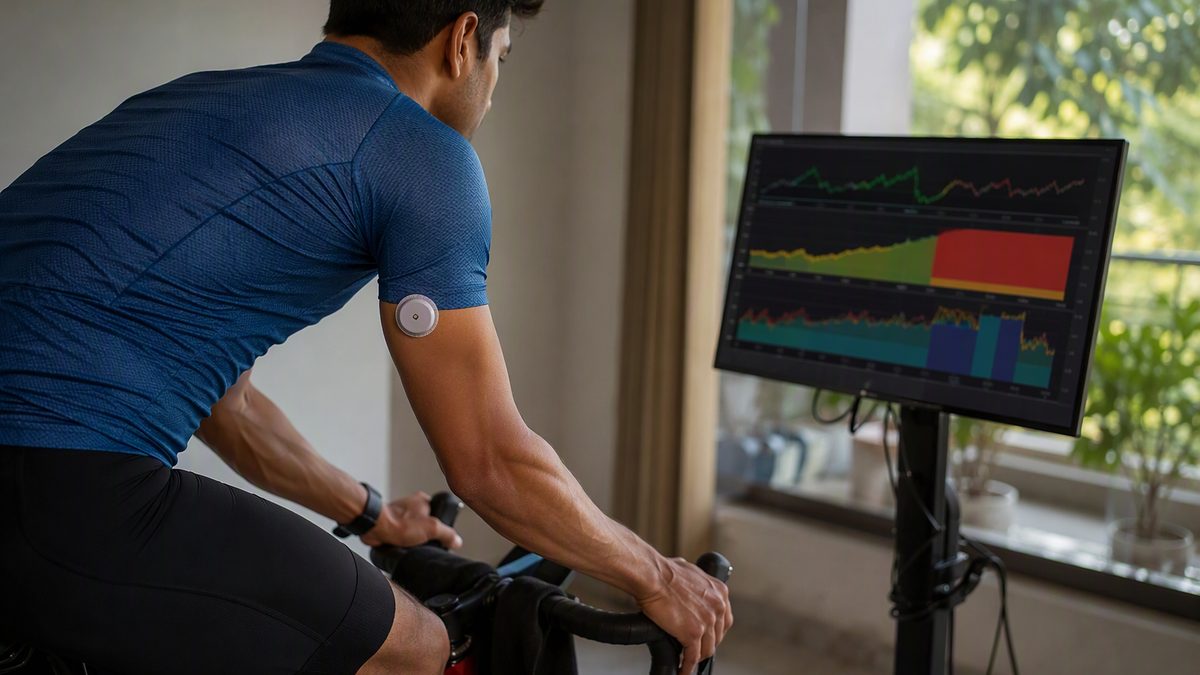
The pitch for continuous lactate patches is seductive for a sport with no convenient place to stop and bleed mid-descent. Resist it. Noninvasive continuous lactate from sweat or optical methods is real research, but it is not a validated training tool, and sweat lactate does not track blood lactate cleanly because it depends on your sweat rate, gland dynamics, skin contamination, and a lag. No consumer patch is validated against a finger-prick meter for training decisions. This is the same pattern documented across cycling wearables: useful trends, but variable and sometimes badly off accuracy versus reference methods, and derived metrics that are frequently inaccurate. So treat any 'lactate' number from a watch or patch as an experimental signal, never as the basis for your zones.
Mountain biking adds physical insults that make this worse. Trail vibration, dirt and sweat on the sensor, a loose strap bouncing on rough ground, and the forearm grip during descents all degrade optical wrist heart rate exactly when you are working hardest, which is another reason to anchor zones to a controlled, indoor finger-prick test rather than field readings. A few honest practicalities round it out. A fasted or low-carb ride flattens your lactate curve, so test fed and keep fueling consistent if you want comparable numbers across a season. Field proxies like a 20-minute FTP test or a critical-power effort are fine when blood testing is not practical, just remember they are estimates that drift with pacing and terrain. And the real-world safety items still stand apart from the data: plan hydration and fuel for remote rides where bonking has consequences, and treat crash recovery as medical territory, not a sensor question.
What Mountain Bikers Ask About Lactate Threshold Testing
Is my FTP the same as my lactate threshold?
Close, but not guaranteed equal. FTP is the power you hold for about an hour, usually estimated from a 20-minute test, and it tends to land near your lactate-defined LT2. But FTP can over- or under-estimate the true threshold depending on you and how you paced the test, and critical power often sits slightly above true maximal lactate steady state. A blood-lactate test measures the transition directly, which settles which side of the line your FTP is on and sharpens your climb pacing.
Does altitude change my lactate test results?
It can shift the readings, because lower oxygen availability changes lactate dynamics and the same power feels harder. If your big rides are at altitude but you test near sea level, your sea-level zones will run a little high up high. The practical fix is to standardize conditions and, ideally, test under conditions that resemble your key rides, then treat heat, dehydration, and altitude as confounders that distort the curve. When in doubt on a big mountain day, pace by power and perceived effort rather than a number set somewhere else.
Can a sweat patch give me lactate on the trail?
Not reliably yet. Sweat lactate depends on sweat rate, skin contamination, and a time lag, so it does not map cleanly onto blood lactate, and no consumer patch is validated against a finger-prick meter for training decisions. On a vibrating, dirty trail those problems get worse. Treat any wearable lactate number as an experimental trend, not a measurement, and set your zones from a controlled finger-prick test or a field FTP proxy instead. The technology is promising but immature.
Why is my heart rate high on descents when I'm barely pedalling?
Because descending is hard work for your arms and core even when your legs coast. Gripping the bar and bracing against vibration is sustained isometric effort, and adrenaline on technical terrain pushes heart rate up too, so HR stays elevated while power reads near zero. That is why you should pace climbs by power, where the lactate test anchors your zones, and treat descent heart rate as a context-heavy signal rather than a training-intensity readout. Optical wrist HR also struggles here from grip and movement.
Disclaimer: This article is for educational purposes only and is not medical advice. Consult a qualified healthcare professional before starting any supplement, nutrition, or training protocol — especially if you are pregnant or breastfeeding, under 18, taking medication, or managing a health condition.
Scientific References & Clinical Sources
- Joyner MJ, Coyle EF. Endurance exercise performance: the physiology of champions. J Physiol, 2008. PMID: 17901124
- San-Millán I, Brooks GA. Assessment of Metabolic Flexibility by Means of Measuring Blood Lactate, Fat, and Carbohydrate Oxidation Responses to Exercise in Professional Endurance Athletes and Less-Fit Individuals. Sports Med, 2018. PMID: 28623613
- Buchheit M, Laursen PB. High-intensity interval training, solutions to the programming puzzle: Part I: cardiopulmonary emphasis. Sports Med, 2013. PMID: 23539308
- Peake JM, et al. A Critical Review of Consumer Wearables, Mobile Applications, and Equipment for Providing Biofeedback, Monitoring Stress, and Sleep in Physically Active Populations. Front Physiol, 2018. PMID: 30002629
- Düking P, et al. Criterion-Validity of Commercially Available Physical Activity Tracker to Estimate Step Count, Covered Distance and Energy Expenditure during Sports Conditions. Front Physiol, 2017. PMID: 29018355

