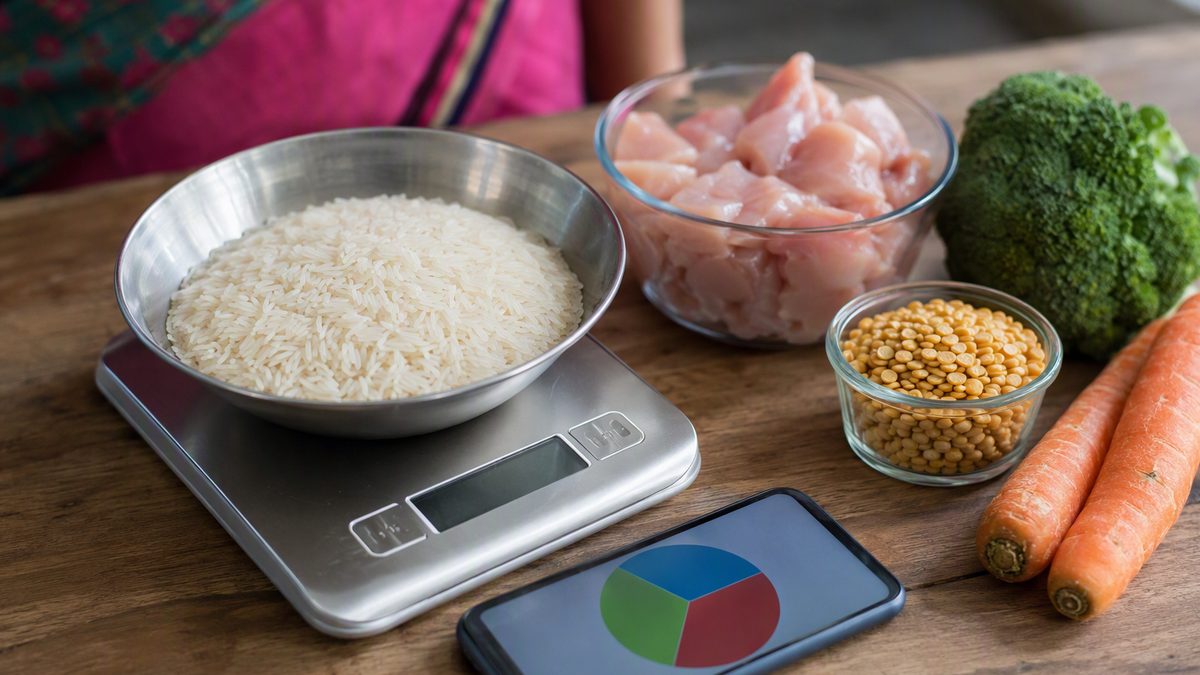
💡 Key Takeaways
- Default to one rule that travels: protein at every meal first (~1.6-2.2 g/kg/day), then let the day fill in around it
- Use 80/20 estimation, not a food scale: hit protein and a calorie ballpark eyeballing restaurant plates, save weighing for the rare home week
- Alcohol is the hidden lever at 7 kcal/g — two business-dinner drinks is roughly a small meal, so it counts even though it is not a macro
- Judge the system on the 7-day weight average and your Whoop/Oura trend, never on a single hotel-scale reading
Picture a normal Tuesday. A 6am call with a different timezone, a sandwich inhaled between meetings, a client dinner with wine you did not order, and a hotel-gym session that may or may not happen. That is the week most macro advice ignores — it assumes a calm kitchen, a digital scale, and time to log every gram. You have none of those, so the system has to work from a restaurant menu and a memory of what you ate.
Good news: the part of macro tracking that actually moves results survives travel intact. The evidence says the awareness matters far more than the decimal places. So this guide slots the work into the week you already run — a default protein rule that needs no decision, an 80/20 estimation method for plates you will never weigh, and one weekly number that tells you whether to adjust. No spreadsheet, no logging fatigue, no all-or-nothing trap.
1. Where tracking actually fits in an executive week
Start from the calendar, not the app. Your week has three kinds of eating moments, and each gets a different level of effort.
Controlled meals — breakfast in your kitchen, a home dinner, a protein shake before the gym — are where you do real estimation, because you know the portions. Defaulted meals — the airport lounge, the catered lunch, the grab-and-go — get one rule applied on autopilot: anchor a palm or two of protein and a sensible carb portion, ignore the rest. Negotiated meals — client dinners with alcohol — are managed, not optimized: you decide the drink count before you sit down, because that is the lever that actually swings the day.
The mistake here is all-or-nothing thinking — a perfect logged week or nothing. Skip that. A defaulted meal estimated in five seconds counts. The consistency of doing it every day, across timezones, is the whole point; that behavioral steadiness is the strongest predictor of body-composition success in the research, far more than logging accuracy on any single plate.
Build it as a default, not a decision, because decision fatigue is your real enemy by 7pm. Pick the same breakfast, the same two or three lunch orders, the same protein anchor — so the choice is already made before the day grinds you down. That is also why estimation beats a food scale for you: a scale demands you be home, calm, and unhurried, which describes almost none of your week. A rule you apply on autopilot from any airport gate is worth more than a precise system you only run when life cooperates.
2. The 80/20 estimation method (no scale, no labels)
You will not weigh food on the road, so estimate with your hand — it travels and roughly scales to your size. A palm of meat or fish is your protein unit. A cupped handful is a carb portion. A thumb is a fat portion. Protein and carbs run 4 kcal per gram; fat runs 9, which is why a thumb of olive oil or a sauce moves the calorie total roughly twice as fast as the same weight of rice.
The 80/20 rule: get the protein anchor right at every meal and the calorie ballpark close, and let the last 20% be imprecise. Eyeballing tends to undercount dense foods — oils, cheese, nut butters, dressings — often badly, so when you estimate a restaurant plate, mentally round those up. The flexible approach also beats rigid rules for adherence; allowing the wine and the bread, accounted for, prevents the guilt-then-overeat cycle that derails busy people. If you want a tighter system for the occasional home week, the batch ideas in our meal-prep guide let you pre-decide portions so estimation is automatic.
3. A travel-proof daily protocol
Here is the system as numbers for an 80 kg executive aiming to maintain or lean out slightly. Protein is set first and is non-negotiable; everything else flexes with the day.
| Eating moment | Hand-portion target | Estimated macros | The default rule |
|---|---|---|---|
| Home or hotel breakfast | 2 palms protein (eggs/Greek yogurt), 1 cupped carb, 1 thumb fat | ~40 g protein, ~30 g carb, ~15 g fat | Protein first, before coffee runs the morning |
| Lounge or catered lunch | 2 palms protein, 1-2 cupped carbs, 1 thumb fat | ~45 g protein, ~50 g carb, ~15 g fat | Default applied in five seconds, no logging |
| Pre-gym snack | 1 palm protein (shake), 1 cupped carb (fruit) | ~25 g protein, ~25 g carb | Protein around the rare hotel-gym window |
| Client dinner | 2 palms protein, 1 cupped carb, vegetables, 2 drinks max | ~50 g protein, ~40 g carb, ~2 drinks (~280 kcal) | Decide drink count before sitting down |
| Daily total (~80 kg) | ~7-8 palms protein across the day | ~160 g protein (2.0 g/kg), carbs/fat fill maintenance | Hit protein and the ballpark; ignore the last 20% |
Two business-dinner drinks land near 280 kcal — a small meal you did not chew. That is not a reason to abstain; it is a reason to count it and trim a carb portion elsewhere if you are leaning out. The same logic handles the rest of an unpredictable week: a missed lunch in back-to-back meetings is not a crisis, it just shifts those calories to dinner. Eyeball the protein at every plate, keep the day's total roughly where you want it, and let timing fall where the calendar dictates. The system bends; it does not break, which is exactly what survives a schedule you do not fully control.
4. Why this works — and the one number to watch
The science is unglamorous and reassuring. Total calories drive weight; the protein-first build protects lean mass when you are busy and under-recovering, and protein is the most satiating macro, which quietly curbs the late-night over-eating that follows skipped meals. Meal timing barely matters — carbs at a 9pm dinner do not behave differently from carbs at noon when the day's total is equal — so a late client dinner is not a problem to engineer around.
For monitoring, you already own the tool: a wearable and a scale. Watch the 7-day weight average under the same conditions, not the single reading after a salty restaurant meal, which can swing 1-2 kg on water alone. Pair it with your Oura or Whoop trend for sleep and recovery. Adjust only when the multi-week average drifts off goal, in small ~100-200 kcal steps. If a cut is the goal, our deficit guide shows how to size it by bodyweight percentage so travel stress does not cost you muscle. One caution worth flagging for high-stress, high-performing people: if estimating ever tips into anxiety or rigid food rules, drop the numbers and eat by habit — the tool should reduce decision load, not add to it.
What time-pressed executives ask about tracking macros
Do client dinners and alcohol ruin macro tracking?
No, if you count the drinks. Alcohol carries 7 kcal per gram and counts toward your daily energy even though it is not a tracked macro — two drinks is roughly 280 kcal, a small meal. Decide your drink count before you sit down, keep the protein anchor on your plate, and trim a carb portion elsewhere if you are cutting. One managed dinner does not undo a consistent week.
Can I really track without weighing food while traveling?
Yes. Use hand portions — a palm of protein, a cupped handful of carbs, a thumb of fat — which scale to your size and travel anywhere. Aim for 80% accuracy: nail the protein and the calorie ballpark, round up dense foods like oils and cheese that are easy to undercount, and let the rest be approximate. The consistency of estimating daily matters more than weighing any single meal.
What single metric should I watch across time zones?
Your 7-day average bodyweight, taken under the same conditions when you can. A single hotel-scale reading is noise — water and travel food swing it 1-2 kg overnight. Pair the weekly trend with your Oura or Whoop recovery data and adjust calories only when the multi-week average drifts off your goal, in small 100-200 kcal steps every few weeks.
How much protein do I actually need with my schedule?
Aim for 1.6-2.2 g per kg of bodyweight per day, leaning toward the higher end if you are in a deficit to protect lean mass under travel stress. For an 80 kg executive that is roughly 130-175 g daily, or about two palm-sized portions at each main meal plus a shake. Setting protein first is the one rule that survives airports, time zones, and skipped lunches.
Disclaimer: This article is for educational purposes only and is not medical advice. Consult a qualified healthcare professional before starting any supplement, nutrition, or training protocol — especially if you are pregnant or breastfeeding, under 18, taking medication, or managing a health condition.
Scientific References & Clinical Sources
- Morton RW, et al. A systematic review, meta-analysis and meta-regression of the effect of protein supplementation on resistance training-induced gains in muscle mass and strength in healthy adults. Br J Sports Med, 2018. PMID: 28698222
- Paddon-Jones D, et al. Protein, weight management, and satiety. Am J Clin Nutr, 2008. PMID: 18469287
- Burke LE, et al. Self-monitoring in weight loss: a systematic review of the literature. J Am Diet Assoc, 2011. PMID: 21185970
- Phillips SM, Van Loon LJ. Dietary protein for athletes: from requirements to optimum adaptation. J Sports Sci, 2011. PMID: 22150425
- Garthe I, et al. Effect of two different rates of weight loss on body composition and strength and power-related performance in elite athletes. Int J Sport Nutr Exerc Metab, 2011. PMID: 21558571

