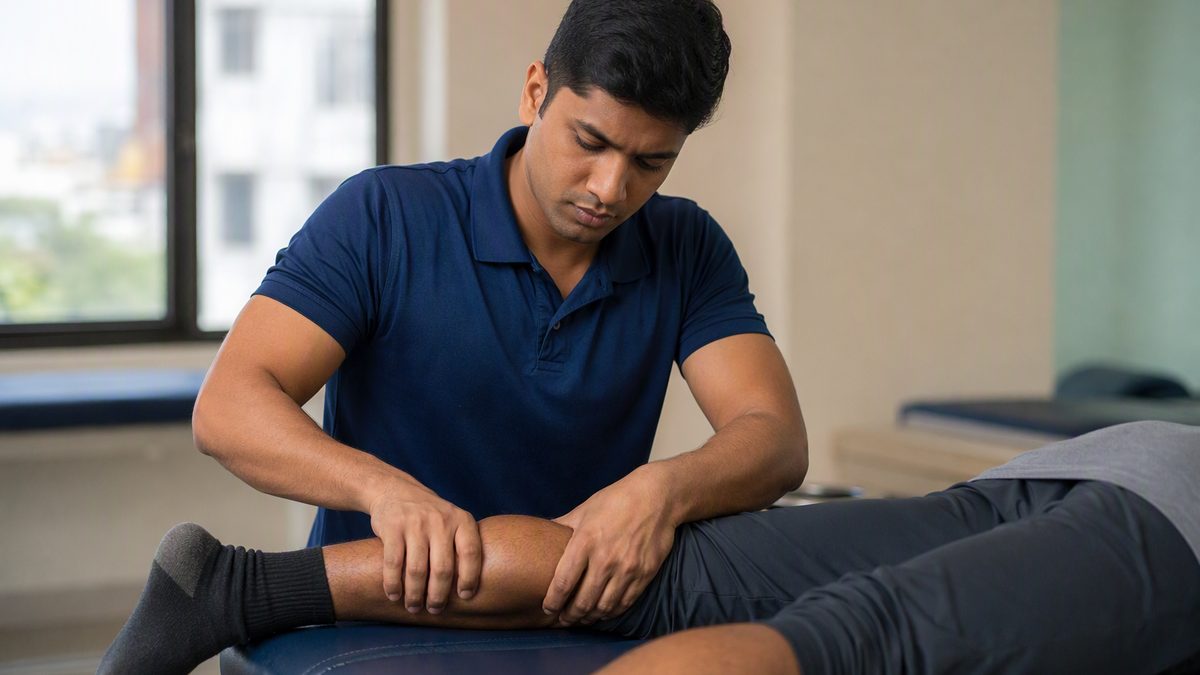
💡 Key Takeaways
- Massage's most useful payoff for you is the parasympathetic, stress-down, sleep-onset effect — not the modest soreness relief.
- A massage gun in your bag covers the felt benefit anywhere, with no booking and no decision — keep it to ~1-2 minutes per muscle.
- It does not undo sleep debt, alcohol, or chronic cortisol; it is a wind-down aid layered on top, not a substitute for sleep.
- Build it into a fixed default (same short routine, pre-sleep) so it survives airports and 6am calls without willpower.
Picture a normal week: red-eye Monday, client dinner with wine Tuesday, a 6am board call Wednesday, hotel gym squeezed in when you can. Your back is tight from the flight, your sleep is fragmented across time zones, and your stress sits high all day. Somewhere in there a 10-minute wind-down with a massage gun, or an occasional proper session, can earn its place — if it slots in without becoming one more decision.
Be clear on why it helps, though, because it is not the reason most people assume. The biggest payoff of massage for someone in your situation is not the modest dent it makes in muscle soreness. It is the parasympathetic shift — the move out of fight-or-flight into a calmer state — that lowers perceived stress and helps you fall asleep. For a chronically wired, under-slept traveler, that sleep-onset nudge is the real prize.
This guide drops massage into your actual week, then explains the science and the limits so you know exactly what you are buying.
1. Where Massage Slots Into a 60-Hour Travel Week
Your default rule should be 'same short routine, same time, anywhere' — decisions are your scarcest resource, so remove them. Anchor a brief massage-gun session to a fixed cue you cannot skip: the 10 minutes before you get into bed, wherever bed happens to be that night.
On a travel day, that pre-sleep slot does double duty: it loosens the back and hips that stiffen from hours in a seat, and it triggers the wind-down response that helps you sleep in an unfamiliar room and a shifted time zone. After a hotel-gym session, a couple of minutes on the muscles you trained takes the edge off the next day's soreness. Around a client dinner with alcohol, keep your expectations low — massage will not rescue the sleep that wine fragments, but the wind-down routine is still worth keeping because it is one of the few stable anchors in an unstable week. The point is consistency of a tiny habit, not intensity of any single session.
2. The Default Protocol: Same Dose, Any Time Zone
Here is the no-decision version, built to survive airports and early calls. The doses are practical guidance — there is no precise validated recovery prescription — so the value is in the routine being repeatable, not in chasing an optimal number.
| Type | When to use it | Strength of the evidence |
|---|---|---|
| Massage gun on back, hips, and shoulders, light pressure (~1-2 min per area) | The 10 minutes before bed, every night, wherever you are — your fixed anchor | Modest for soreness; relaxation supports sleep onset |
| Massage gun on trained muscles (~1-2 min each) | After a hotel-gym or home session, to take the edge off next-day soreness | Modest — similar felt benefit to hands-on work |
| Professional Swedish or sports massage (45-60 min) | Occasionally at home between trips, for a deeper reset and an assessment | Modest — small perceived-soreness and clear relaxation benefit |
| Deep, aggressive work right before a power session or big presentation | Avoid — transient looseness and tenderness can blunt readiness | Practical guidance — keep deep work away from peak-output windows |
Glide the gun slowly over the muscle belly, stay off the spine and the front and sides of the neck, and keep pressure moderate. The routine, not the force, is what compounds.
3. Why the Sleep Effect Matters More Than the Soreness Effect
For most athletes the headline benefit of massage is feeling less sore. For you, the order flips. Your training volume is modest and your soreness is rarely the limiting factor — your sleep is. Travel, time zones, alcohol, and a racing mind chip away at the one recovery lever that does the heavy lifting, because most of your hormonal and tissue recovery happens while you sleep, and short or broken sleep measurably degrades both recovery and next-day performance.
This is exactly where massage's best-supported mechanism earns its keep. A pre-sleep session down-regulates sympathetic tone — the always-on, decision-fatigued, cortisol-high state you live in — and shifts you toward the parasympathetic side that makes sleep onset easier. It will not add hours to a four-hour night or cancel the alcohol from a client dinner, and it is no replacement for actually protecting your sleep window. But as a reliable wind-down ritual that travels in your bag, it is one of the more sensible recovery tools you can carry. If you want to systematize the whole travel-recovery routine rather than wing it, the options in our fitness apps guide can hold the default in place for you.
4. Executive Mistakes That Massage Can't Out-Run
- Stacking stimulants over sleep debt. Caffeine to paper over a bad night, then a massage to 'recover' — neither fixes the deficit. Protect the sleep window first.
- All-or-nothing thinking. A missed perfect week is not failure. The 10-minute pre-sleep routine is precisely the small, repeatable habit that survives a chaotic schedule.
- Expecting massage to undo alcohol. Wine fragments sleep architecture no rubdown can repair. Moderate the drinks; do not lean on the massage.
- Deep work before a high-output morning. Aggressive massage can leave you transiently loose and tender, which is the wrong feeling before heavy lifting or a demanding day. Keep it light when output matters.
- Believing it 'detoxes' travel. It does not flush toxins or jet lag. Its honest job is wind-down and modest soreness relief.
5. The One Metric Worth Watching
You asked for a single number to track, and the right one is not a soreness score — it is your sleep. Your premium wearable already estimates sleep onset, duration, resting heart rate, and HRV. Read those as trends across a week, not as gospel single readings, since consumer devices vary in accuracy. If your pre-sleep massage routine is helping, the place it will show up is faster, more consistent sleep onset and a calmer resting heart rate on the nights you do it — not in any objective muscle marker, which barely moves.
Run it like a quick experiment, the way you would test anything else: keep the routine for two weeks, drop it for one, and compare your sleep-onset trend and how fresh you feel. Your annual executive physical is a natural broader checkpoint for the things that actually matter most — cardiovascular numbers, blood pressure, the consequences of chronic stress and poor sleep. Massage sits at the bottom of that hierarchy as a low-stakes wind-down aid. Sleep, training-load management, and not stacking stimulants over a deficit are the levers that move your numbers; the massage gun in your bag is the small, reliable ritual that supports the first of those, and nothing more.
Frequent-Traveler Questions About Massage
What's the minimum effective massage routine when I travel?
A massage gun in your bag and 10 minutes before bed. Run it lightly over your back, hips, and shoulders, a minute or two per area, as a fixed pre-sleep anchor. That covers the two things massage actually does for you: a small reduction in next-day soreness and, more usefully, a wind-down that helps you fall asleep in an unfamiliar room. No booking, no decision, works in any time zone. Keep it off the spine and neck.
Does alcohol at client dinners cancel out the benefit?
Alcohol does not cancel the soreness benefit, but it sabotages the sleep your massage routine is meant to support. Wine and spirits fragment sleep architecture, so even with a good wind-down you will sleep less deeply. Massage cannot repair that. The honest move is to moderate the drinks when you can and keep the pre-sleep routine anyway, since it is a stable anchor in an unstable week. Just do not expect it to undo what the alcohol does to your night.
Can I keep a massage routine consistent across time zones?
Yes, and that is its strength. Because your anchor is a cue — the 10 minutes before bed — rather than a clock time, it travels with you regardless of zone. A massage gun needs no appointment and no local therapist, so the routine survives a red-eye, a hotel, and a 6am call equally well. The wind-down effect is actually most valuable when your sleep is disrupted, which makes a shifting schedule the best argument for keeping the habit, not abandoning it.
What single metric should I watch to know it's working?
Your sleep onset, not a soreness score. On the nights you run the pre-sleep routine, look for falling asleep faster and a calmer resting heart rate on your wearable, read as a trend over a week rather than a single night. Objective muscle markers barely move with massage, so they tell you nothing. Test it like anything else: two weeks on, one week off, and compare. If sleep onset improves, the routine is earning its place; if not, drop it.
Disclaimer: This article is for educational purposes only and is not medical advice. Consult a qualified healthcare professional before starting any supplement, nutrition, or training protocol — especially if you are pregnant or breastfeeding, under 18, taking medication, or managing a health condition.
Scientific References & Clinical Sources
- Dupuy O, et al. An Evidence-Based Approach for Choosing Post-exercise Recovery Techniques to Reduce Markers of Muscle Damage, Soreness, Fatigue, and Inflammation: A Systematic Review With Meta-Analysis. Front Physiol, 2018. PMID: 29755363
- Dattilo M, et al. Sleep and muscle recovery: endocrinological and molecular basis for a new and promising hypothesis. Med Hypotheses, 2011. PMID: 21550729
- Thun E, et al. Sleep, circadian rhythms, and athletic performance. Sleep Med Rev, 2015. PMID: 25553531
- Fullagar HH, et al. Sleep and athletic performance: the effects of sleep loss on exercise performance. Sports Med, 2015. PMID: 25315456
- Peake JM, et al. A Critical Review of Consumer Wearables, Mobile Applications, and Equipment for Providing Biofeedback, Monitoring Stress, and Sleep in Physically Active Populations. Front Physiol, 2018. PMID: 30002629

