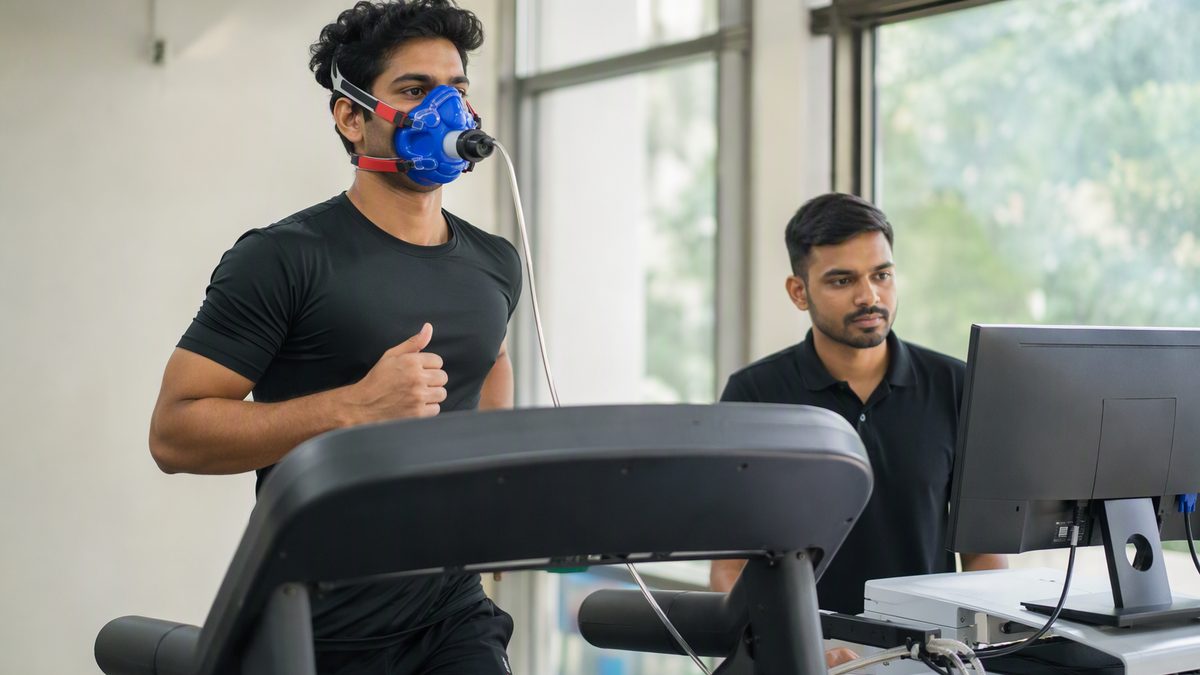
💡 Key Takeaways
- VO2max is among the strongest single predictors of all-cause mortality — and the steepest health gains come from moving out of the lowest fitness band, exactly where many desk workers sit.
- One gym session can't undo 8-10 sitting hours; frequent movement plus 1-2 weekly hard sessions matters more than a single heroic workout.
- From a sedentary start you can realistically gain 15-20%+ VO2max over a few months — beginners respond fastest of anyone.
- Your watch's VO2max is a +/-10-15% estimate; use it to watch the trend line, not to obsess over a single reading.
What's the one fitness number worth tracking if I sit at a desk all day? Your VO2max — the highest rate at which your body can take in and use oxygen. It's the best single measure of overall aerobic fitness because it reflects your whole oxygen-delivery system, and it's one of the strongest predictors of how long you'll live. For a desk worker, that makes it the metric that matters most.
Here's the direct answer to the worry behind the question: yes, a sedentary job drags this number down, and yes, you can move it — faster than almost anyone, because beginners respond hardest to training. The mortality data are striking: being in the lowest fitness band carries risk on par with traditional factors like smoking and high blood pressure, and the benefit of being fitter keeps climbing with no clear ceiling.
Below: why sitting blunts your fitness even if you exercise, how much you can realistically improve, a simple weekly plan that fits a 9-to-6, and how to read your wearable's number without being misled by it.
1. Why VO2max Is the Longevity Number Worth Watching
Of all the things a wearable shows you, VO2max is the one most tightly linked to living longer. It captures the capacity of your entire aerobic system — heart, blood, vessels and the mitochondria in your muscles that actually burn oxygen — in a single figure, which is why it outperforms most individual health metrics as a predictor. In a large study of more than 122,000 adults given treadmill tests, higher fitness was tied to substantially lower long-term mortality, the benefit kept rising with no observed upper limit, and the least-fit group carried risk comparable to or worse than smoking, diabetes or hypertension (PMID 30646252).
The encouraging twist for a desk worker is where the curve is steepest. The biggest mortality drop comes from climbing out of the lowest fitness band into a merely moderate one — you don't need an athlete's engine to capture most of the longevity benefit. That's precisely the move available to someone who's been sedentary. This is an association, not proof that each point of VO2max directly buys years, but it's strong, consistent and dose-dependent across huge populations. For a desk worker deciding where to spend limited training energy, raising this number is about as evidence-backed a target as fitness offers.
2. How Sitting Quietly Blunts Your Engine
The frustrating reality is that long sedentary stretches work against your fitness even if you train. Hours of uninterrupted sitting blunt insulin sensitivity and suppress the activity of enzymes that clear fat from your blood — and this happens even in people who exercise regularly. A single workout improves your day, but it doesn't cancel the metabolic cost of the 8-10 hours your body spent still. The body responds to the overall pattern of movement across the day, not to one virtuous hour at 6pm.
That's why the desk worker's most common belief — 'my morning gym session covers me' — quietly fails. The fix isn't necessarily a longer workout; it's breaking up the sitting AND giving your heart a real aerobic stimulus a couple of times a week. Mitochondria, the cellular power plants that burn oxygen, are built by repeated aerobic contraction: physical activity measurably raises skeletal-muscle mitochondrial content and improves blood-sugar control, an effect shown even in people with type 2 diabetes (PMID 17536069). More movement, more often, switches that machinery on; long sitting blocks let it idle. Movement snacks at your desk — a few minutes of stairs or brisk walking every hour or two — won't max your VO2max, but they meaningfully blunt the metabolic harm of sitting between your real sessions.
3. A Desk Worker's Weekly Plan to Move the Number
Raising VO2max needs both ends of the intensity range, because they fix different limiters. The big base of easy aerobic work — brisk walks, easy cycling, lunch loops — builds mitochondrial density and fat-burning, the peripheral machinery. A small weekly dose of hard intervals stresses your heart's maximal output, raising the ceiling itself (PMID 17901124). For someone starting from sedentary, build a few weeks of easy aerobic base first, then add one or two short hard sessions. The most reliable interval format is the Norwegian 4x4: four minutes hard, three minutes easy, four times.
| Slot | Session | Time | Frequency |
|---|---|---|---|
| Hourly at desk | Movement snack: stairs or brisk walk | 2-3 min | Every 1-2 h |
| Lunch break | Easy aerobic walk | 20-30 min | Most days |
| Before/after work | Easy aerobic base (walk, bike, jog) | 30-45 min | 2-3x/week |
| Once/twice weekly | 4x4: 4 min hard, 3 min easy, x4 | ~35 min | 1-2x/week |
| Weekend | Longer easy session | 45-60 min | 1x/week |
Keep the two hard sessions at least 48 hours apart so you recover and adapt. From a sedentary start the gains are the best you'll ever see — roughly 15-20% or more over a few months is realistic, with most of it measurable across 8-12 weeks. If consistency is your real obstacle, our guide to building fitness habits covers anchoring these slots to your existing routine so they actually survive a busy week.
4. Reading Your Wearable Without Being Fooled
Your watch's VO2max is a modelled estimate, not a measurement. It infers the figure from how your heart rate relates to your walking or running pace, so it's only as good as the optical heart-rate data and the pace it sees — and it commonly carries +/-10-15% error, with many devices capping or smoothing the value (PMID 29018355; PMID 30002629). It needs reliable outdoor walks or runs to calibrate; treadmill, cycling or stop-start movement can throw it off. Don't read a single number as gospel, and don't compare yours to a colleague's like a leaderboard. The device is far better at showing the direction of travel over weeks than at nailing an absolute figure.
So track the trend, and back it with things you can feel. The cleanest no-gadget signal is pace at a fixed comfortable heart rate — if your lunch-walk loop gets faster at the same heart rate over a month, your aerobic fitness genuinely improved. A resting heart rate drifting down and quicker recovery after a hard effort tell the same story. Set a realistic expectation: as a sedentary starter you'll likely see the number climb early, then slow as you get fitter, which is normal and not a plateau to panic over. And a safety note — near-maximal intervals briefly raise cardiac load, so if you've been inactive for years, are over 40 with risk factors, or have any chest symptoms, get a medical check before pushing into all-out efforts, and build your easy base first.
What Desk Workers Ask About VO2 Max
Does sitting all day cancel out my training?
Not entirely, but it works against you. Long uninterrupted sitting blunts insulin sensitivity and fat-clearing enzyme activity even in regular exercisers, so a single workout improves your day without erasing the cost of 8-10 still hours. Your body responds to the whole movement pattern, not one session. The fix is both: break up sitting with movement snacks every hour or two, and give your heart a real aerobic stimulus a couple of times a week. The combination protects your fitness far better than one heroic gym session.
When should I fit this around a 9-to-6?
Use the slots you already have. Movement snacks — two or three minutes of stairs or brisk walking — fit between meetings every hour or two. A 20-30 minute easy walk fits at lunch. Your one or two hard 4x4 sessions slot before or after work, kept at least 48 hours apart so you recover. Consistency beats perfect timing here, so anchor sessions to fixed points in your day rather than hunting for the ideal window. The best schedule is the one that survives a busy week.
Can movement snacks at my desk actually help?
Yes, for a specific job. Short bursts of movement every hour or two won't maximise your VO2max — that needs real aerobic sessions — but they meaningfully blunt the metabolic harm of prolonged sitting, like the dip in insulin sensitivity and fat clearance. Think of them as damage control between your real workouts, not a replacement for them. A few minutes of stairs, a brisk walk to refill water, or standing calf raises on a call all count. Frequency matters more than intensity for this particular benefit.
Why am I exhausted at 3pm, and will this help?
The afternoon slump has many causes — poor sleep, big lunches, blood-sugar swings, and long stretches of stillness all feed it. Improving your aerobic fitness and breaking up sitting won't fix everything, but better cardiorespiratory fitness and regular movement do improve daytime energy and blood-sugar control over time. A short brisk walk after lunch is one of the most reliable ways to blunt the slump in the moment. If fatigue is severe or persistent despite good sleep, it's worth raising with your doctor.
Disclaimer: This article is for educational purposes only and is not medical advice. Consult a qualified healthcare professional before starting any supplement, nutrition, or training protocol — especially if you are pregnant or breastfeeding, under 18, taking medication, or managing a health condition.
Scientific References & Clinical Sources
- Mandsager K, et al. Association of Cardiorespiratory Fitness With Long-term Mortality Among Adults Undergoing Exercise Treadmill Testing. JAMA Netw Open, 2018. PMID: 30646252
- Toledo FG, et al. Effects of physical activity and weight loss on skeletal muscle mitochondria and relationship with glucose control in type 2 diabetes. Diabetes, 2007. PMID: 17536069
- Joyner MJ, Coyle EF. Endurance exercise performance: the physiology of champions. J Physiol, 2008. PMID: 17901124
- Düking P, et al. Criterion-Validity of Commercially Available Physical Activity Tracker to Estimate Step Count, Covered Distance and Energy Expenditure during Sports Conditions. Front Physiol, 2017. PMID: 29018355
- Peake JM, et al. A Critical Review of Consumer Wearables, Mobile Applications, and Equipment for Providing Biofeedback, Monitoring Stress, and Sleep in Physically Active Populations. Front Physiol, 2018. PMID: 30002629

