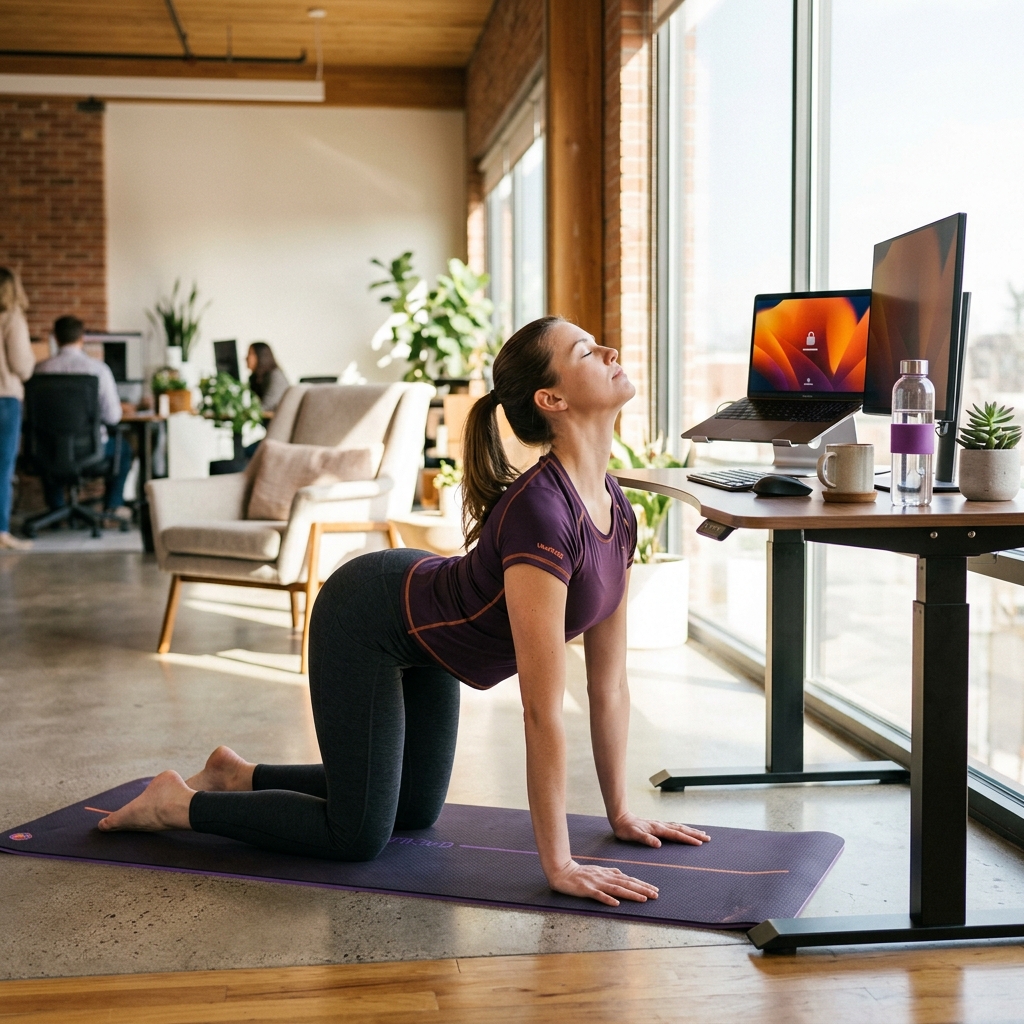
If you spend the majority of your day seated at a desk, your body is paying a quiet but compounding price. Tight hip flexors, a stiff thoracic spine, rounded shoulders — these are not inevitable signs of aging. They are the predictable result of hours spent in the same fixed position. The good news is that just fifteen to twenty minutes of intentional movement first thing in the morning can interrupt that pattern, restore range of motion, and fundamentally change how your body feels by the time you sit down at your computer. This is not a workout. It is a reset — and it is one of the highest-return habits a desk worker can build.
What Sitting Does to Your Body
The human body is designed for movement, not sustained stillness. When you sit for long periods, several things happen at once, and none of them are good for your long-term comfort or performance.
- Hip flexors shorten and tighten. The iliopsoas — the primary hip flexor — stays in a contracted position while seated. Over months and years, it adapts to that shortened length, pulling the pelvis into an anterior tilt and compressing the lower lumbar vertebrae.
- The thoracic spine rounds and stiffens. Sitting with a forward-leaning posture causes the mid-back to flex continuously. The joints between thoracic vertebrae lose their natural extension capacity, making it harder to stand tall or rotate freely.
- Shoulder internal rotation becomes the default. Typing with hands in front of you keeps the shoulders internally rotated and the chest compressed. The pec minor tightens, the serratus anterior weakens, and the shoulder blades lose their ability to move properly across the rib cage.
- Glutes become underactive. Sitting literally compresses the glutes for hours at a time. Combined with the shortened hip flexors, this creates a reciprocal inhibition effect where the glutes stop firing efficiently — contributing to lower back pain and poor hip mechanics.
None of this happens overnight, which is why so many desk workers do not notice it until they feel persistent stiffness, discomfort, or reduced performance during exercise. A morning mobility routine directly addresses all of these patterns before they accumulate further throughout the day.
Why Morning Is the Right Time
There is nothing magical about the morning from a physiological standpoint — mobility work done at any point in the day will help. But the morning has a distinct practical advantage: it happens before the demands of the day erode your intention to do it. A routine completed before you open your inbox is one that actually gets done.
There are also some real physical reasons the morning works well. After sleep, your joints and connective tissue have been largely still for several hours. Gentle, controlled mobility work warms the tissue, increases synovial fluid circulation in the joints, and wakes up the neuromuscular pathways that control movement. You are essentially preparing your body for the positions it will be forced into during the workday, rather than just reacting to the damage after the fact.
Doing this routine consistently also creates a measurable proprioceptive baseline — your nervous system learns what full, pain-free range of motion feels like, making it easier to detect and correct postural drift throughout the day.
The Routine: Six Movements That Cover Everything
This sequence is designed to progress from the ground up, moving from the hips and spine to the shoulders. You need no equipment. A yoga mat or soft surface helps for comfort, but even carpet works. Plan for fifteen to eighteen minutes total.
1. Cat-Cow — 2 minutes
Start on all fours with your wrists under your shoulders and knees under your hips. On an inhale, drop your belly toward the floor, lift your tailbone, and let your gaze come forward (cow). On an exhale, press the floor away, round your entire spine toward the ceiling, and tuck your chin to your chest (cat). Move slowly, pausing briefly at each end range. This movement decompresses the lumbar spine, restores segmental movement through the thoracic vertebrae, and gently wakes up the deep spinal stabilizers. Focus on feeling each vertebra participate in the movement rather than just hinging at one or two spots.
2. Thoracic Rotations — 90 seconds per side
From all fours, place one hand behind your head with your elbow pointing out to the side. Keep your lower back stable and rotate your upper back, threading your elbow toward the ceiling as far as it will go without your hips shifting. Pause at the top for a breath, then return. The key is isolating the rotation to the thoracic spine — your hips should stay relatively still. This directly undoes the stiffness created by hours of forward flexion and restores the rotational capacity that the thoracic spine is anatomically built for but rarely gets to use.
3. 90/90 Hip Stretch — 2 minutes per side
Sit on the floor and position both legs in a ninety-degree angle at the knee — one leg in front of you with the shin parallel to your body, and the other leg behind with the shin also at ninety degrees. This places the front hip in external rotation and the back hip in internal rotation simultaneously. Sit tall through your spine and hinge gently forward over your front shin, feeling a deep stretch in the front hip's external rotators. Hold for thirty to sixty seconds, then switch sides. This is one of the most effective positions for restoring hip mobility lost through prolonged sitting, and it targets the piriformis, glute medius, and hip capsule in a way that standing stretches often miss.
4. Hip Flexor Stretch — 90 seconds per side
From a half-kneeling position (one knee on the floor, one foot forward), tuck your pelvis slightly under — this is crucial. Without the posterior pelvic tilt, most people compensate by extending the lower back rather than actually stretching the hip flexor. Shift your weight gently forward until you feel a stretch in the front of the rear hip and thigh. You can add a reach of the same-side arm overhead to increase the stretch through the lateral line of the body. Hold steady for sixty to ninety seconds per side rather than bouncing.
5. World's Greatest Stretch — 5 reps per side
This movement earns its name. Start in a push-up position. Step your right foot to the outside of your right hand. Drop your left knee to the floor. Take your right hand off the floor and rotate your torso open, reaching your right arm toward the ceiling and following it with your gaze. Return your hand to the floor, then press your hips back toward a modified downward dog to stretch the hamstring of the front leg. Return to the start and repeat. Each full rep hits the hip flexors, adductors, thoracic rotation, hamstrings, and shoulder — making it the single most efficient movement in this entire sequence.
6. Shoulder CARs — 5 reps per side
CARs stands for Controlled Articular Rotations. Stand tall and, keeping the rest of your body completely still, slowly move one arm through the largest circle it can make while maintaining tension throughout the entire range. The key is active control — you are not swinging the arm but rather using the muscles of the shoulder to drive the movement through every degree of available range. This trains the nervous system to own the full range of motion at the shoulder joint, rather than just having passive flexibility. Do this slowly and deliberately; one full rotation should take five to eight seconds.
How to Build the Habit
The most common reason mobility routines fail is complexity, not laziness. When the routine feels overwhelming or requires too much setup, it gets skipped. Here is how to make this one stick.
- Attach it to something you already do. Do this routine immediately after waking and before your shower, coffee, or phone check. It becomes part of the existing morning sequence rather than a separate obligation.
- Keep the mat out. Having to find and unroll a mat adds friction. Leave it out somewhere visible. Visual cues are more reliable than memory or motivation.
- Start with ten minutes. If fifteen minutes feels like too much at first, cut the hold times and do fewer reps. Consistency over weeks matters more than perfect execution on any given morning.
- Track how you feel, not just whether you did it. Notice where you felt tight, which side is more restricted, and whether your lower back feels better on days you do this versus days you skip it. That feedback loop is what turns a routine into a genuine priority.
What to Expect Over Time
In the first week, you will likely notice reduced morning stiffness and a clearer sense of where your mobility restrictions actually are. By weeks three and four, you may find that positions like the 90/90 feel noticeably more accessible, and that your lower back feels less compressed by midday. After two to three months of consistent practice, the neurological adaptations become significant — your body begins to maintain better posture automatically because the muscles controlling it are now accustomed to working through full range.
It is worth noting that mobility work is cumulative. Missing a day or two has no lasting impact. What matters is the long-term average — five mornings per week over six months will produce changes that no single session ever could. The goal is not perfection. It is a small, consistent investment in the body that has to carry you through decades of a largely sedentary work life.
Track each morning mobility session directly in UltraFit360 — log which movements you completed, note which areas felt restricted, and let the app build a picture of your mobility progress over time so you can see exactly how far you have come.
Transform Your Fitness Journey
Log your workouts, track your diet, and get AI coaching insights — all with UltraFit360.