💡 Key Takeaways
- A 3-minute roll has one default rule: same areas, same short doses, anywhere — no decisions to make at 6am or in a hotel gym.
- Pre-session, roll 30-90 seconds per area to move better; after long sitting or a flight, it eases a stiff feeling but does not undo the metabolic cost of sitting.
- A travel massage gun matches a roller's modest, mostly-acute benefit — convenient, no floor space needed — keep it off the spine, neck, and joints.
- Rolling never replaces the real levers: sleep, managing stimulant-over-sleep-debt habits, and training load. It is a 3-minute feel-good extra.
It is 6:10am in a hotel gym you have never seen before, you have a 7:30 call, and your hips are locked from yesterday's flights and back-to-back meetings. You have maybe twenty minutes. The question is not whether foam rolling is optimal — it is where three minutes of it slots into a morning that has no slack.
Here is where it fits. Spend the first three minutes rolling the areas that stiffen from sitting and travel, then move straight into your real warm-up and session. The rolling buys you a looser, more mobile body to train in, right now, for the next hour or two. That is the entire job. It will not warm you up by itself, will not make the workout count for more, and will not undo what a day of sitting does to your metabolism.
This guide gives you a default routine that survives airports and time zones, then explains why it works and where it stops — so you can run it on autopilot without a single decision.
1. Where 3 Minutes of Rolling Slots Into a Compressed Morning
The principle that survives your schedule is the same one you apply everywhere: remove decisions. Do not stand in a hotel gym deciding what to roll. Have one default — the same handful of areas, the same short doses, every time, anywhere — so the only choice is to start.
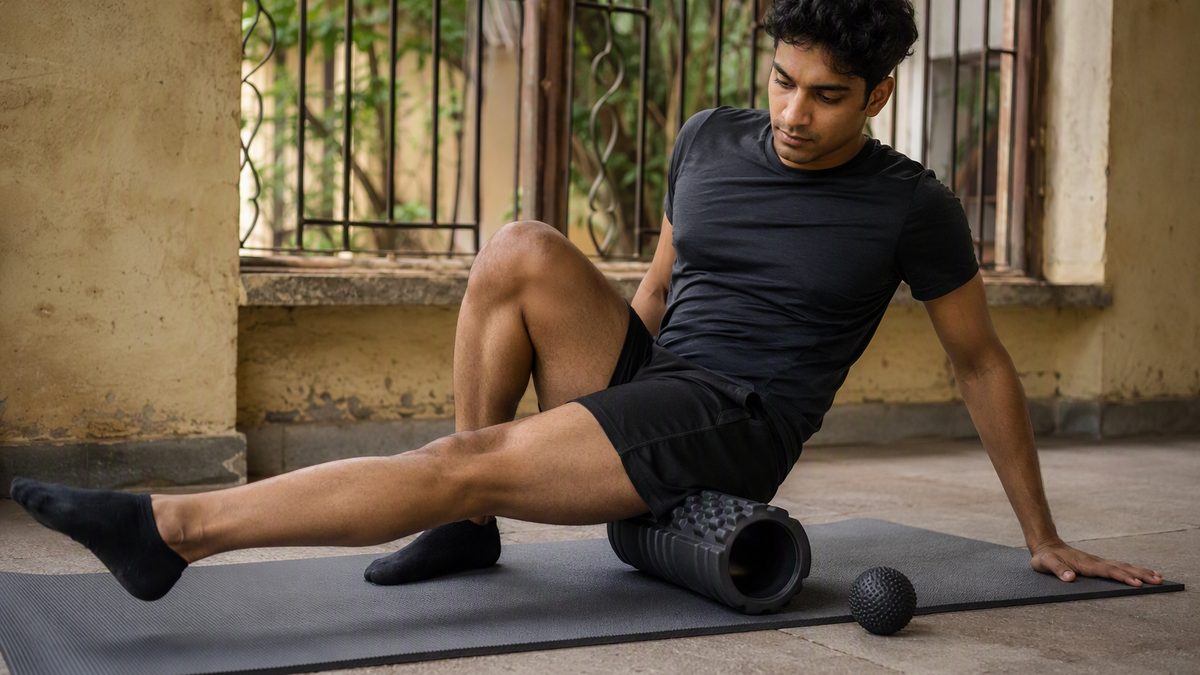
The slot is the first three minutes of your session, before anything else. Self-myofascial release simply means rolling a muscle over a foam tube, or pressing a ball into a tight spot, with your own bodyweight. From a chair-bound day, the predictable culprits are the hip flexors and quads, the upper back that rounds over a laptop, the glutes, and the calves. Roll each one briefly to take the locked feeling out, then go straight into a real dynamic warm-up — a few minutes of light cardio and movement — because rolling does not raise your body temperature or rehearse the patterns you are about to train. Done in that order, three minutes of rolling makes the next twenty count for more, because you move through fuller, more comfortable range from the first set. On a travel day with no roller, a packable massage gun does the same job from a chair or the edge of a bed.
2. Your Travel-Proof Default Routine
Here is the routine to memorize so you never have to think. Same areas, same short doses, whether it is your home rack, a hotel gym floor, or a chair before a flight. The doses are deliberately short — the point is to prime range, not to fatigue you before a 6am session.
| Area and tool | Duration | Pre-session or anytime |
|---|---|---|
| Hip flexors and quads, foam roller or gun | 30-60 sec each side | Pre-session — the priority after a sitting day |
| Upper and mid back, foam roller | 45-60 sec, slow passes | Pre-session — opens a laptop-rounded posture |
| Glutes, firm ball or gun | 30-45 sec each side | Pre-session, or seated during a long flight |
| Calves, foam roller or gun | 30 sec each | Pre-session, especially after long-haul travel |
| Spine, neck, lower back, joints | Avoid — muscle only | Never — unsafe regardless of how stiff they feel |
Roll slowly, about an inch per second, at a tolerable 'good ache' you can breathe through. Total time is roughly three minutes. Then warm up properly and train. Run this exact sequence everywhere and it becomes a default rule, not a decision.
3. Why It Works on the Road, and What Sitting Still Does
The reason a quick roll loosens you is neural, not mechanical. You are not breaking up knots, melting fascia, or flushing anything — fascia is far too tough for bodyweight to deform, and the lactic-acid story is a myth. What the slow pressure does is quiet the nerves around the muscle and raise your tolerance for stretch, so a stiff, shortened-feeling area moves through more range, by a few percent, right away. That is exactly the transient looseness you want before a compressed session, and unlike long static stretching it does not blunt your strength or power afterward — which matters when your session is already short.
What rolling will not touch is the deeper cost of your day. Long sedentary blocks dull insulin sensitivity and lipoprotein lipase activity even in people who train hard, and a single workout does not cancel that out. The antidote is breaking up the sitting itself — standing, walking, a few minutes of movement between meetings — not rolling harder afterward. Treat rolling as a mobility primer for the time you do get to train, and treat frequent movement through the day as the separate, more important habit. The two solve different problems.
4. Executive Mistakes: Stimulants, Sleep Debt, and Rolling Theater
- Rolling instead of fixing sleep. Most recovery happens asleep, and travel and time zones are already eroding yours. No amount of rolling offsets chronic sleep restriction — that is the lever, not the roller.
- Stacking stimulants over sleep debt. Pre-workout and a fourth coffee mask under-recovery; they do not resolve it. Rolling does not either. Address the sleep, not the symptoms.
- All-or-nothing thinking. A missed perfect routine is not a wasted one. Three minutes of rolling and a 20-minute session beats skipping because you could not do the full plan.
- Grinding hard for a 'release'. Nothing releases. More pressure just bruises tissue and wastes minutes you do not have. Short and slow is the whole game.
- Expecting it to undo client dinners and sitting. Rolling does not counter alcohol, missed meals, or ten sitting hours. Those need their own fixes.
5. The One Metric Worth Watching, and Where Rolling Ranks
You like a single number to track, so here it is: your sleep, read as a trend. If you run a premium wearable, watch sleep duration and your resting heart rate and HRV trends over weeks, not any single night — consumer devices are best read as direction over time, since their accuracy varies. Those trends tell you whether travel and workload are out-recovering you far more reliably than how a muscle feels under a roller. Your annual executive physical is a natural checkpoint to look at the bigger picture.
Against that, rank rolling honestly: it is a three-minute, low-cost convenience that makes a short session feel better to move through, and modestly eases stiffness after a hard one or a long flight. It does not build fitness, fix sleep, or counter sitting. The executives who get the most from it are the ones who treat it as the trivial extra it is — running the default routine on autopilot in any gym in the world — while spending their actual attention on protecting sleep, breaking up sitting, and keeping training load sane through travel. Do those, and the roller is a pleasant three minutes. Skip those, and no recovery gadget will save the week.
Executive Questions About Foam Rolling on the Road
What's the minimum effective rolling routine when I travel?
Three minutes, same default everywhere: 30-60 seconds each on hip flexors and quads, upper back, glutes, and calves, slow and at a tolerable ache. That is enough to take the locked feeling out of a sitting-stiffened body before a session. With no roller, a packable massage gun does the same from a chair. Keep it off the spine, neck, and joints. Then do a real warm-up — rolling primes range but does not warm you up.
Does alcohol at client dinners ruin the benefit of rolling?
Rolling and alcohol are largely unrelated — rolling does not counter alcohol, and alcohol does not erase rolling's small, short-term mobility benefit. The real issue is that alcohol disrupts your sleep, which is the lever that actually drives recovery. So a roller does nothing to offset a heavy dinner; protecting your sleep window and hydrating do. Treat rolling as a mobility primer for your sessions and manage alcohol's effect on sleep as the separate, bigger problem.
Can I keep this up across time zones?
Yes — that is the point of a fixed default. Because the routine is the same areas and the same short doses anywhere, jet lag and a strange hotel gym do not change it; you run it on autopilot. What time zones genuinely disrupt is your sleep, and rolling cannot fix that. Anchor the routine to the start of whatever session you manage to do, keep it to three minutes, and put your real effort into recovering your sleep across the shift.
What single metric should I watch to know if I'm recovering?
Sleep, tracked as a trend rather than a single night. If you wear an Oura, Whoop, or Garmin, follow sleep duration alongside resting heart rate and HRV trends over weeks — read them as direction, since device accuracy varies. Those tell you whether travel and workload are out-recovering you. How a muscle feels under a roller is not a recovery metric; rolling only changes short-term mobility. Your annual executive physical is a good moment to review the fuller picture.
Disclaimer: This article is for educational purposes only and is not medical advice. Consult a qualified healthcare professional before starting any supplement, nutrition, or training protocol — especially if you are pregnant or breastfeeding, under 18, taking medication, or managing a health condition.
Scientific References & Clinical Sources
- Dupuy O, et al. An Evidence-Based Approach for Choosing Post-exercise Recovery Techniques to Reduce Markers of Muscle Damage, Soreness, Fatigue, and Inflammation: A Systematic Review With Meta-Analysis. Front Physiol, 2018. PMID: 29755363
- Gill ND, et al. Effectiveness of post-match recovery strategies in rugby players. Br J Sports Med, 2006. PMID: 16505085
- Dattilo M, et al. Sleep and muscle recovery: endocrinological and molecular basis for a new and promising hypothesis. Med Hypotheses, 2011. PMID: 21550729
- Thun E, et al. Sleep, circadian rhythms, and athletic performance. Sleep Med Rev, 2015. PMID: 25553531
- Peake JM, et al. A Critical Review of Consumer Wearables, Mobile Applications, and Equipment for Providing Biofeedback, Monitoring Stress, and Sleep in Physically Active Populations. Front Physiol, 2018. PMID: 30002629

