💡 Key Takeaways
- Slot a 3-4 minute roll before the strength piece to free overhead and squat positions, and a few minutes post-WOD to ease soreness between high-volume days.
- Pre-WOD rolling raises ROM a few percent with no loss of strength, power, or barbell speed — the reason it beats long static stretching before lifting.
- It does not 'flush' a metcon, fix kipping-shoulder overuse, or speed glycogen recovery — and the fundamentals (carbs, sleep, deloads) do the real work.
- Prioritize shoulders, wrists, thoracic spine, and hips with a roller plus one ball; keep pressure off the spine, joints, and any tweaky shoulder you should rest instead.
Picture a normal training day at the box: a strength piece up top, then a metcon that puts you in the red, five or six days a week, sometimes 90 to 120 minutes a session. Somewhere in there you need overhead positions for snatches and jerks, a deep front-rack squat, and shoulders and wrists that survive kipping volume. The question is where a few minutes of foam rolling actually slots in — and where it is just wasted time.
Here is the answer up front. Roll for three or four minutes before the strength piece to open the positions you are about to load, then warm up properly and lift. Roll again for a few minutes after the session, or that evening, to take the edge off soreness between high-volume days. That is the whole job. Rolling will not 'flush' a metcon, will not fix a cranky shoulder, and will not speed your recovery between the brutal sessions your sport stacks up.
This guide walks through where rolling fits in a competitor's week, why it works for lifting specifically, and where the fundamentals have to carry the load instead.
1. Where Rolling Fits a Strength-Plus-Metcon Day
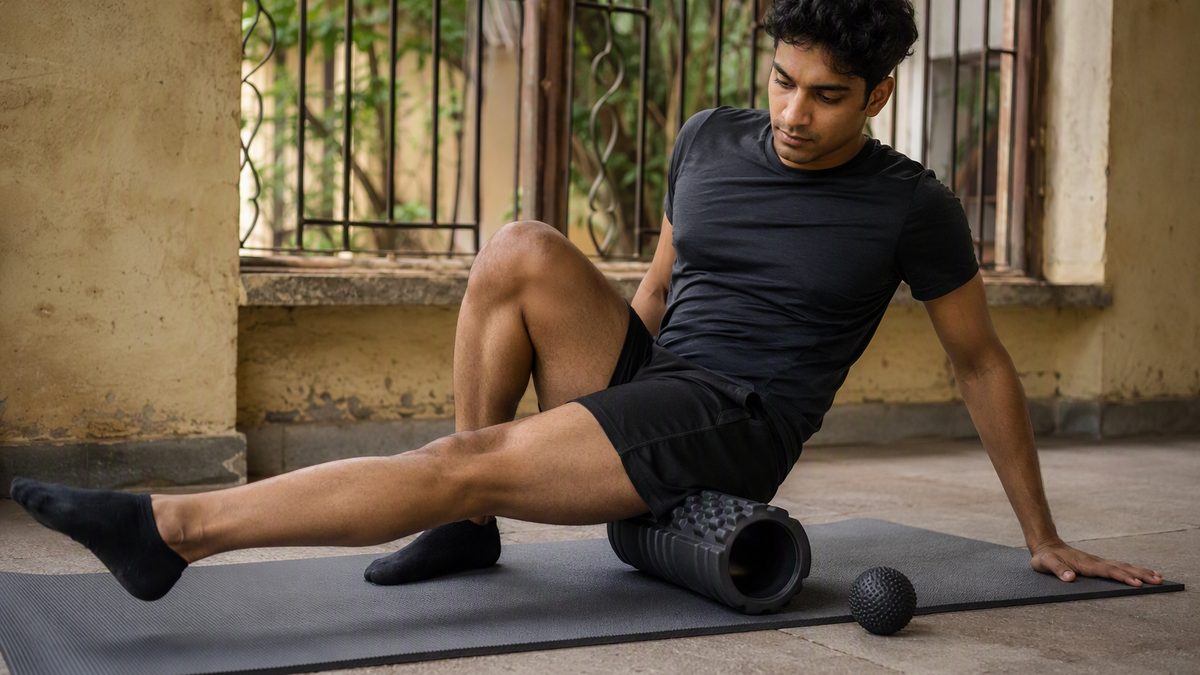
The timing that matters is before the barbell work. Self-myofascial release — rolling a muscle over a foam tube or pressing a ball into a tight spot with your bodyweight — earns its place as a short opener that frees the positions your lifts demand. Before a session with snatches, overhead squats, or heavy front squats, three or four minutes on the thoracic spine, lats, and hips makes overhead and squat positions more available, so you reach better positions from your first warm-up set. Then you do a real ramp-up — light aerobic work, dynamic drills, build-up sets — because rolling primes range but does not raise your core temperature or rehearse the movement.
After the WOD, a few minutes of rolling on the muscles that took the worst of it eases next-day soreness, which has practical value when tomorrow brings another strength-plus-metcon hit. What rolling is not is a mid-session recovery tool: it does not clear lactate, does not 'flush' a metcon, and will not buy you a faster Fran time. Lactate clears on its own within an hour or two and was never the cause of your soreness. So keep rolling at the two useful spots in the day — a short primer before loading, a modest soreness aid after — and do not expect it to do anything during the engine work itself.
2. Why It Works Before Lifting (and the Lactic-Acid Myth)
The reason a pre-lift roll is genuinely useful comes down to one combination: it raises your range of motion by a few percent without dropping your strength or power. Long static stretching can free a position too, but it transiently blunts force and power output — exactly what you do not want before a heavy snatch or a max-effort metcon. Rolling gives you the mobility gain without that cost, which is precisely why it is the better pre-lifting primer. The mechanism is neural: the slow pressure quiets the muscle's tension reflexes and raises your tolerance for stretch, so you move further before discomfort stops you. You are not lengthening tissue, and you are not breaking up anything.
That last point kills the most stubborn box myth. You are not 'flushing lactic acid' when you roll between or after efforts. Lactate is not what makes you sore the next day, and it clears on its own in an hour or two regardless of what you do to your legs. Rolling does not detox a muscle, does not break up fascia (it is far too tough for bodyweight to deform), and does not dissolve knots. What it does — quiet a tight feeling, raise stretch tolerance, modestly ease perceived soreness — is real and useful in its lane. Knowing the actual mechanism keeps you from wasting your between-sets rest grinding on a roller expecting a recovery that is not happening there.
3. A Weekly Rolling Map for 5-6 Training Days
Across a high-volume week, prioritize the areas your sport overuses: shoulders, wrists, thoracic spine, and hips from kipping and overhead volume. A roller for big groups, a firm ball for focal spots. Doses are short pre-session by design; post-session can run a touch longer.
| Area and tool | Duration | Pre-WOD or post-WOD |
|---|---|---|
| Thoracic spine, foam roller | 45-60 sec, slow passes | Pre-WOD on overhead and Oly days |
| Lats and pecs, foam roller or ball | 30-60 sec each | Pre-WOD to free overhead and front-rack |
| Quads, glutes, hips, foam roller | 30-90 sec each | Pre-WOD for squat depth; post-WOD for soreness |
| Calves and forearms, firm ball | 30-45 sec each, gentle | Post-WOD after grip- and rope-heavy work |
| Spine, neck, wrists, elbows, knees | Avoid — muscle only | Never — joints and spine are off-limits |
Roll slowly at a tolerable 'good ache', about an inch per second. Keep the pre-WOD bout short so you prime range without fatiguing for the work ahead, then warm up properly.
4. Does It Matter During the Open and Red-Zone Workouts?
During the Open or a local comp, rolling plays the same modest role it always does — a pre-WOD position primer and a post-WOD soreness aid — and nothing more. It will not improve your score, will not give you a better engine on the day, and will not help mid-workout when you hit the red zone. The redline is an energy-system and pain-tolerance problem; a roller does nothing for it. Where it helps in a competition week is on the margins: opening your overhead and squat positions before you warm up so you start the workout moving well, and easing soreness between heats or events so you show up to the next one less stiff.
A word on the red zone specifically, because your sport flirts with extreme intensity: rolling has no role in the genuine risks there. At the far end of all-out effort, rhabdomyolysis is a real, rare danger — dark urine, severe persistent muscle pain, and swelling after a brutal session are medical emergencies, not something to roll out. A muscle that is sharply, locally painful, swollen, or not working is not a candidate for a roller; that is a stop-and-assess signal. Keep rolling filed as the small mobility-and-soreness convenience it is, respect the hydration and intensity cautions your sport demands, and never let a recovery gadget substitute for the judgment to back off.
5. What Actually Drives Recovery for the Volume You Do
The honest hierarchy for a CrossFit competitor puts rolling near the bottom, and that is fine — it is a cheap, useful extra, not a pillar. The pillars are unglamorous. Carbohydrate and total energy come first for your sport specifically: the mixed energy-system stress you carry chronically depletes glycogen, and under-fueling the volume is one of the fastest ways to stall and get hurt. Sleep is the other foundation — most tissue and hormonal recovery happens there, and trying to absorb 90-minute sessions five or six days a week on poor sleep is a losing game. Programmed deloads keep the shoulder and wrist overuse from kipping and overhead volume from turning into injury.
Against those, rolling is the small lever you pull because it makes positions feel better to enter and recovery days feel less stiff. Use it well — a short primer before the strength piece, a few minutes after the worst sessions, prioritizing the areas you overuse — and it is worth the time. Just keep the order straight: if your Fran time is stalling or your shoulders are barking, the answer is in your fueling, sleep, and load management, not in more rolling. Track your soreness, sleep, and session load over the week so you can see what is actually moving, and let the roller be the trivial bonus it is.
CrossFit Questions About Foam Rolling
Will foam rolling help my Fran time or just my lifts?
Neither directly — rolling does not improve your Fran time or add to your lifts. Its real contribution is opening overhead and squat positions before you warm up, so you start a workout or a lift moving well, plus a modest soreness reduction afterward. A better Fran time comes from your engine, your gymnastics efficiency, and your pacing; bigger lifts come from training and recovery. Rolling is a position primer and soreness aid, not a performance enhancer for either.
How do I time rolling around two-a-days?
Put a short 3-4 minute roll before the strength or skill piece of each session to free the positions you are about to load, then do a real warm-up. Save a few minutes of soreness-focused rolling for after the harder session or that evening, prioritizing whatever took the worst of the day. Keep pre-session bouts short so you do not fatigue yourself between sessions, and remember rolling is a primer and soreness aid, not a recovery tool that replaces fuel and sleep between the two.
Does foam rolling matter during the Open?
Only in its usual modest role. During the Open, rolling will not change your score or improve your engine on the day — it just helps you start each workout in better positions and feel a bit less stiff between events. Use a short primer before you warm up for a workout and a few minutes after to ease soreness for the next one. The things that actually drive Open performance are your training, fueling, sleep, and pacing, not a roller.
What about workouts where I hit the red zone?
Rolling does nothing for the red zone — the redline is an energy-system and pain-tolerance issue, not something a roller addresses, and you should not be rolling mid-workout expecting it to help. More importantly, respect the real risk at extreme intensity: dark urine, severe persistent muscle pain, or swelling after a brutal session can signal rhabdomyolysis and are medical emergencies, not things to roll out. Sharp, local, or swollen muscle pain is a stop-and-assess signal, not a candidate for a roller.
Disclaimer: This article is for educational purposes only and is not medical advice. Consult a qualified healthcare professional before starting any supplement, nutrition, or training protocol — especially if you are pregnant or breastfeeding, under 18, taking medication, or managing a health condition.
Scientific References & Clinical Sources
- Dupuy O, et al. An Evidence-Based Approach for Choosing Post-exercise Recovery Techniques to Reduce Markers of Muscle Damage, Soreness, Fatigue, and Inflammation: A Systematic Review With Meta-Analysis. Front Physiol, 2018. PMID: 29755363
- Gill ND, et al. Effectiveness of post-match recovery strategies in rugby players. Br J Sports Med, 2006. PMID: 16505085
- Dattilo M, et al. Sleep and muscle recovery: endocrinological and molecular basis for a new and promising hypothesis. Med Hypotheses, 2011. PMID: 21550729
- Fullagar HH, et al. Sleep and athletic performance: the effects of sleep loss on exercise performance. Sports Med, 2015. PMID: 25315456
- Peake JM, et al. A Critical Review of Consumer Wearables, Mobile Applications, and Equipment for Providing Biofeedback, Monitoring Stress, and Sleep in Physically Active Populations. Front Physiol, 2018. PMID: 30002629

