💡 Key Takeaways
- Expect a measurable few-percent (up to roughly 10%) range-of-motion boost right after rolling, lasting minutes to a couple of hours — useful before mobility-demanding sessions, with no power cost.
- Rolling will not improve your compromised running, sled pace, or roxzone transitions — it primes positions and modestly eases soreness, nothing more.
- After heavy posterior-chain and grip work it gives a moderate drop in next-day soreness; it does not speed muscular-endurance recovery.
- In race week, keep rolling short, light, and familiar; never trial anything new, and let sleep, fueling, and tapered load drive your freshness.
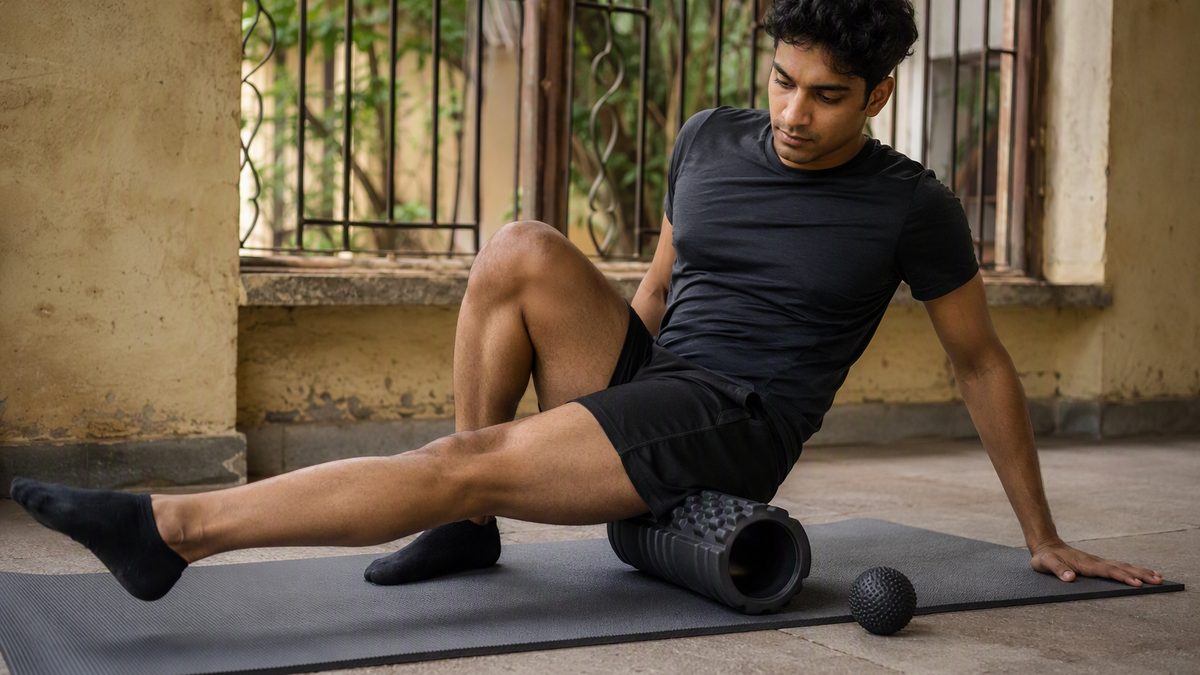
Treat foam rolling like a number you can test, because you can. Roll your quads, calves, hips, or lats slowly for 30 to 90 seconds and check the range right after — squat depth, a lunge position, overhead reach for wall balls — and you will typically find a few percent more, sometimes approaching ten percent, available immediately. It lasts minutes to a couple of hours, then fades. That is the reliable signal foam rolling gives a hybrid racer.
What that signal is good for is narrow but real: priming positions before a mobility-demanding session, with no drop in strength or power afterward — unlike long static stretching, which would blunt the force you need for sleds and carries. After heavy posterior-chain or grip work, a few minutes of rolling buys a moderate reduction in next-day soreness. That is the entire ledger.
What the data does not show is any effect on the things that decide a HYROX race — compromised running off the sled, your pace across eight stations, your roxzone transitions, or your legs in the last 2K. This guide lays out the timeline you can expect, a protocol around your blocks, the race-day reality, and where the fundamentals carry your result.
1. The Timeline: What You'll Measure and When
Track rolling like any training variable. Immediately after a 30-90 second bout: measurable range of motion in the area you rolled rises a few percent, sometimes up to around ten percent — a deeper, more comfortable squat, a freer lunge, a better overhead position for wall balls. These are textbook, meta-analytic ballpark figures, so treat them as approximate rather than guaranteed for your body. Your strength and power are unaffected — measured force, jump, and sprint output hold, which is exactly why rolling beats long static stretching before a session that demands sled force.
That extra range stays for minutes to a couple of hours, then fades, and it does not accumulate — rolling daily for a month does not bank a permanent flexibility gain, because the change is your nervous system tolerating more stretch, not the muscle getting longer. After a hard posterior-chain or grip session, a few minutes of rolling gives a moderate, mostly-felt reduction in next-day soreness and a better perceived-recovery sense — real but moderate, and it does not speed the underlying repair of the muscular endurance you tax. Knowing this timeline keeps you honest: rolling is an acute mobility primer you re-apply each session, not a flexibility or recovery program. The numbers it moves are short-term ROM and perceived soreness — not your splits.
2. Does It Help Compromised Running or Sled Work? The Data
The questions a HYROX athlete actually asks are about the race: compromised running off the sled, sled push and pull pace, roxzone transitions, the last 2K when everything is heavy. The honest data answer to all of them is no — rolling does not improve any of those. Compromised running is an aerobic and muscular-endurance problem: your ability to run hard on legs full of lactate after sleds and lunges comes from your conditioning, your pacing, and your fueling, not from how a muscle feels under a roller. Sled pace is force and posterior-chain endurance. Transitions are practiced efficiency. None of those respond to rolling.
What rolling can legitimately do sits before and after the work, not during it. Before a session, priming your hip, ankle, and overhead range a few percent can make you reach better positions in lunges, wall balls, and squats from the first rep — with no power cost, which matters when sleds are coming. After a heavy session, a few minutes eases the soreness in a thrashed posterior chain and grip-fatigued forearms so the next session feels less stiff. That is the whole, modest contribution: better positions going in, less soreness coming out. It buys you nothing on the clock during the race itself, and treating it as race-pace insurance just wastes minutes you could spend on the engine work that actually moves your time.
3. A Rolling Protocol Around Your Race Blocks
Across a 4-6 session week of long runs, intervals, and station-specific strength endurance, slot rolling as a short pre-session primer and a modest post-session soreness tool, prioritizing the posterior chain, calves, hips, and grip-related forearms your stations hammer. A roller for big groups, a firm ball for focal spots. Pre-session doses are short by design.
| Area and tool | Duration | Pre-session or post-session |
|---|---|---|
| Quads and hip flexors, foam roller | 30-90 sec each | Pre-session for lunge and run mechanics |
| Calves, foam roller | 30-60 sec each | Pre-session for ankle range; post-run for soreness |
| Glutes and hamstrings, foam roller or ball | 30-90 sec each | Pre-session for sleds; post-session for soreness |
| Forearms, firm ball | 30-45 sec each, gentle | Post-session after farmers carries and pulls |
| Lower back, spine, knees, bony areas | Avoid — muscle only | Never — pressure on spine and joints is unsafe |
Roll slowly at a tolerable ache, then do a real dynamic warm-up. Keep the pre-session bout short so you prime range without fatiguing legs you need for the work ahead.
4. Race Week and Race Day: Keep It Boring
Race week is where data discipline matters most: change nothing, trial nothing. If rolling has been a familiar part of your routine, keep it light and short — a brief pre-session primer in your taper sessions and a few minutes to ease stiffness — and that is fine. What you must not do is introduce a new tool, a new aggressive technique, or a long grinding session in the days before a race; the time to learn how your body responds to a massage gun or a firmer roller is in a normal training block, never in race week. The cardinal rule of hybrid racing applies to recovery tools too: nothing new on race day.
On race morning, a short, gentle roll on tight calves and hips during your warm-up can help you reach better positions, with no power cost — but it is optional and should never replace a proper dynamic warm-up of light running and movement, which actually raises your temperature and primes you to race. After the race, rolling can ease soreness over the next day or two, modestly. Two cautions specific to your event: indoor HYROX venues run hot, so manage heat and hydration as the real performance variables, and never roll through sharp, localized, or worsening pain — that is an injury signal, not soreness. Keep race-week rolling boring, familiar, and minor, and let your taper, sleep, and tested fueling do the work that decides your finish.
5. Where Rolling Ranks Among Your Real Performance Drivers
Set rolling against what actually moves your HYROX time and it lands as a minor, optional tool — and that is the accurate place for it. The drivers are your aerobic engine and threshold work, since the race sits at threshold for over an hour; your station-specific strength endurance for sleds, carries, and wall balls; and your practiced ability to run compromised off each station. Those are trained, not rolled. Underneath them, sleep is the recovery foundation — most tissue and hormonal repair happens there, and the volume you carry demands it — and fueling and load management keep you absorbing the work rather than breaking down under it.
Rolling's measurable contributions — a few percent more usable range before a session, a modest soreness reduction after — are real and worth the few minutes when a position feels locked or your posterior chain is thrashed. But they do not show up on the clock, and no amount of rolling fixes a compromised-running weakness or a slow sled. The athletes who use it well treat it as the small primer-and-soreness convenience it is, log it honestly alongside the metrics that matter — session load, sleep trends, how your legs feel running off the sleds — and spend their real effort on the engine. Track the right numbers, and rolling stays in its lane as a useful extra rather than a distraction from the work that wins.
HYROX Questions About Foam Rolling
Will foam rolling help my compromised running off the sled?
No. Compromised running — holding pace on legs full of lactate after sleds and lunges — is an aerobic and muscular-endurance skill built through conditioning, pacing, and fueling, not something rolling improves. What rolling can do is prime your hip and ankle range a few percent before a session so you start with better mechanics, and ease soreness afterward. Neither shows up in your race splits. Train the compromised running directly with brick-style sessions; use rolling only as a pre-session primer.
How do I use foam rolling in race week?
Keep it short, light, and familiar — nothing new. If rolling is already part of your routine, a brief pre-session primer in your taper sessions and a few minutes to ease stiffness are fine. Do not introduce a new tool, a firmer roller, or a long aggressive bout in race week; learn how your body responds in normal training, never before a race. On race day, an optional short roll during your warm-up can help positions, but a proper dynamic warm-up matters far more.
Does foam rolling improve my roxzone transitions?
No. Roxzone transitions are about practiced efficiency — moving smoothly between run and station, managing your pace and composure — and rolling does nothing for them. Faster transitions come from rehearsing them in training, not from any recovery tool. Rolling's only role is before and after sessions: priming positions a few percent and easing soreness. If you want to improve your roxzone, drill the transitions themselves under fatigue; the roller has no part in that part of your race.
What about the last 2K when everything is heavy?
Rolling cannot help there. The last 2K on dead legs is decided by your aerobic capacity, muscular endurance, pacing earlier in the race, and fueling — all trained, none of them affected by how a muscle feels under a roller beforehand. A pre-race roll gives you a short-term range boost that has faded long before the final run. Build the back end of your race with threshold and compromised-running work and smart pacing; rolling is a warm-up primer, not late-race insurance.
Disclaimer: This article is for educational purposes only and is not medical advice. Consult a qualified healthcare professional before starting any supplement, nutrition, or training protocol — especially if you are pregnant or breastfeeding, under 18, taking medication, or managing a health condition.
Scientific References & Clinical Sources
- Dupuy O, et al. An Evidence-Based Approach for Choosing Post-exercise Recovery Techniques to Reduce Markers of Muscle Damage, Soreness, Fatigue, and Inflammation: A Systematic Review With Meta-Analysis. Front Physiol, 2018. PMID: 29755363
- Gill ND, et al. Effectiveness of post-match recovery strategies in rugby players. Br J Sports Med, 2006. PMID: 16505085
- Dattilo M, et al. Sleep and muscle recovery: endocrinological and molecular basis for a new and promising hypothesis. Med Hypotheses, 2011. PMID: 21550729
- Fullagar HH, et al. Sleep and athletic performance: the effects of sleep loss on exercise performance. Sports Med, 2015. PMID: 25315456
- Peake JM, et al. A Critical Review of Consumer Wearables, Mobile Applications, and Equipment for Providing Biofeedback, Monitoring Stress, and Sleep in Physically Active Populations. Front Physiol, 2018. PMID: 30002629

