💡 Key Takeaways
- Foam rolling has zero effect on ketosis, blood sugar, or fat-adaptation — it is a carb-free, calorie-free mobility tool with no interaction with your diet at all.
- It does not 'flush lactic acid' or detox a muscle; its real, modest jobs are a short-term ROM boost before training and a moderate soreness drop after.
- Rolling eases the feeling of a cramp-prone muscle but does not fix the cause — on keto, cramps usually trace to sodium, potassium, and magnesium losses, which need electrolytes, not a roller.
- Expect performance dips during keto-adaptation regardless of rolling; the roller won't restore top-end glycolytic output, and that's not its job.
If you eat keto, you have probably learned to interrogate everything for hidden carbs and anything that might 'kick you out' of ketosis. So a fair question is whether foam rolling interacts with your diet at all — and a second, more common one is whether it can help the cramps that plague low-carb athletes. There is a myth tangled in both, and clearing it up changes how you use the roller.
Here is the truth. Foam rolling has no effect whatsoever on ketosis, blood sugar, fat-adaptation, or your macros. It contains no carbs, burns essentially nothing, and does not touch your metabolism — it is mechanically and metabolically separate from your diet. And it does not 'flush' anything: the idea that rolling clears lactic acid or detoxes a muscle is false, on keto or any other diet.
This guide clears those myths, explains what rolling actually does, and tackles the cramp question keto lifters genuinely worry about — because the real answer there is about electrolytes, not the roller.
1. The 'It Flushes the Muscle' Myth, Keto Edition
The most repeated claim about foam rolling is that it 'flushes out lactic acid', 'clears toxins', or 'pushes out waste' — and keto athletes hear an extra version, that rolling helps clear the byproducts of training on low glycogen. All of it is wrong. Lactate is not a toxin and is not what makes you sore the next day; it clears on its own within an hour or two regardless of what you do, low-carb or not. There is nothing to flush, and a roller does not detox a muscle. You are also not breaking up knots or melting fascia — fascia is far too tough for bodyweight pressure to deform.
What rolling actually does is neural. The slow, sustained pressure quiets the nerves around the muscle and raises your tolerance for stretch, so a tight area moves through a few percent more range right away and feels looser. That effect is real but short-lived, lasting minutes to a couple of hours, and it works exactly the same whether you are fat-adapted or carb-fueled — your diet does not change the mechanism. Letting go of the flushing myth matters because it stops you grinding on a roller for a recovery that is not happening there, and refocuses you on what genuinely drives recovery on keto: sleep, adequate protein and energy, sensible load, and the electrolyte management your diet specifically demands.
2. Does Rolling Touch Ketosis, Blood Sugar, or Fat-Adaptation?
No, on every count, and it is worth being explicit because keto athletes reasonably check everything. Foam rolling is a mechanical, external technique — you press a muscle against a foam tube. It introduces no carbohydrate, no calories worth counting, and no compound that could shift your blood sugar or ketone levels. It does not interrupt fat-adaptation, does not 'use up' glycogen in any meaningful way, and does not interact with intermittent fasting windows, since there is nothing to break a fast. You can roll fasted, mid-adaptation, or deep in ketosis with zero diet consequence.
This is genuinely good news for a keto athlete, because it makes rolling one of the few recovery tools with no fine print on your diet. Where keto does change your training picture is in performance, not in rolling: with lower muscle glycogen and water storage, your top-end glycolytic output — sprints, repeated maximal efforts — is blunted, especially during the adaptation weeks, while your aerobic engine holds up well. Rolling does not restore that glycolytic ceiling; nothing about a roller adds glycogen back. So do not expect a pre-workout roll to recover the explosive performance keto costs you. Its job is mobility and soreness, full stop, and on that front your diet is simply irrelevant — the roller works the same for you as for anyone.
3. A Carb-Free Rolling Plan Around Your Training
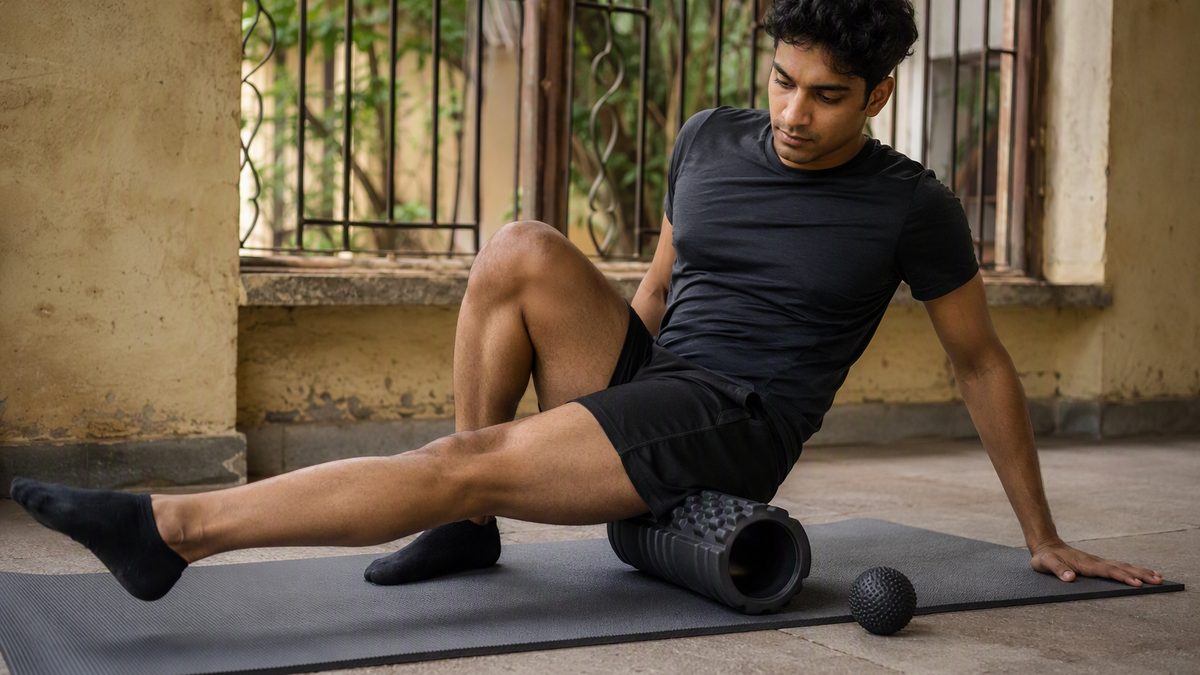
Use rolling for its two honest jobs: a short pre-workout primer to move better and a modest post-workout soreness aid. Your diet changes none of the doses. A basic foam roller and one firm ball cover almost everything. Pre-workout bouts are short by design.
| Area and tool | Duration | Pre-workout or post-workout |
|---|---|---|
| Quads, hamstrings, calves, foam roller | 30-90 sec each, 1-2 slow passes | Pre-workout primer, then a real dynamic warm-up |
| Glutes and upper back, foam roller or ball | 30-60 sec each | Pre-workout to free squat and overhead positions |
| Cramp-prone calves and feet, firm ball | 30-45 sec each, gentle | Eases the feeling, but fix the cause with electrolytes |
| Sore muscles from the session, foam roller | 2-3 min per region | Post-workout or that evening, to ease soreness |
| Spine, lower back, neck, joints, bony areas | Avoid — muscle only | Never — unsafe regardless of diet |
Roll slowly, about an inch per second, at a 'good ache' you can breathe through. You can do all of this fasted or in ketosis — there is no diet interaction to time around.
4. Why You're Cramping: It's Electrolytes, Not the Roller
This is the question keto lifters actually google: 'I keep cramping — is foam rolling helping or is it related?' The honest answer is that rolling can ease how a cramp-prone muscle feels for a short while, but it does not address why you are cramping, and on keto the why is almost always electrolytes. When you cut carbs, your insulin drops, your kidneys excrete more sodium, and potassium and magnesium losses rise with it — the classic 'keto flu' chemistry. Low sodium, potassium, and magnesium are a well-known driver of muscle cramps, and that is a fueling problem a roller cannot touch.
So if your calves are seizing up on low carb, the fix is to manage your electrolytes deliberately — adequate sodium first, then potassium and magnesium, scaled to your sweat and training — not to roll harder. This is the central safety theme of training on keto, and it is worth getting right: under-replacing electrolytes during adaptation makes you feel terrible and cramp-prone, and people often wrongly blame their training or their tools instead. Use rolling for the temporary relief it gives a tight, crampy muscle if you like, but treat it as a comfort, not a solution. And note the cautions: if you choose flavored electrolyte products, check for hidden sugars, and if you have a medical reason for keto — epilepsy, diabetes — manage electrolytes under clinician oversight. A roller is a mobility tool; your electrolytes are the actual lever for cramps.
5. Where Rolling Sits in Keto Recovery
Put rolling in its place and it becomes a clean, no-fine-print tool for a keto athlete. Its contributions are modest and real: a short-term range-of-motion boost before training, with no strength loss, and a moderate easing of next-day soreness after. It costs you nothing on your diet — no carbs, no broken fast, no ketosis risk — which is genuinely convenient. That is the whole offer.
What carries your recovery on keto is the same as off it, with one addition. Sleep is the foundation — most tissue and hormonal repair happens there, and seven to nine hours does more than any recovery gadget. Adequate protein and overall energy support repair, and sensible load management prevents the breakdown rolling can never undo. The keto-specific addition is electrolyte management: sodium, potassium, and magnesium, kept up deliberately, which resolves the cramps and 'flu' symptoms that people wrongly pin on their training. Against those levers, foam rolling is a low-stakes, feel-good extra — use it regularly in small doses if it helps you move and feel better, fasted or fed, and do not ask it to fix performance dips from adaptation or cramps from low electrolytes. Get the diet fundamentals right and the roller is a pleasant bonus; get them wrong and no amount of rolling will compensate.
Keto Athletes' Questions About Foam Rolling
Will foam rolling kick me out of ketosis?
No. Foam rolling has no effect on ketosis, blood sugar, ketone levels, or fat-adaptation. It contains no carbohydrate, burns essentially nothing, and is a purely mechanical, external technique with no metabolic interaction. You can roll fasted, mid-adaptation, or deep in ketosis with zero diet consequence — it does not break a fast either, since there is nothing to break one. Use it freely for mobility and soreness; your diet simply is not part of the equation when it comes to rolling.
Does foam rolling work without carbs to drive uptake?
Yes — rolling does not depend on carbs at all, because it does not work through nutrient uptake. Its mechanism is neural: pressure quiets the muscle's tension reflexes and raises your stretch tolerance, giving a short-term range-of-motion boost and modest soreness relief. None of that requires glycogen or carbohydrate. The thing keto does change is glycolytic performance — sprints and repeated maximal efforts are blunted — but rolling never affected that anyway. It works the same for you as for a carb-fueled athlete.
How does foam rolling interact with my fasting windows?
It does not. Rolling introduces no calories or nutrients, so it cannot break a fast, and you can do it any time inside or outside your eating window without consequence. There is no benefit to timing it around fasting either — its short-term mobility and soreness effects are unrelated to when you eat. Roll whenever it is convenient: before a fasted session to prime movement, or after to ease soreness. Your fasting schedule and your rolling are simply independent of each other.
Why am I cramping, and is foam rolling related?
Your cramping is most likely electrolytes, not rolling. Cutting carbs makes your kidneys excrete more sodium, and potassium and magnesium losses follow — low levels of these are a classic cramp driver on keto. Rolling can ease how a crampy muscle feels for a short while, but it does not fix the cause. Manage sodium first, then potassium and magnesium, scaled to your training and sweat. Check flavored electrolyte products for hidden sugar, and if you have a medical reason for keto, manage this with a clinician.
Disclaimer: This article is for educational purposes only and is not medical advice. Consult a qualified healthcare professional before starting any supplement, nutrition, or training protocol — especially if you are pregnant or breastfeeding, under 18, taking medication, or managing a health condition.
Scientific References & Clinical Sources
- Dupuy O, et al. An Evidence-Based Approach for Choosing Post-exercise Recovery Techniques to Reduce Markers of Muscle Damage, Soreness, Fatigue, and Inflammation: A Systematic Review With Meta-Analysis. Front Physiol, 2018. PMID: 29755363
- Gill ND, et al. Effectiveness of post-match recovery strategies in rugby players. Br J Sports Med, 2006. PMID: 16505085
- Dattilo M, et al. Sleep and muscle recovery: endocrinological and molecular basis for a new and promising hypothesis. Med Hypotheses, 2011. PMID: 21550729
- Fullagar HH, et al. Sleep and athletic performance: the effects of sleep loss on exercise performance. Sports Med, 2015. PMID: 25315456
- Peake JM, et al. A Critical Review of Consumer Wearables, Mobile Applications, and Equipment for Providing Biofeedback, Monitoring Stress, and Sleep in Physically Active Populations. Front Physiol, 2018. PMID: 30002629

