💡 Key Takeaways
- Foam rolling gives a short-term range-of-motion bump (often a few percent up to about 10%) and a modest cut in next-day soreness, working through the nervous system, no diet implications at all.
- It won't 'flush' anything or remodel tissue; the looser feeling comes from raised stretch tolerance, and the effect is acute, minutes to a couple of hours.
- Roll workhorse muscles 30-90 seconds each, slow and tolerable, as a pre-session primer and post-session soreness aid; consistency beats aggressive grinding.
- Your plate does the real recovery work: hit leucine-rich plant protein per meal and keep iron, B12, and ferritin in check, since under-fueling, not a rolling deficit, drives lingering tightness.
For a vegetarian athlete, almost every recovery and performance question eventually loops back to the kitchen, leucine thresholds, iron status, B12, getting enough protein from plants. Foam rolling is a rare exception: it's a recovery tool that has nothing to do with your diet at all. No ingredients, no animal products, no labels to scan. It's just you, a roller, and your bodyweight.
That makes it refreshingly simple, but it also means it's narrow. Self-myofascial release does one modest thing well: it briefly improves your range of motion and takes the edge off how sore you feel after hard training. It won't fix the things that actually limit a plant-based athlete, your protein quality, your iron and B12 status, your sleep, those live on your plate and in your routine, not on a foam roller.
This page covers the real problem rolling helps with, what it genuinely does about it, a simple routine that fits any sport, and an honest reminder that for a vegetarian athlete the heavy lifting of recovery happens at the table, not under the roller.
1. The Problem: Stiffness and Soreness Between Hard Sessions
Whatever your sport, hard training leaves you stiff and sore between sessions, and that nagging tightness is the narrow problem foam rolling can genuinely address. After a heavy block your muscles feel bound up, your range overhead or into a deep squat is reduced, and the next day carries a layer of soreness. That's normal training stress, and it's where rolling earns its small, honest place.
Foam rolling steps into exactly that. Its most reliable effect is a short-term increase in range of motion, often a few percent up to roughly 10% right after rolling, which shows up as a freer, looser feeling and an easier path into your training positions. And that range gain comes without the temporary strength and power drop that long static stretching can cause, so it works as a brief pre-session primer.
Be honest about the size, though, so you don't over-rely on a tool that has nothing to do with your nutrition. Rolling won't fix the recurring tightness that actually comes from under-fueling or low iron, won't lengthen a muscle long-term, and won't make you faster or stronger. It buys a looser feeling and a brief range boost between sessions, that's the lane, and for a plant-based athlete it's a useful but small one.
2. What Rolling Actually Does (and What It Has Nothing to Do With)
The mechanism is neural, not structural. Rolling stimulates sensory receptors that briefly lower the nervous system's sense of tension and raise your tolerance to stretch, so you move through more range before the tight feeling stops you. Add a mild calming, pain-dampening effect and a short bump in local blood flow, and the muscle feels looser, even though it hasn't actually lengthened.
What it doesn't do matters here. Rolling does not 'flush out' anything, there's no toxin or lactic acid to drain, lactate clears within an hour or two and never caused your next-day soreness, which comes from muscle damage. It does not break up adhesions or remodel fascia, your connective tissue is far too tough to deform under a roller, and it does not detoxify, lengthen tissue long-term, or fix posture or imbalances on its own.
And crucially for you, it has nothing to do with your diet. Rolling won't help you absorb iron, hit leucine targets, or make up for low B12, those are nutrition questions, fully separate from a foam roller. So enjoy rolling for its real, modest benefit, a looser feeling and a brief range boost, and keep your recovery attention on the plate, where a plant-based athlete's real levers live. Set expectations against the soreness clock too: delayed soreness peaks around 24 to 72 hours and fades on its own within days, so part of any 'rolling fixed me' feeling is just soreness resolving on schedule.
3. A Simple Routine for Any Sport
Because rolling is diet-agnostic, the routine is the same whatever sport you train, slot brief primers before sessions and slightly longer bouts after hard work. Doses below are practical consensus ranges, presented as approximate.
| Timing | Target muscles | Dose | Purpose |
|---|---|---|---|
| Pre-session primer | Quads, glutes, calves (or lats for upper-body sport) | 30-45 sec each, 1 pass | Prime range, then do a real dynamic warm-up |
| Focal tight spot | Glutes, upper back | 20-30 sec hold with a ball | Ease a pinpoint tender area, gently |
| After a hard session | Worked muscle groups | 60-90 sec each, 1-2 passes | Modestly reduce next-day soreness |
| Sore recovery day | Sorest muscles | 60-90 sec each, slow | Take the edge off stiffness |
| Easy / rest day | Whole-body light pass | 3-4 min total | Keep the habit; small and regular |
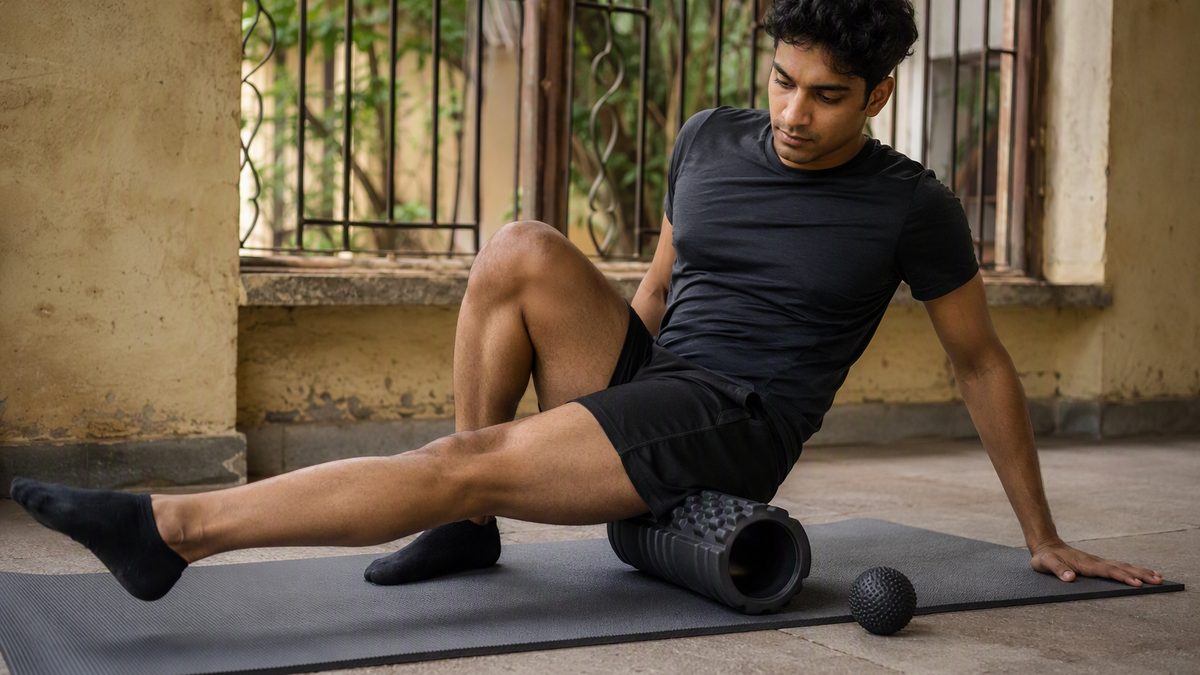
Two rules. Roll slowly, about an inch a second, with a tolerable 'good ache' you can breathe through, never sharp pain, and when you hit a tender spot, hold steady pressure for 20 to 30 seconds while you relax, then continue. And don't grind, more pressure and more time don't release more, they just bruise; keep the tool on muscle and off your spine, the front of your neck, and your joints. A basic roller plus one firm ball covers almost everything.
4. Why Your Plate, Not Your Roller, Drives Recovery
Here's the honest hierarchy for a vegetarian athlete. Recurring tightness and slow recovery usually trace back to fueling and nutrient status far more than to any rolling deficit. Plant proteins digest more slowly and carry less leucine per serving, so hitting a leucine-rich protein dose at each meal, from soy, legumes, seitan, and quality plant powders, does more for your recovery than a foam roller ever will. If a 'tight spot' keeps coming back no matter how much you roll, look at your fueling, sleep, and training load, not at rolling harder.
Mind the nutrients vegetarians most often run low on, since deficiency shows up as fatigue and poor recovery that no rolling can fix. Iron is non-heme and absorbed less efficiently from plants, and B12 needs supplementation, so it's worth checking iron, ferritin, and B12 with your clinician periodically and acting on the results. That's the kind of monitoring that genuinely protects recovery; a roller doesn't touch it.
Above all, sleep is the foundation, most hormonal and tissue repair happens while you sleep, and sleep loss impairs recovery and performance, so seven to nine hours outranks any tool. Use rolling as the cheap, diet-free feel-better extra it is: rate soreness 0 to 10 before and after and notice whether a key movement feels easier right after, those short-term wins are where its benefit lives. For a structured way to keep the plate-first habits consistent, our guide to building fitness habits pairs well with this.
Foam Rolling Questions Vegetarian Athletes Ask
Does foam rolling interact with my vegetarian diet at all?
No, not in any way, and that's part of its appeal. A foam roller is just a tool you press a muscle against; there's nothing to ingest, no animal products, no labels to check. It works through your nervous system to briefly raise range of motion and ease soreness, completely independent of what you eat. So you can use it freely, and keep your nutrition attention where it belongs, on protein quality, iron, and B12.
Will rolling help me recover faster on a plant-based diet?
Only modestly, and not where it counts most for you. Rolling can make you feel a bit looser and a touch less sore the next day, which is real but small. The bigger drivers of recovery on a plant-based diet are hitting leucine-rich protein at each meal, keeping iron and B12 in range, and sleeping enough. If recovery feels slow, fix those first, a foam roller won't compensate for under-fueling or a nutrient gap.
Does foam rolling flush out toxins or lactic acid after training?
No. There's no toxin to flush, and the lactic acid from your session cleared on its own within an hour or two, it never caused your next-day soreness, which comes from muscle damage. Rolling doesn't detoxify or drain anything; it briefly lowers your nervous system's sense of tension and raises stretch tolerance, so a sore muscle feels looser. The relief is real, but the flush-and-detox story is just marketing.
Which yearly labs should I check, and does rolling change them?
Rolling changes none of them, it's separate from your bloodwork entirely. As a vegetarian athlete, it's worth checking iron, ferritin, and B12 periodically with your clinician, since those run low on plant-based diets and low levels sap recovery and energy in ways no rolling can fix. Treat foam rolling as a small feel-good extra, and let your labs and your plate, not a roller, guide the nutrition side of your recovery.
Disclaimer: This article is for educational purposes only and is not medical advice. Consult a qualified healthcare professional before starting any supplement, nutrition, or training protocol — especially if you are pregnant or breastfeeding, under 18, taking medication, or managing a health condition.
Scientific References & Clinical Sources
- Dupuy O, et al. An Evidence-Based Approach for Choosing Post-exercise Recovery Techniques to Reduce Markers of Muscle Damage, Soreness, Fatigue, and Inflammation: A Systematic Review With Meta-Analysis. Front Physiol, 2018. PMID: 29755363
- Gill ND, et al. Effectiveness of post-match recovery strategies in rugby players. Br J Sports Med, 2006. PMID: 16505085
- Dattilo M, et al. Sleep and muscle recovery: endocrinological and molecular basis for a new and promising hypothesis. Med Hypotheses, 2011. PMID: 21550729
- Halson SL. Sleep in elite athletes and nutritional interventions to enhance sleep. Sports Med, 2014. PMID: 24791913
- Peake JM, et al. A Critical Review of Consumer Wearables, Mobile Applications, and Equipment for Providing Biofeedback, Monitoring Stress, and Sleep in Physically Active Populations. Front Physiol, 2018. PMID: 30002629

