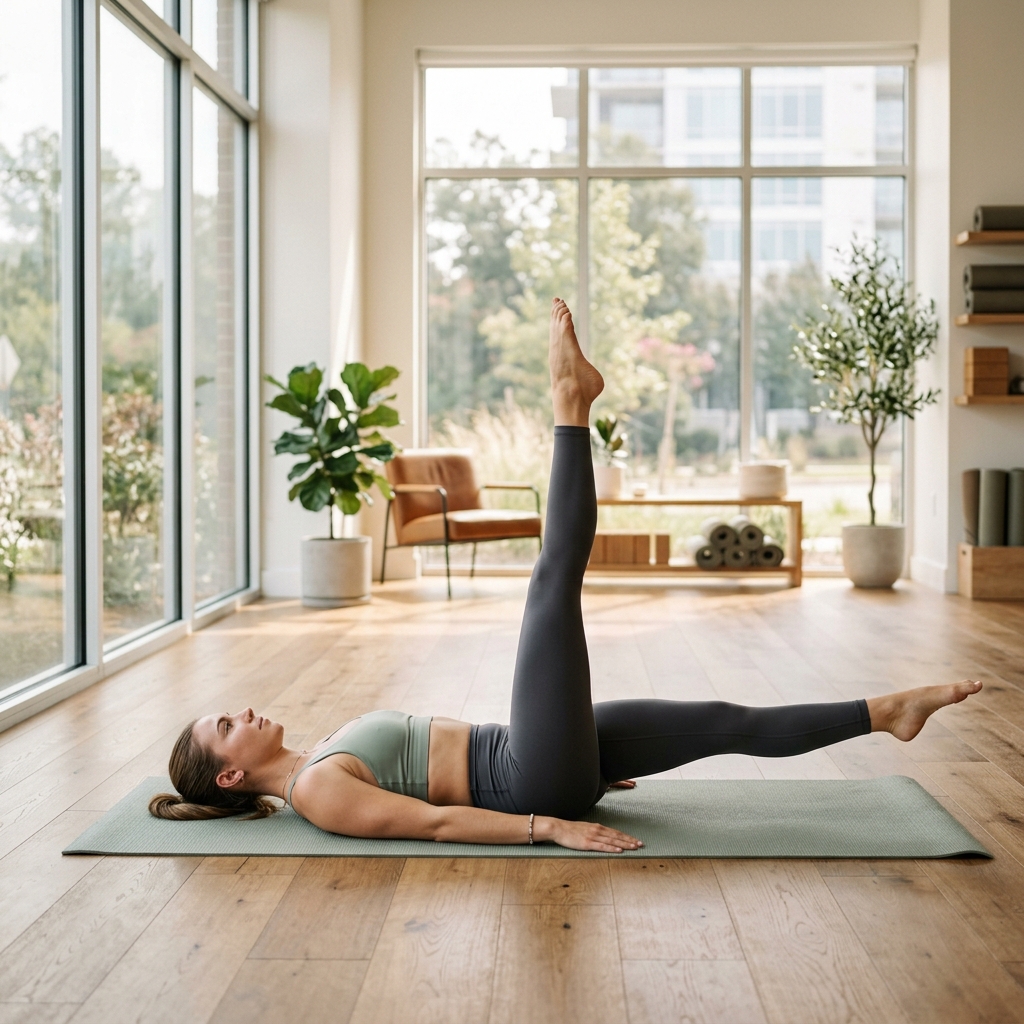
Pilates has quietly become the most-booked fitness class of 2026, and not because people want to "tone up." Something more interesting is happening: athletes, strength coaches, and everyday gym-goers are discovering that Pilates — done with real progression — builds genuine strength. Not the kind measured by a one-rep max, but the deep, stabilizing, injury-resistant strength that makes every other training modality work better. If you've dismissed Pilates as stretching with better marketing, it's time to look again.
Why Pilates Actually Builds Strength
The skepticism is understandable. Photos of Pilates studios show people moving slowly, sometimes barely at all. But that's the point — and the mechanism behind the strength gains. Pilates places muscles under tension across a full range of motion, often at tempos that would humble anyone used to fast, momentum-driven reps.
Three factors drive the strength adaptation:
- Stabilizer recruitment: Most gym exercises allow you to brace against a bench, seat, or floor. Pilates removes that support. Your deep spinal muscles, rotator cuff, hip stabilizers, and intrinsic core have to work continuously just to hold position while the primary movers contract. You're training twice the muscle mass per movement.
- Tempo under tension: A standard Pilates rep might take four to six seconds in each direction with no momentum at the turnaround. That sustained time under tension is one of the most reliable drivers of hypertrophy and strength endurance — the same principle strength coaches apply when they program slow eccentrics.
- Range of motion under load: Pilates regularly loads muscles at their longest position — the end range where most training stops. This is where connective tissue adaptation happens and where strength has the most carryover to real-world movement and injury prevention.
The result is a training style that builds what coaches sometimes call "functional strength" — not a buzzword here, but a literal description of strength that transfers to sport, daily life, and longevity.
The Progression Problem: Why Most People Plateau
Pilates has a progression problem, but not the one you'd expect. The problem isn't that it's too easy — it's that most people never learn how to make it harder. They take the same beginner class for two years, feel good, and wonder why their body stopped changing.
Like any training modality, Pilates obeys the principle of progressive overload. The body adapts to a given stimulus and then stops responding until you increase the challenge. The good news is Pilates offers multiple levers for progression, and you can pull them independently:
- Tempo: Slow everything down. A movement that feels manageable at a 2-2 tempo (two seconds up, two seconds down) becomes significantly harder at 4-4 or 6-2-6 (six seconds down, two-second pause, six seconds up).
- Fewer points of contact: Removing a hand or foot from the mat forces more stabilizer work and dramatically increases the demand on your core. A single-leg variation of almost any supine exercise is a meaningful progression over its bilateral version.
- Range of motion: Extending into a deeper range — reaching further, lowering legs closer to the floor, increasing spinal flexion or extension — increases the lever arm and the muscle length under which you're working.
- Resistance: On a reformer, heavier spring tension increases load. On a mat or with wall Pilates, adding a resistance band changes the force curve and overall difficulty.
- Instability: Moving exercises to a stability ball, Bosu, or simply shifting your center of mass increases stabilizer demand.
Tracking which lever you pulled — and when — is what separates people who keep making progress from people who do Pilates and stay exactly the same.
Wall Pilates: The Ideal Starting Point
If you're new to Pilates, wall Pilates is one of the most underrated entry points in fitness right now. The wall provides feedback and mild assistance that helps beginners find neutral spine, understand what proper engagement feels like, and build confidence with the movement patterns before removing support.
A few foundational wall Pilates exercises worth mastering before moving to floor work:
- Wall roll-down: Standing with your back against the wall, feet a few inches forward, you slowly peel the spine away from the wall one vertebra at a time. The wall gives you a reference for spinal articulation that's nearly impossible to fake.
- Wall sit with heel raise: Combining isometric quad work with calf activation and the balance challenge of the heel raise. Slow, controlled, and immediately humbling.
- Wall single-leg press: Lying on your back with feet flat against the wall, alternating leg presses while keeping the pelvis completely neutral. This teaches the fundamental Pilates skill of spinal stabilization under limb load.
- Standing wall leg circles: Standing side-on to the wall with one hand for light support, circling the opposite leg with control. Builds hip mobility, stability, and glute strength simultaneously.
Wall Pilates is not a watered-down version of the real thing. It's a specific tool. Once you've learned to feel what's supposed to be working, the transition to mat work is much cleaner and significantly safer.
Mat vs. Reformer: Honest Comparison
The reformer gets the glamour shots and the higher price tags, but mat Pilates has real advantages depending on what you're after. Here's an honest breakdown:
- Mat Pilates demands more from your stabilizers because there's no carriage mechanism providing assistance or feedback. Exercises like the Hundred, Roll-Up, and Teaser are genuinely hard on a mat. You also need nothing except floor space, making daily practice accessible in a way that studio reformer sessions are not.
- Reformer Pilates introduces variable spring resistance that you can load progressively — similar to adjusting weight on a machine. It also allows exercises that aren't possible on a mat, particularly standing and kneeling work with resistance and the footbar. For rehabilitation and for athletes who need specific loading patterns, the reformer is a superior tool.
The practical answer for most people: build your mat foundation first. If you can do a controlled Roll-Up, a clean single-leg stretch series, and hold a side plank with good form, you'll get far more from a reformer because you'll actually understand what you're supposed to be feeling. Too many beginners go straight to reformer classes and let the spring tension compensate for their lack of core engagement — which misses the point entirely.
Programming Pilates Alongside Other Training
One of the reasons Pilates has broken into the mainstream training community is how well it fits alongside other modalities. It doesn't compete with your strength training days — it enhances them.
Some practical programming approaches:
- As a warm-up: Twenty minutes of Pilates activation work before lifting primes your stabilizers, improves your body awareness, and often leads to better technique and heavier working sets.
- As a recovery session: Low-intensity Pilates on off days keeps you moving, maintains range of motion, and builds volume without accumulating the fatigue of another hard session.
- As a dedicated training day: If you're treating Pilates as a primary training stimulus, aim for 45-60 minutes with deliberate progression in tempo, range, or difficulty each week.
- Frequency: Two to three sessions per week is where most people see consistent improvement. The daily practice model popularized by Pilates studios is fine too, but vary intensity — not every session needs to be a challenge session.
One thing that often surprises strength-focused athletes: after six to eight weeks of consistent Pilates work, compound lifts frequently improve. Deadlifts feel more stable, overhead pressing is more controlled, and single-leg exercises become noticeably less wobbly. The stabilizer work pays dividends across the board.
Common Mistakes That Kill Your Progress
A few patterns that consistently hold people back in Pilates:
- Using momentum at the turnarounds: If there's a "swing" at the top or bottom of any rep, you're losing the tension that drives adaptation. Pause. Control the reversal.
- Neck tension as a substitute for core engagement: In exercises requiring upper body flexion, many people crank their neck forward to compensate for lack of deep abdominal strength. This builds nothing except a sore neck. Use a towel or foam roller behind the head until your core can support the position.
- Staying in beginner exercises indefinitely: The Hundred is a foundational exercise — it's also not very challenging once your core is conditioned. If you're not actively progressing difficulty, you're just maintaining, not building.
- Skipping unilateral work: Bilateral exercises allow compensation. Single-leg and single-arm variations reveal asymmetries and force each side to work independently. These are where real strength gaps get addressed.
- Treating all Pilates classes as equal: A 45-minute beginner flow and a 45-minute advanced reformer circuit are not comparable training stimuli. Match the class level to your actual goals, not your comfort level.
What Real Progression Looks Like Over Time
A realistic picture of Pilates progression over six months of consistent practice looks something like this: In weeks one through four, the work is primarily about learning motor patterns, finding neutral spine, and building the habit of deep core engagement. Weeks five through twelve, you start pulling the tempo and range of motion levers — the same exercises feel genuinely harder, and you begin noticing improved posture and better performance in other training. By months three through six, you're working with fewer support points, fuller ranges, and potentially adding resistance. The strength gains are visible and measurable — single-leg exercises that were wobbly are now controlled, and your overall body awareness in other workouts has meaningfully improved.
This is not a fast process. But it is a reliable one, provided you track what you're doing and deliberately increase the challenge over time. UltraFit360 lets you log every Pilates session with notes on tempo, modifications, and how each exercise felt — so you can see exactly where you've been and where to push next. Consistent progression is only possible when you can see the pattern, and that's exactly what your training log is for.
Transform Your Fitness Journey
Log your workouts, track your diet, and get AI coaching insights — all with UltraFit360.