💡 Key Takeaways
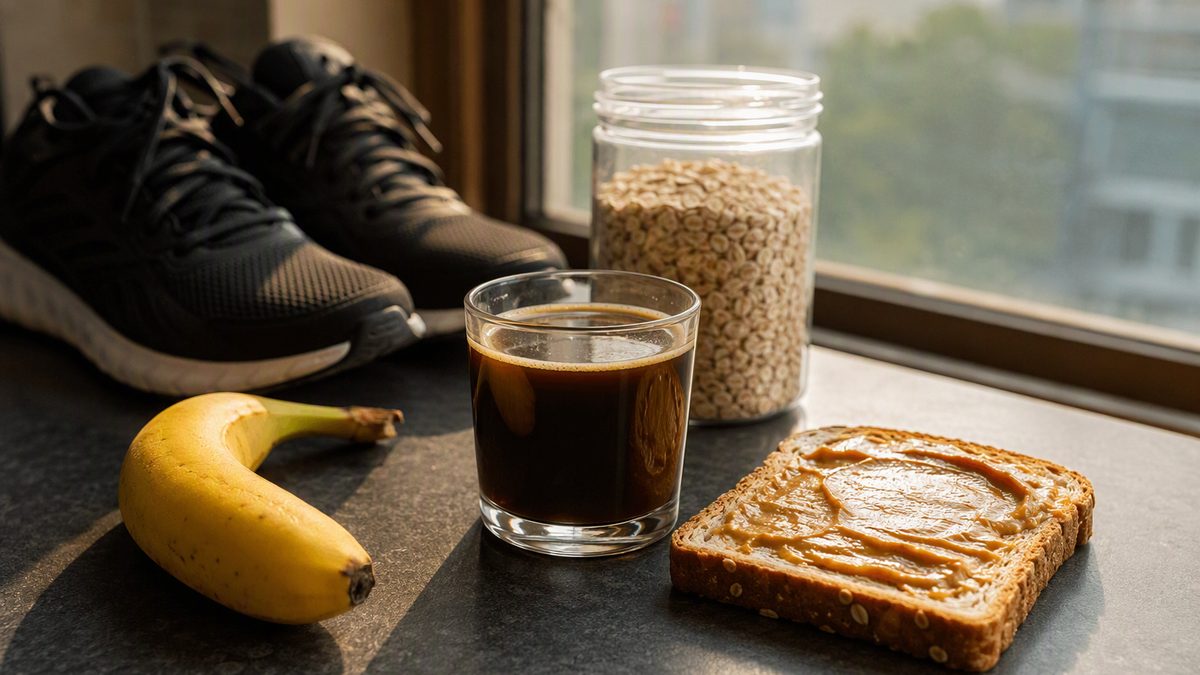
- Build one default rule, not a daily decision: black coffee plus a banana 30-45 minutes before a short hotel-gym session covers most travel days.
- Before a hard 30-40 minute session, ~0.5-1 g carb per kg from a fast snack is enough; you rarely have time for a 3-hour meal, and you do not need one.
- Caffeine at ~3 mg/kg about 45-60 minutes before is the highest-return pre-workout lever, but cut it before evening sessions and never stack it on a sleep debt.
- After a client dinner with alcohol, train easy and fasted the next morning rather than chasing a hard session you will only half-complete.
It is 5:50 a.m. in a hotel room three time zones from home, and you have a 7 o'clock call. The gym closes the window between now and then. The last thing you want is a fueling decision; you want a rule that already decided for you. That is how pre-workout nutrition has to work for someone running on a 60-hour week and a packed calendar: as a default, not a daily deliberation.
The good news is the science is forgiving. For the short, hard sessions you actually do, the fueling that matters fits in the few minutes between waking and the squat rack. You do not need a three-hour pre-meal or a supplement shelf in your suitcase.
Here is where fueling slots into your real week, the default rules that survive airports and client dinners, and the one metric worth watching when sleep and stress are working against you.
1. Where Fueling Fits Your 60-Hour Week
Map it to the windows you already have. Three patterns cover most of your training, and each gets one default so you never decide twice.
- The 6 a.m. squeeze: short window before calls. Black coffee on waking, a banana or a slice of toast 20 to 30 minutes before you lift. That is it. A small carb hit plus caffeine is all a 30-to-40-minute session needs.
- The midday reset: you have likely had breakfast a few hours back, which already fuels a lunchtime session, no extra food required. If breakfast was light, add a quick carb snack 30 minutes before.
- The evening unwind: dinner-adjacent training. A normal earlier meal covers it; skip caffeine this late so it does not wreck the sleep you are already short on.
Notice none of these involve a planned three-hour pre-meal. Those exist for athletes with predictable days; yours is built on snacks-before and meals-you-already-ate. Treat the default as the decision, made once, and let it run anywhere. Turning these into fixed habits is what keeps training alive when the calendar fights you.
2. Default Rules for the Hotel Gym and Travel Days
Travel is where routines die, so the rules have to be portable and forgiving. The table gives your defaults by session type and the short lead times you realistically have, scaled to typical bodyweights.
| Scenario and lead time | Default fuel | Amount for ~75 kg / ~90 kg |
|---|---|---|
| Hard lift or intervals, ~30-45 min before | Banana or toast with honey, plus coffee | ~38-75 g / ~45-90 g carbs (0.5-1 g/kg) |
| Longer cardio after a meal, ~2-3 h before | Whatever you ate; no special add | Existing meal sufficient |
| Easy 20-30 min mobility or Zone 2 | Nothing; train fasted | 0 extra needed |
| Caffeine, ~45-60 min before a hard session | Coffee or tablet, daytime only | ~225 mg / ~270 mg (~3 mg/kg) |
| Fluid, after a flight, before training | Water to pale urine; add electrolytes | ~375-750 mL / ~450-900 mL (5-10 mL/kg) |
Flying dehydrates you, so on arrival days lead with fluid and a pinch of sodium before training, then sip to thirst. Keep the pre-session snack low in fiber and fat so it clears fast and never sits heavy before a 6 a.m. session. The whole point is that these are the same numbers in Singapore as in Chicago, no recalculation required.
3. Caffeine Without Wrecking Your Sleep
Caffeine is the one pre-workout ingredient that earns its place: it reliably improves endurance, repeated efforts, and perceived effort. For you it is the highest-return, lowest-effort lever there is. A dose around 3 milligrams per kilogram, roughly 45 to 60 minutes before a hard session, does the job for most people with fewer side effects than the megadoses in commercial pre-workouts.
The trap is stacking stimulants on top of sleep debt and timezone chaos, which is exactly your risk profile. More caffeine on a bad night does not buy back the recovery; it just spikes your heart rate, frays your focus, and pushes the next night's sleep later still. Two firm rules: do not chase a higher dose to compensate for poor sleep, and keep caffeine out of any session within several hours of bedtime, including the deceptively 'evening' workouts that travel forces on you.
The same discipline applies to the pre-workout powders airport shops and hotel minibars push. Most are caffeine plus a few underdosed extras whose real amounts hide behind a proprietary-blend label, so you cannot even tell how big the stimulant hit is, a problem when you are already managing sleep debt. A measured coffee or a single caffeine tablet gives you a known dose you control. Skip the tubs; they add cost and uncertainty without adding anything food and coffee do not.
If you train at night, train without the stimulant. Protecting sleep is worth more to a chronically under-slept executive than any acute lift caffeine provides.
4. Client Dinners, Alcohol, and the One Metric to Watch
Business dinners come with late, heavy food and alcohol, and there is no fueling trick that makes a hard 6 a.m. session a good idea the morning after. The smart play is to flex the plan: train easy and fasted the next morning, a Zone 2 session or mobility, which needs no special fuel and asks little of a fatigued body. Save the hard, well-fueled session for a day you actually recovered. All-or-nothing thinking, a perfect week or a write-off, is the real enemy; an easy session beats a skipped one.
One more habit to drop: skipping meals all day under pressure, then over-eating late. That leaves you under-fueled for afternoon training and over-full for evening sessions. A small planned carb snack before you train solves it without adding a decision.
If you track one thing, track sleep, via your Oura, Whoop, or Garmin. It predicts how a session will go better than any pre-workout metric, and your annual executive physical is the natural checkpoint for blood pressure and the other markers a heavy travel-and-stimulant lifestyle nudges. Fuel the training; let sleep tell you how hard to push.
A closing reframe worth internalizing: pre-workout fueling for you is not optimization, it is friction removal. Every decision you eliminate, every default you set once and run anywhere, is one less thing competing with your real work for attention. The executives who train consistently for years are rarely the ones with the most elaborate nutrition; they are the ones who made the simple choices automatic and stopped renegotiating them at 5:50 a.m. in a strange hotel room. Build the rules, then stop thinking about them.
Pre-Workout Questions From the Road
What is the minimum I need to eat before a hotel-gym session when I travel?
Very little. For a short, hard 30-to-40-minute session, a banana or slice of toast 20 to 30 minutes before, plus your usual coffee, is enough; that small carb hit covers it. For easy mobility or Zone 2, you need nothing and can train fasted. Keep the snack low in fiber and fat so it clears fast. Make this your fixed default so you never have to decide it again at 5:50 a.m.
Does alcohol at a client dinner ruin the next day's training?
It does not ruin your progress, but it makes a hard next-morning session a poor bet. Alcohol and a late heavy meal degrade sleep and recovery, so plan an easy, fasted session, Zone 2 or mobility, that needs no special fuel and asks little of a tired body. Move the hard, fueled work to a recovered day. Flexing the plan beats the all-or-nothing trap of writing off the whole day.
Can I keep the same fueling routine across time zones?
Yes, that is the goal. The defaults, a small carb snack before hard sessions, coffee 45 to 60 minutes prior, nothing before easy ones, are the same numbers in any city. Anchor them to your session rather than the local clock. The one adjustment on arrival days is to lead with fluid and a little sodium before training, because flying dehydrates you. Otherwise, do not recalculate; just run the rule.
What single metric should I watch instead of obsessing over pre-workout details?
Sleep. With your wearable, it predicts how a session will go better than any pre-workout number and flags when stimulants are masking real fatigue. If sleep is short, train easier and skip the extra caffeine rather than pushing through. Use your annual executive physical to check blood pressure and related markers, since heavy travel, stress, and stimulants nudge them. Fuel simply; let sleep set the intensity.
Disclaimer: This article is for educational purposes only and is not medical advice. Consult a qualified healthcare professional before starting any supplement, nutrition, or training protocol — especially if you are pregnant or breastfeeding, under 18, taking medication, or managing a health condition.
Scientific References & Clinical Sources
- Thomas DT, et al. American College of Sports Medicine Joint Position Statement: Nutrition and Athletic Performance. Med Sci Sports Exerc, 2016. PMID: 26891166
- Jeukendrup AE. Nutrition for endurance sports: marathon, triathlon, and road cycling. J Sports Sci, 2011. PMID: 21916794
- Aragon AA, Schoenfeld BJ. Nutrient timing revisited: is there a post-exercise anabolic window?. J Int Soc Sports Nutr, 2013. PMID: 23360586
- Schoenfeld BJ, et al. Body composition changes associated with fasted versus non-fasted aerobic exercise. J Int Soc Sports Nutr, 2014. PMID: 25429252
- Schoenfeld BJ, et al. The effect of protein timing on muscle strength and hypertrophy: a meta-analysis. J Int Soc Sports Nutr, 2013. PMID: 24299050

