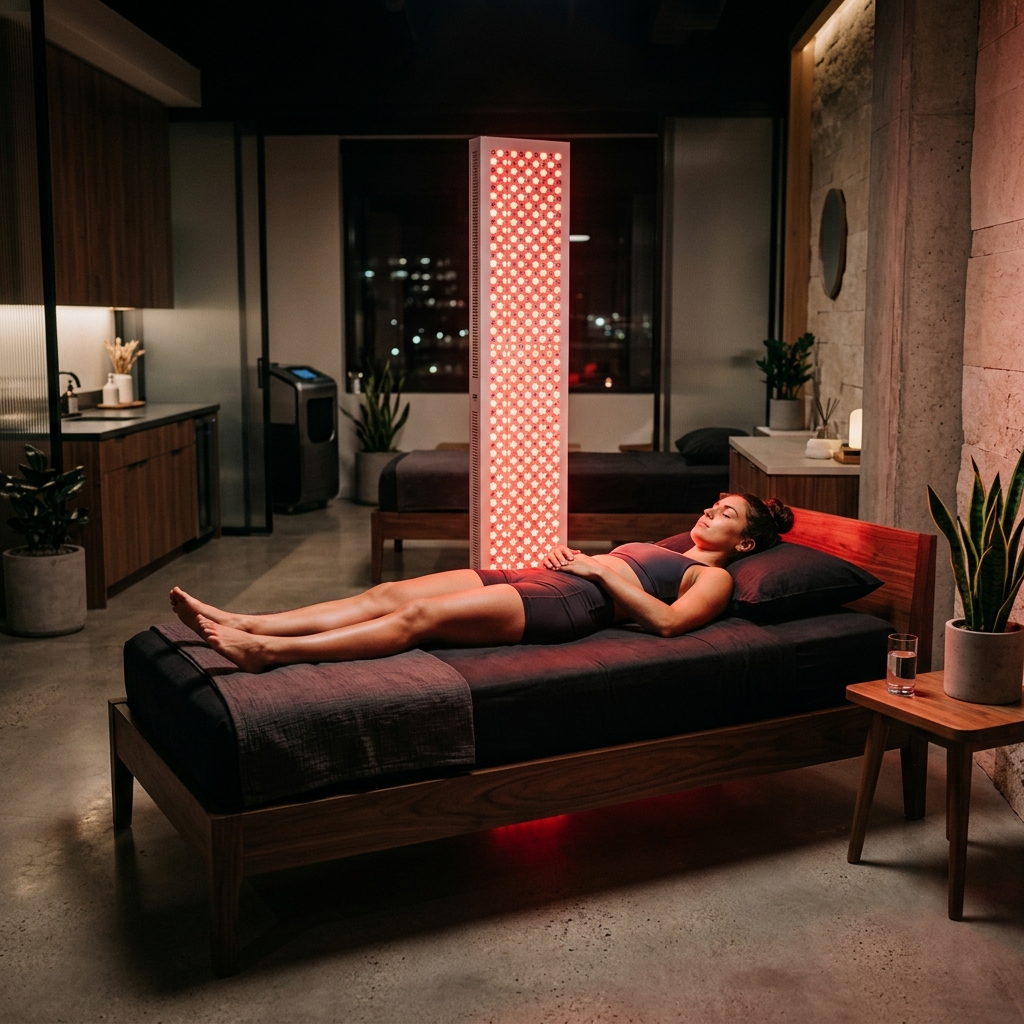
Walk into any modern gym or sports medicine clinic and you might notice athletes sitting in front of glowing red panels before or after training. Red light therapy — technically called photobiomodulation (PBM) — has moved from fringe wellness gadget to a legitimate area of sports science research. The evidence is still maturing, but what's already there is genuinely interesting, especially if you take muscle recovery seriously. Here's what the science actually shows, what it doesn't, and how to think about it practically.
What Is Photobiomodulation?
Photobiomodulation refers to the use of specific wavelengths of light — typically in the red (630–700 nm) and near-infrared (NIR) (700–1100 nm) ranges — to trigger biological responses in tissue. Unlike UV light, which damages DNA, or blue light, which disrupts sleep hormones, red and near-infrared light interact with a protein called cytochrome c oxidase in your mitochondria. When light photons are absorbed there, they appear to increase mitochondrial membrane potential and boost ATP production — essentially giving your cells more energy currency to work with.
The mechanism sounds almost too simple, which is part of why PBM was dismissed for years. But the mitochondrial pathway is well-documented in cell and animal studies, and a growing body of human trials has brought it into serious scientific conversation. The key caveat: most human studies are small, device parameters vary enormously, and placebo effects in wellness research are notoriously hard to control for.
The Case for Muscle Recovery
The most consistent human evidence for PBM centers on exercise-induced muscle damage and delayed-onset muscle soreness (DOMS). A number of randomized controlled trials and several meta-analyses have found that applying red or near-infrared light to muscles — either before or after exercise — can reduce perceived soreness in the 24–72 hour window afterward and may help markers of muscle damage recover faster.
Specifically, studies have looked at blood markers like creatine kinase (CK) and lactate dehydrogenase (LDH), which rise when muscle fibers are stressed and broken down. Some trials report lower post-exercise CK levels in groups receiving PBM compared to sham or control groups. Inflammatory markers like IL-6 and TNF-alpha have also shown reductions in some protocols.
What's driving this? The leading hypothesis is that PBM reduces oxidative stress at the cellular level and modulates the inflammatory cascade — not by suppressing inflammation entirely (which would be counterproductive to adaptation), but by helping the process resolve more efficiently. The analogy is moving from a slow-simmering inflammation that lingers for days to a faster, cleaner response that gets out of the way sooner.
Important reality check: effect sizes across studies vary considerably. The research isn't saying you'll be 100% recovered overnight. It's suggesting a modest but real improvement in the speed of recovery — which, compounded over weeks and months of training, could be meaningful.
Wavelengths and Dosing: What the Research Uses
This is where consumer confusion runs high. Not all red light devices are equivalent, and the parameters used in research don't always translate directly to the devices being sold to the public.
Here's a general framework for what the literature tends to use:
- Red light (630–680 nm): Penetrates skin and superficial tissue; often used for skin applications and surface-level muscle groups.
- Near-infrared (800–850 nm): Penetrates deeper — several centimeters into tissue — making it more relevant for larger muscle groups and joints.
- Power density (irradiance): Typically 10–100 mW/cm² in research settings. Too low and you get no effect; too high and you risk inhibiting the same mitochondrial pathways you're trying to stimulate (a "biphasic dose response").
- Energy dose (fluence): Most positive studies fall in the 1–10 J/cm² range per treatment site. Sessions lasting 5–20 minutes per area are common.
- Frequency: Most trials use protocols of 3–5 sessions per week, not daily. There's no strong evidence that more frequent application accelerates benefit beyond a threshold.
Consumer-grade panels vary wildly in actual output versus advertised specs. If you're investing in a device, look for independently verified irradiance measurements and dual wavelengths (both red and NIR).
Skin Health and Other Potential Benefits
Muscle recovery isn't PBM's only evidence base. Red light therapy has some of the strongest research support in dermatology, where it's used for wound healing, acne reduction, and collagen stimulation. The skin-level evidence is generally more robust than the exercise science evidence, simply because dermatology trials have been running longer and with better controls.
For athletes, this translates to potentially faster healing of minor skin abrasions, reduced scarring from friction injuries, and better connective tissue health over time — though "connective tissue health" is notoriously hard to measure in short-term trials.
Some researchers have also looked at performance — whether PBM applied before exercise can improve strength output or endurance capacity. The results here are more mixed. A subset of studies finds modest improvements in repetitions to failure or time to exhaustion; others find no effect. The pre-exercise application protocol is less consistent in the literature than post-exercise recovery protocols, so treat any performance claims with extra skepticism for now.
Realistic Expectations
Red light therapy is not a magic recovery tool. It won't replace sleep, adequate protein, or progressive programming. Here's a balanced take on what you can and can't reasonably expect:
- What's plausible: Moderate reduction in DOMS after hard sessions; slightly faster return to baseline muscle function; modest support for skin healing around training sites.
- What's uncertain: Meaningful performance gains; significant reduction in actual injury risk; benefits at the tissue level in well-trained athletes versus sedentary populations (most studies use untrained participants).
- What's not supported: Dramatic fat loss claims, "detox" effects, hormonal overhauls — none of these have a serious evidence base in the PBM literature.
If your goal is reducing the 48-hour soreness window after leg day so you can train at higher frequency, the evidence is reasonably encouraging. If your goal is shaving seconds off your 5K with a light panel, the evidence doesn't support that expectation yet.
Safety and Practical Considerations
Red and near-infrared light therapy has a strong safety profile when used appropriately. The risk profile is low compared to most physical interventions, with a few important caveats:
- Eye protection: Never look directly into high-powered panels without appropriate goggles. The intensity can cause retinal damage even if the light doesn't feel painful.
- Photosensitizing medications: Certain medications (some antibiotics, retinoids, and psychiatric drugs) increase light sensitivity. Check with your physician if you're on any of these.
- Active cancer: PBM is generally contraindicated over areas with known malignancies, since stimulating cellular energy production in cancerous tissue is a theoretical concern.
- Skin type and session duration: Darker skin tones absorb more red light, which can mean shorter effective session times. Start conservatively and observe how your skin responds.
- Device quality: The consumer market is flooded with underpowered panels that produce too little irradiance to match research protocols. Cheap devices may simply not do anything — which makes them a waste of money rather than a safety risk, but worth knowing.
In clinical settings, adverse events are rare and typically limited to mild, transient skin redness. PBM is one of the lower-risk recovery modalities you can add to your toolkit, as long as you respect the eye safety rule and aren't in a contraindicated medical category.
How to Integrate It Into Your Training
If you decide to experiment with red light therapy, here's a practical starting framework based on what the research uses:
- Apply to worked muscle groups within 30–60 minutes post-training for recovery goals.
- Target 3–5 minutes per site at appropriate irradiance (device-dependent — follow manufacturer guidelines adjusted against research benchmarks).
- Use 3–5 times per week rather than every single day.
- Give it a consistent 4–6 week trial before evaluating whether it's making a difference for your recovery speed.
- Stack it with fundamentals: 7–9 hours of sleep, adequate protein (1.6–2.2 g/kg bodyweight), and periodized programming still matter far more than any recovery modality.
Track your soreness levels, how your first session feels after a rest day, and your session quality over consecutive training days. Subjective tracking, done consistently, tells you more than the general research population averages — because you're an n of 1 and your response may differ from the mean.
Whether or not you add red light panels to your recovery toolkit, the principle behind it matters: recovery is trainable and trackable, and the tools you use should earn their place through measurable impact on how you feel and perform. Use UltraFit360 to log your recovery quality, soreness ratings, and readiness scores session by session — that's the data that will tell you what's actually working for your body.
Transform Your Fitness Journey
Log your workouts, track your diet, and get AI coaching insights — all with UltraFit360.