💡 Key Takeaways
- The seat glides and your feet stay strapped in, so the erg lets you raise your heart rate hard with no heel-strike pounding on arthritic knees, hips or ankles.
- Rowing drives most of your body's muscle at once, so it trains heart and legs together and fights the cardio-only trap that lets strength slip away.
- Start at a low-to-moderate damper of 3-4 and learn the legs-body-arms sequence first; cranking it to 10 is what wrecks older lower backs.
- If you take blood-pressure, heart or diabetes medication, get clinician clearance before any all-out 2K test or hard intervals; beta-blockers also make your heart-rate read low.
The frustration that pushes a lot of people past 60 toward the rower is the same one: you want to train your heart hard enough to matter, but running hurts your knees and the bike gets dull. Brisk walking is wonderful and you should keep it, yet it tops out fairly easily, and a flare-up in a hip or a knee can sideline you for weeks. You need a way to work genuinely hard that your joints will tolerate day after day.
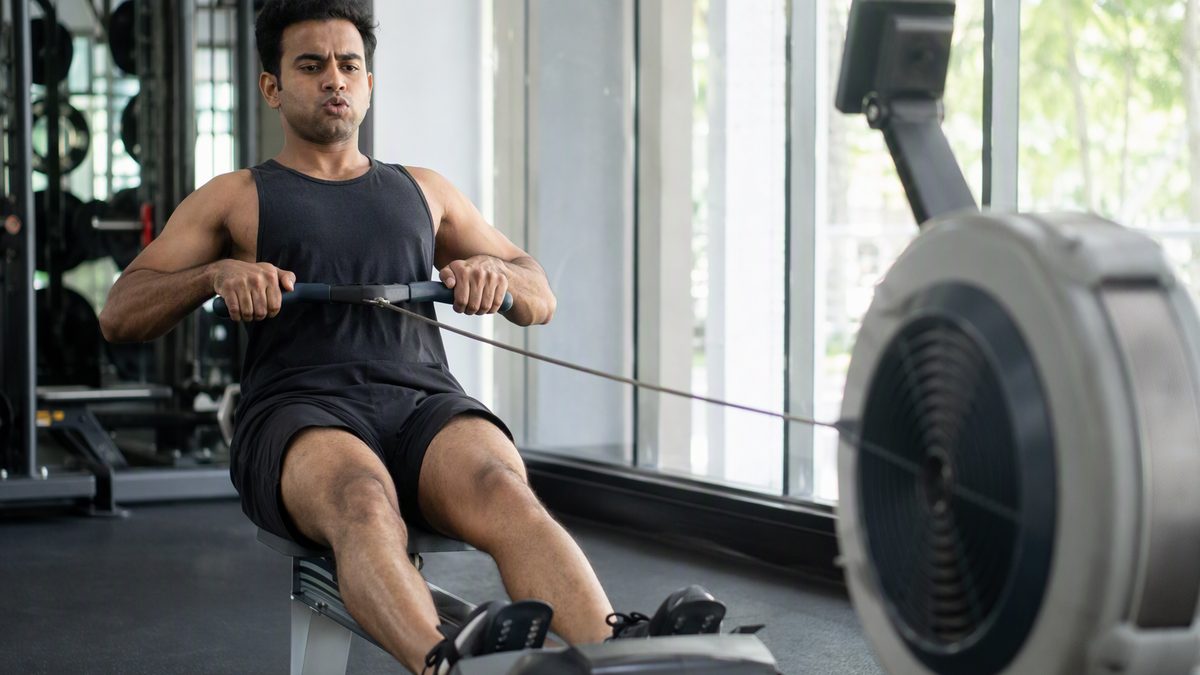
The indoor rower, or erg, solves that better than almost any machine in the gym. The seat slides and your feet stay strapped to the footplate, so there is no repeated impact the way there is with running. At the same time, each stroke drives nearly your whole body, so you can reach a real cardiovascular effort and still spare the joints.
Below: why impact is the problem the erg fixes, how to set it up and move so your back stays happy, a weekly plan with real numbers, the conversation to have with your doctor, and how to read recovery at this stage of life.
1. The Joint Problem the Erg Actually Solves
Running asks your body to absorb a ground-reaction force on every heel-strike, thousands of times per session, and after 60 that repeated loading is exactly what an arthritic knee or a worn hip protests. The erg removes it entirely. Your feet never leave the footplate, the seat carries your weight along a smooth rail, and the only resistance is a flywheel you spin with your own effort. That makes it a sensible high-intensity option for heavier bodies and for anyone managing knee, hip or ankle complaints.
What makes it different from the bike, which is also joint-friendly, is how much muscle it uses. The bike works mostly your legs through a small range. Rowing recruits an unusually large fraction of your total muscle, roughly nine major muscle groups across your legs, back, trunk and arms in one stroke. More muscle working at once means a higher heart rate and oxygen demand for the same comfort level, which is why a rower feels productive in a way easy pedalling sometimes does not. One honest caveat: low-impact is not no-risk, and poor technique can load your lower back, so the setup below matters.
2. Setting Up the Erg So Your Back Stays Happy
The single biggest mistake beginners make is grabbing the handle and yanking with the arms. Rowing is a leg movement. Roughly 60% of the power comes from your legs, about 30% from your hips and back swinging open, and only the last 10% from your arms. Think of it as a leg press, then a gentle lean back, then a light pull to the chest. On the way back to the start you reverse it: arms reach away, hips hinge forward, then the knees bend to slide you in.
Two setup rules protect an older spine. First, keep the damper low to moderate, around 3 or 4, not cranked to 10. The damper is not the difficulty dial, and a heavy flywheel tempts you to grind with a rounded back, which is what aggravates the lumbar spine. Second, keep your back in a neutral, tall position and hinge from the hips rather than rounding your lower back at the front of the stroke. Let the recovery take longer than the drive, roughly a one-to-two rhythm, so nothing is rushed. Master those before you chase any pace number on the screen.
3. A Joint-Friendly Rowing Week After 60
Most of your rowing should be easy and conversational, the kind of steady effort where you could still talk in short sentences. That easy aerobic volume builds the base that makes everything feel easier, and it recovers so cheaply you can do it often. On top of that, a small dose of harder work once or twice a week sharpens fitness, but never on back-to-back days. The table below adapts standard erg formats to a cautious, joint-aware starting point.
| Session | Format | Intensity and setup |
|---|---|---|
| Easy steady state (your foundation) | 15-30 min continuous, building toward 40 | 60-70% max HR, 18-22 spm, damper 3-4, can talk |
| Short intervals (add after a few weeks) | 4-6 x 1 min strong / 2 min easy row | Firm but controlled, RPE 6-7, never breathless to dizziness |
| Longer aerobic intervals | 3 x 4 min / 3 min easy | Comfortably hard, full sentences only at the rest |
| Optional benchmark (clinician-cleared) | 2000m time trial, a few times a year | All-out; skip if any cardiac risk without medical sign-off |
A realistic week is two to four easy pieces and one hard session, with a full rest or walking day between hard efforts. Hard rowing systems need roughly 48 hours to recover, so spacing matters more than volume. If you also lift for muscle and bone, which you should at this age, keep your hardest rowing on a different day from your priority strength work so neither blunts the other.
4. Medications, Screening and Knowing Your Numbers
This is the part to settle with your doctor before you push hard. Easy steady-state rowing is low-risk and appropriate for almost everyone. An all-out 2K test or genuinely hard intervals are different: maximal effort transiently raises cardiac demand, so known or suspected heart disease, uncontrolled high blood pressure, diabetes with complications, or any chest pressure or unusual breathlessness all warrant clearance first. The good news is that higher cardiorespiratory fitness tracks strongly with lower long-term mortality, which is precisely why building it, carefully, is worth doing.
Common medications change how training feels and reads. Beta-blockers blunt heart rate, so your monitor will show a low number even when you are working hard, which means you should pace by breathing and effort rather than chasing the screen. Some blood-pressure drugs and diuretics shift fluid balance and how hard a session feels. The reduced thirst signal that comes with age also means you can start a session under-hydrated without noticing, so drink to a plan around longer rows rather than waiting to feel thirsty. None of this rules out the erg; it just sets your starting line.
5. Reading Recovery So You Keep Improving
The real limit on how much hard rowing you can absorb after 60 is recovery, so watch a few simple signals across days rather than any single reading. A resting heart rate sitting several beats high for several mornings, poorer sleep, or legs and a back that stay heavy all argue for an easy steady row or a walk instead of a planned hard piece. If your watch tracks heart-rate-variability trends, they point the same way. Let an off day veto intensity; a missed interval session costs you almost nothing.
Track the right things and progress becomes obvious. Watch your pace as time per 500m, your stroke rate, and your heart rate together. When your split gets faster at the same heart rate over a few weeks, your aerobic base is growing, and most people see that kind of measurable gain within the first month of consistent rowing. If you want help turning scattered daily signals into one simple weekly decision, the approach in our guide to building fitness habits keeps the routine steady without overcomplicating it.
What Active Seniors Ask About Rowing Machine Conditioning
Is the rowing machine safe with my blood-pressure or kidney medication?
Easy steady-state rowing is low-risk for almost everyone, but get your clinician's sign-off before all-out intervals or a 2K test if you have heart disease, uncontrolled high blood pressure, or diabetes with complications. Medications change how you train: beta-blockers blunt heart rate, so your monitor reads low even when you are working hard, meaning you should pace by breathing instead. Keep the damper moderate, ramp slowly, and stop for any chest pressure, dizziness or unusual breathlessness.
Am I too old to start rowing?
No. The erg is one of the friendliest machines to start late on, because the seat glides and your feet stay strapped in, so there is no impact on knees or hips. Begin with short 10-15 minute easy rows at a low damper of 3-4 and focus on the legs-body-arms sequence before any pace target. People starting from a lower base often see the quickest early fitness gains, so consistent easy rowing with a little harder work added later is a strong, safe plan.
Will rowing help my bone density?
Not much directly. Rowing is a low-impact cardiovascular tool, and because there is no impact loading, it does little for bone the way weight-bearing and resistance work do. Keep strength training as a separate pillar of your week for muscle and bone. Think of the erg as defending your heart, stamina and the fitness linked to independence, and your lifting as defending muscle and bone. You need both; rowing does not replace resistance training, and resistance training does not replace it.
Does it matter that I recover more slowly now?
Yes, and it is the dial to respect most. Slower recovery is exactly why hard rowing caps at one or two sessions a week after 60, never on back-to-back days, while easy steady-state rows can be near-daily because they recover cheaply. Watch your morning resting heart rate, sleep and how heavy your legs and back feel across several days, and swap a planned hard piece for an easy row or a walk whenever those markers are off. A few well-recovered sessions beat many tired ones.
Disclaimer: This article is for educational purposes only and is not medical advice. Consult a qualified healthcare professional before starting any supplement, nutrition, or training protocol — especially if you are pregnant or breastfeeding, under 18, taking medication, or managing a health condition.
Scientific References & Clinical Sources
- Mandsager K, et al. Association of Cardiorespiratory Fitness With Long-term Mortality Among Adults Undergoing Exercise Treadmill Testing. JAMA Netw Open, 2018. PMID: 30646252
- Joyner MJ, Coyle EF. Endurance exercise performance: the physiology of champions. J Physiol, 2008. PMID: 17901124
- Tabata I, et al. Effects of moderate-intensity endurance and high-intensity intermittent training on anaerobic capacity and VO2max. Med Sci Sports Exerc, 1996. PMID: 8897392
- Keating SE, et al. A systematic review and meta-analysis of HIIT versus continuous training for fat loss. Obes Rev, 2017. PMID: 28401638
- Plews DJ, et al. Training adaptation and heart rate variability in elite endurance athletes: opening the door to effective monitoring. Sports Med, 2013. PMID: 23852425
Want a plan built around your training history? UltraFit360's free AI workout planner creates and adjusts programs for you.

