💡 Key Takeaways
- The erg is the highest-return cardio machine for your minutes because it drives most of your body at once, so a 20-minute row does real full-body work.
- Make it a default, not a decision: same damper (3-5), same two formats, whatever hotel gym you are in, so jet lag and a packed calendar cannot derail it.
- Most weeks should lean on easy steady-state rowing with one or two short interval sessions; that easy volume is also low-stress on an already cortisol-heavy system.
- Watch one recovery signal (morning resting HR or HRV from your wearable) and let it veto a hard session after red-eyes or a night of client dinners.
It is 6:10am in a hotel you cannot quite place, you have ninety minutes before the first call, and the fitness room has a treadmill that sounds like a jet engine, a rack of mismatched dumbbells, and a rowing machine in the corner. This is the actual environment your training has to survive, not a perfect home gym. The question is never what the optimal program is; it is what you can execute, half-asleep and jet-lagged, in 20 minutes, in this room, today.
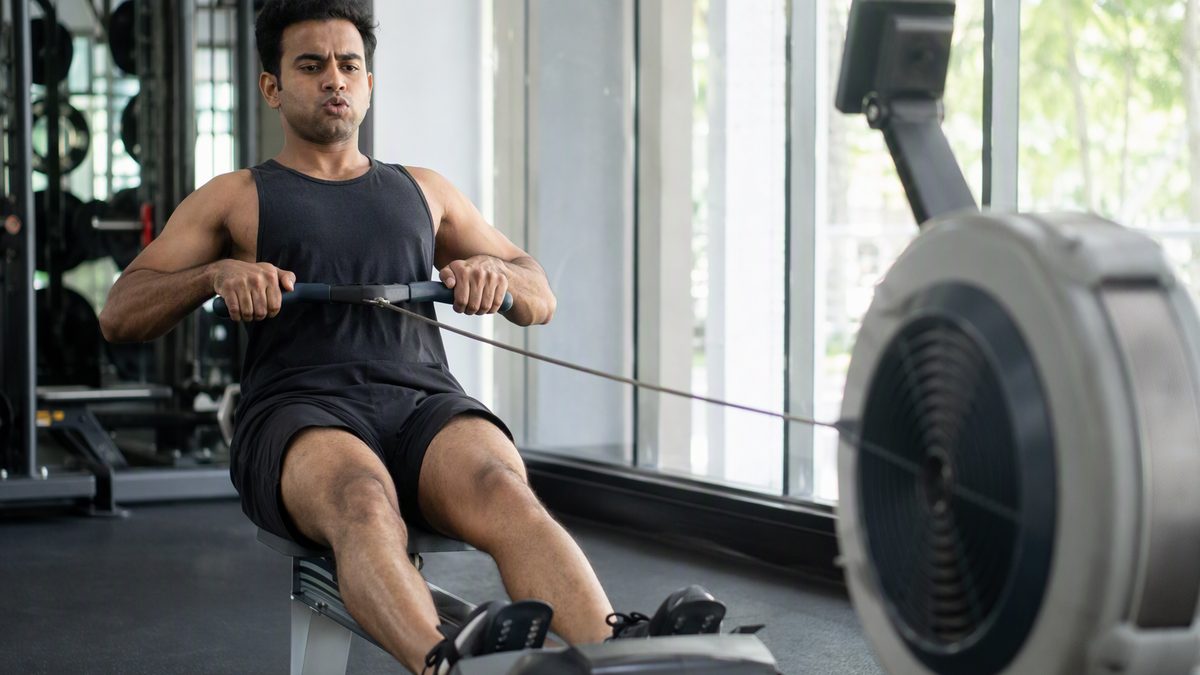
The rower wins that test more often than anything else in the room. It is full-body, low-impact, scalable from a gentle flush to an all-out effort, and it asks nothing of you except to pull. No spotter, no setup, no skill barrier once you know the stroke.
Below: where the erg slots into a chaotic week, the two-format default that removes decisions, a time-boxed protocol with real numbers, the science behind why it earns its minutes, and how to handle travel, alcohol and the one metric worth watching.
1. Where the Erg Slots Into a 60-Hour Week
Your enemy is not effort; it is decision fatigue and unpredictability. The fix is to make rowing a default rule rather than a daily choice: same machine, same setup, same two workouts, executed in whatever 20-to-40-minute window the day offers, before the first call, between meetings, or after the last one. Because the erg needs no skill warm-up and no equipment changes, it removes every micro-decision that usually kills a session before it starts.
It also fits the all-or-nothing trap you are prone to. A perfect week is rare, so the goal is a non-zero week: even three short rows beat a skipped block waiting for the ideal moment. On a brutal travel day, a 15-minute easy row in the hotel room of a gym still counts and still moves your fitness. The erg is forgiving that way, you can dial the same machine from a recovery flush to a lung-busting interval set, so it flexes to your energy and your calendar instead of demanding you flex to it.
2. The Two-Format Default That Removes Decisions
You do not need a varied program; you need two reliable formats you can run on autopilot. Format one is easy steady state: a continuous 20-to-40-minute row at a conversational effort, low stroke rate, the kind of low-stress aerobic work that builds your base and actively helps a cortisol-loaded system rather than adding to it. Format two is intervals: short, hard, time-efficient pieces that deliver the top-end fitness gains when minutes are scarce. That is the whole menu.
Lock the setup so it is never a decision. Set the damper at a moderate 3 to 5 and leave it; the damper is not the resistance dial, it only changes how the stroke feels, so cranking it to 10 buys you nothing but a grindy stroke and a tired back. Drive with the legs first, swing the torso, finish with the arms, legs-body-arms, and keep a neutral spine so your lower back, the most common rowing complaint, stays out of trouble. Two formats, one setup, repeated anywhere: that is a protocol that survives airports.
3. The Time-Boxed Executive Protocol
Here is the default in numbers. Pick the row that matches the time and energy you have, run the same setup every time, and keep hard days off back-to-back. The interval formats borrow directly from established HIIT design, where work and rest durations are tuned to bias the aerobic stimulus.
| If you have... | Format | Intensity and setup |
|---|---|---|
| 20 min, low energy | Easy steady state, continuous | 60-70% max HR, 18-22 spm, damper 3-5, conversational |
| 20 min, fresh | 8 x 250m hard / equal easy rest | Strong leg drive, RPE 8, controlled posture |
| 30 min | 4 x 4 min / 2-3 min easy | Comfortably hard, RPE 7, full sentences only at rest |
| 15 min, jet-lagged | Easy flush, continuous | Recovery effort, low stroke rate, just move blood |
| 40 min, building | Mixed: 20 min easy + 4 x 1 min hard | Aerobic base plus a short top-end touch |
A strong default week is two or three easy steady rows and one or two interval sessions, total under three hours. Hard rowing systems need roughly 48 hours to recover, so never stack interval days. If your week implodes, fall back to two easy 20-minute rows; that alone maintains a real base. The point is a floor you never drop below, not a ceiling you rarely reach.
4. Why the Erg Earns Its Minutes (the Science)
The return-per-minute case rests on muscle mass. Rowing recruits an unusually large fraction of your total muscle in each stroke, roughly nine major groups across legs, posterior chain, trunk and arms, which means a higher achievable heart rate and oxygen uptake than machines that isolate fewer muscles. Whole-body work taxes the cardiorespiratory system heavily, so you get more cardiovascular stimulus for the same 20 minutes than you would on, say, an arms-only machine.
The intervals carry their own evidence. Short, hard interval work delivers time-efficient gains in aerobic capacity and supports fat loss comparably to longer continuous training when energy is matched, which is exactly the trade a time-poor executive wants. And the fitness itself matters beyond aesthetics: higher cardiorespiratory fitness tracks strongly with lower long-term mortality, so the engine you build on the erg is a genuine longevity asset, not just a way to fit into a suit. The honest caveat is that hard endurance work can interfere a little with concurrent strength gains, so if you also lift, keep your hardest rows on different days from your priority lifting. Use your annual executive physical as a natural checkpoint on the markers that matter.
5. Travel, Alcohol and the One Metric to Watch
Three realities will test this protocol, and each has a simple rule. Travel across time zones fragments sleep and elevates stress, so anchor rowing to your wake-time, not the clock, and default to easy rows on the worst-sleep days rather than forcing intensity. Alcohol at client dinners does not erase a session, but it degrades the next day's sleep and recovery, so the morning after a heavy night is an easy-row morning, not a 2K. And resist the stack-stimulants-over-sleep-debt habit; caffeine can mask fatigue but it does not repay it, and piling hard intervals on a wrecked system is how minor strains become real ones.
Watch one metric, not five. Your premium wearable already tracks morning resting heart rate and heart-rate-variability trends; let those be the single signal that decides hard versus easy. When resting HR sits several beats high for a few mornings or HRV drops, take the easy row and bank the recovery. That one rule does more for a busy professional than any program tweak. If you want help turning that signal into an automatic daily decision, the systems in our guide to building fitness habits are built for exactly this kind of low-friction consistency.
What Busy Executives Ask About Rowing Machine Conditioning
What is the minimum effective rowing routine when I travel?
Two short rows a week maintains a real aerobic base: one easy 20-to-40-minute steady piece and, when you are fresh, one interval session like 8 by 250m hard with equal rest. Keep the damper at 3 to 5 and run the same setup in every hotel gym so it requires no decisions. On your worst-sleep travel days, default to a 15-minute easy flush rather than forcing intensity. A non-zero week beats waiting for the perfect window that never comes.
Does alcohol at client dinners ruin my rowing progress?
Not directly, but it degrades the sleep and recovery that the next session depends on. One heavy night will not erase your fitness; the smart move is to make the morning after an easy-row morning instead of a hard one, so you train around the impairment rather than stacking intensity on a poorly recovered system. The bigger risk is the pattern, regular client dinners plus chronic sleep debt, so protect sleep where you can and let your recovery signal pick the session.
Can I keep this up across time zones?
Yes, if you anchor rowing to your wake-time rather than the local clock and default to easy sessions when jet lag wrecks your sleep. The erg is ideal for travel because it needs no skill warm-up, no spotter and no equipment changes, and it scales from a gentle flush to a hard interval set depending on how you feel that morning. Run the same two formats and the same damper everywhere, and let a single recovery metric decide whether today is hard or easy.
What single metric should I watch?
Morning resting heart rate, or heart-rate-variability if your wearable tracks it. Watch the trend across several mornings, not one reading. When resting HR sits several beats high or HRV drops after travel or a late night, take the easy row and let recovery catch up; when the trend is normal, you are clear to do intervals. That one signal replaces a lot of programming guesswork, and your annual executive physical is a good checkpoint for the deeper fitness and cardiometabolic markers.
Disclaimer: This article is for educational purposes only and is not medical advice. Consult a qualified healthcare professional before starting any supplement, nutrition, or training protocol — especially if you are pregnant or breastfeeding, under 18, taking medication, or managing a health condition.
Scientific References & Clinical Sources
- Joyner MJ, Coyle EF. Endurance exercise performance: the physiology of champions. J Physiol, 2008. PMID: 17901124
- Tabata I, et al. Effects of moderate-intensity endurance and high-intensity intermittent training on anaerobic capacity and VO2max. Med Sci Sports Exerc, 1996. PMID: 8897392
- Keating SE, et al. A systematic review and meta-analysis of HIIT versus continuous training for fat loss. Obes Rev, 2017. PMID: 28401638
- Mandsager K, et al. Association of Cardiorespiratory Fitness With Long-term Mortality Among Adults Undergoing Exercise Treadmill Testing. JAMA Netw Open, 2018. PMID: 30646252
- Plews DJ, et al. Training adaptation and heart rate variability in elite endurance athletes: opening the door to effective monitoring. Sports Med, 2013. PMID: 23852425

